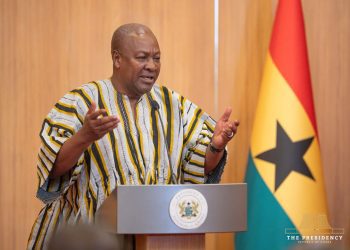
President John Dramani Mahama has called for a stronger, more sustainable and predictable African financing architecture for peace and security, urging African leaders to move beyond declarations and translate continental commitments into concrete action.
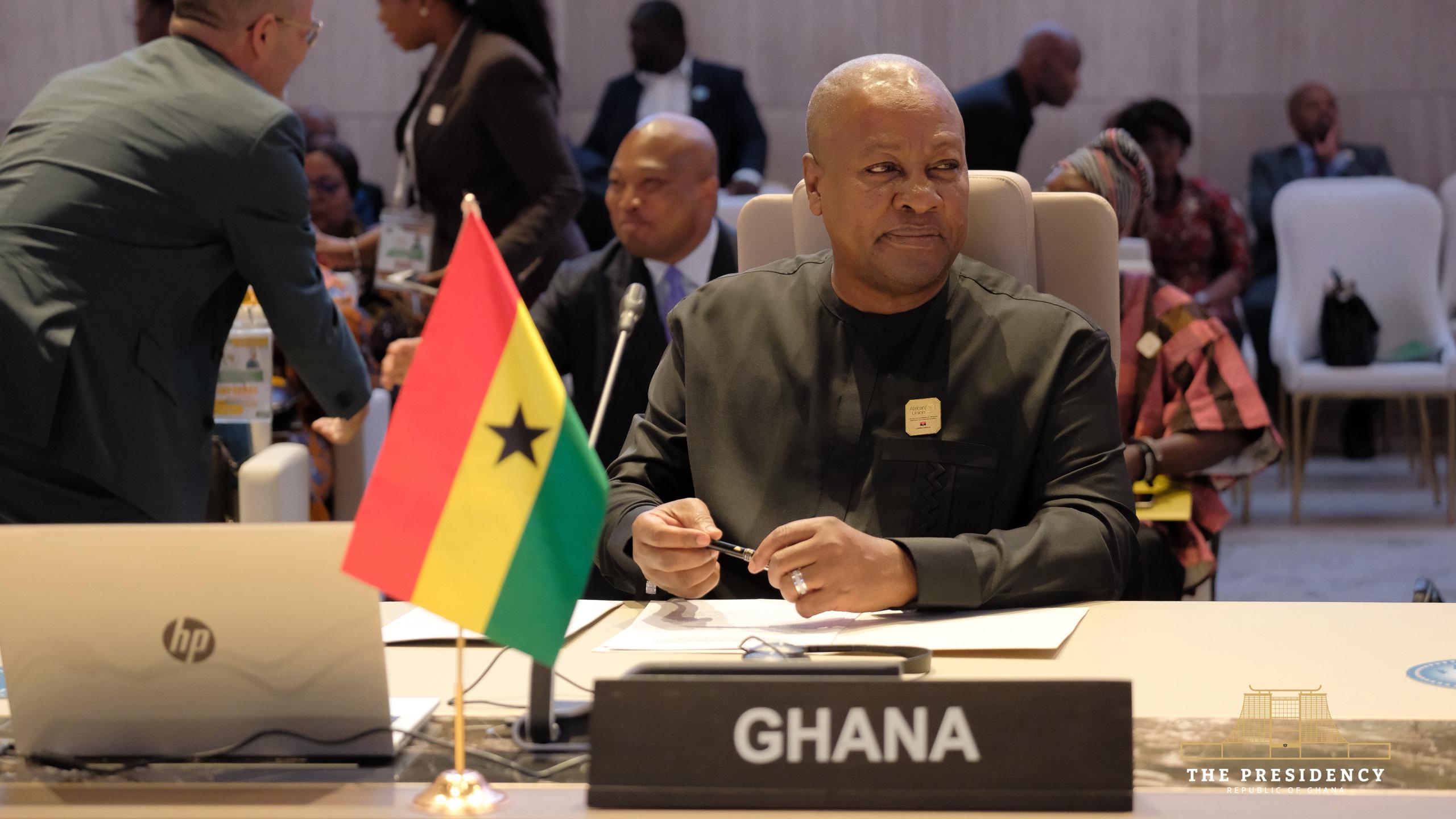
Addressing the 21st Extraordinary Session of the Assembly of Heads of State and Government of the African Union (AU) in Luanda, President Mahama said the summit was both timely and necessary, given the persistent and evolving conflicts confronting the continent despite the existence of comprehensive mechanisms under the AU’s peace and security architecture.
He stressed that the priority must now be to ensure that existing mechanisms are effectively implemented, better coordinated and adequately resourced.
According to President Mahama, Ghana attaches particular importance to sustainable, predictable and African-owned financing of the continent’s peace and security agenda.
“Early warning must translate into early action, and early action requires resources that are available in a timely and predictable manner,” he said.
The President welcomed progress in operationalising the African Union Peace Fund and expressed Ghana’s support for its continued capitalisation towards the US$1 billion target.
He also called for the accelerated implementation of the Peace Fund’s resource mobilisation strategy, including the effective application of the 0.2 percent import levy, while encouraging greater mobilisation of resources from African financial institutions, the private sector and other African sources.
President Mahama acknowledged, however, that predictable and sustainable international financing remains important for African-led peace support operations.
In this regard, he welcomed United Nations Security Council Resolution 2719 of 2023, which provides a framework for financing AU-led peace support operations through UN assessed contributions.
He urged continued efforts to operationalise the framework in a manner consistent with the principles of African ownership, accountability and shared responsibility for maintaining international peace and security.
Conflict Prevention Must Be Linked to Development
President Mahama further argued that conflict prevention must be embedded within Africa’s broader development agenda.
He said early warning systems should not merely identify imminent threats but should also help governments detect and address the underlying grievances that can eventually trigger conflict.
Ghana, he said, welcomes and endorses the Luanda Action Plan, its implementation matrix and accompanying decision, as well as the African Union Trigger Model.
“African ownership of peace and security must be matched by African ownership of its financing,” President Mahama stressed.
He called for the development of a financing architecture that is predictable enough to facilitate planning, flexible enough to respond to emergencies and sustainable enough to reduce excessive dependence on external resources.
He also linked the discussion to Ghana’s Accra Reset, noting that the initiative contains important lessons on self-financing beyond healthcare, including approaches that could support peace and security.
“As we consider the decisions, action plan, and implementation matrix arising from this summit, Ghana encourages us to ensure that our commitments are supported by clear responsibilities, timelines, measurable indicators, and importantly, credible and sustainable financing arrangements,” he said.
President Mahama said Africa had discussed the issue for too long and must now move decisively from rhetoric to implementation.
“We have spoken on this topic for too long, and it is time for us to move from words to action,” he declared.
Mahama Highlights Africa’s Reparatory Justice Agenda
President Mahama also used his address to highlight Ghana’s role in advancing the global campaign for reparatory justice for Africans and people of African descent.
He recalled the adoption by the United Nations General Assembly on 25 March of a resolution recognising the enslavement of Africans as a grave crime against humanity, describing the achievement as historic.
He credited the coalition of the African Union, CARICOM and the African Diaspora for helping to secure the resolution, noting that it received the endorsement of 123 UN member states.
President Mahama said the adoption of the resolution immediately raised a critical question: What comes next?
As the AU Champion for Reparations, Ghana subsequently convened the Next Steps Conference in Accra in June, which sought to chart a practical pathway following the UN resolution.
He disclosed that the conference agreed to broaden the reparatory justice agenda to include indentured labour as another historical injustice against humanity.
The conference also established three important mechanisms: a High-Level Advisory Council on Reparatory Justice, a Global Experts Panel on Restitution of Cultural Heritage, and a Global Legal Panel on Reparatory Justice.
According to President Mahama, the international conversation around reparations has shifted significantly, with an issue that was once considered taboo now becoming increasingly prominent on the global agenda.
He cited the growing discussion by countries on reparations and efforts to return cultural artefacts removed from Africa during the colonial period.
President Mahama also referenced recent developments involving religious and historical institutions, including apologies for their historical roles in the transatlantic slave trade and initiatives towards reparatory justice.
Invitation to UN General Assembly Side Event
Looking ahead, President Mahama announced that Ghana will use a side event during the 81st Session of the United Nations General Assembly in September to provide an update on the work of the high-level panel and expert committees established following the Accra conference.
He extended an invitation to fellow African leaders to participate in the event.
President Mahama’s intervention in Luanda therefore placed two interconnected issues at the centre of Ghana’s continental diplomacy: building an African-owned and adequately financed peace and security architecture, and advancing a coordinated global campaign for reparatory justice.
His message was clear: Africa’s ownership of its future must be reflected not only in the decisions it takes, but also in its capacity to finance, implement and sustain those decisions.
Story: Patrick Asford Boadu