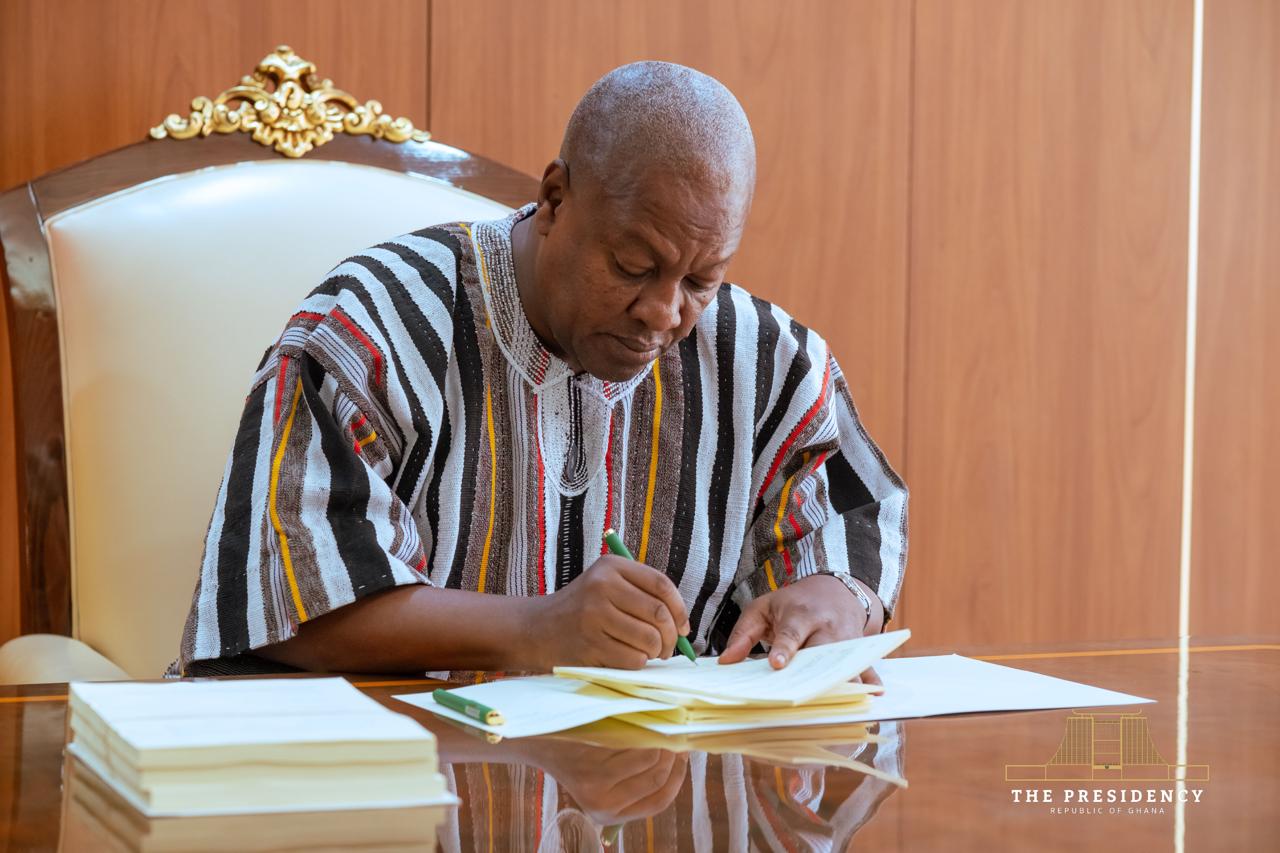
President John Dramani Mahama has signed ten Bills passed by Parliament into law, marking a major step in the government’s efforts to reform Ghana’s legal, fiscal, justice, maritime and cocoa sectors.
The newly enacted laws include the Customs Act, Community Service Act, Tribunals Act, Maritime and Related Offences Act, National Defence University Act, Income Tax Amendment Act, Energy Sector Levies Amendment Act, Ghana Cocoa Board Act, Value Added Tax Amendment Act and Excise Act.
Explaining the significance of the reforms, President Mahama said the new Customs Act consolidates several amendments into a single legal framework to make customs administration more efficient and address revenue leakages.
“It incorporates all the amendments that have been done over the years into one single document,” President Mahama said. “It makes it simpler to administer and to make it more efficient, and it will seal the loopholes that have made the government lose a lot of revenue as a result of the scattered nature of the law.”
Community service for minor offences
The Community Service Act introduces non-custodial sentencing for misdemeanours and other minor offences.
President Mahama said the legislation would help reduce the number of people sent to prison for relatively minor offences while also reducing the cost to the state of maintaining inmates.
“Instead of putting people in jail and government going to have to pay for looking after prisoners, a lot of prisoners for stealing goods or for committing some very minor offences, they can be sentenced to do community service,” he explained.
Regional tribunals
The Tribunals Act gives effect to constitutional provisions for the establishment of regional tribunals.
According to President Mahama, the legislation will enable the Chief Justice to establish regional tribunals to deal with specific categories of offences.
The Maritime and Related Offences Act, meanwhile, provides Ghana with domestic legislation to deal with crimes and offences committed at sea and gives effect to the country’s obligations under the United Nations Convention on the Law of the Sea.
National Defence University gains legal backing
The National Defence University Act provides the statutory and legal framework for the National Defence University, including the accreditation of its courses and recognition of the institution as a legal entity.
President Mahama said the law would provide the necessary legal backing for the university and its academic programmes.
Income tax relief for minimum-wage earners
Under the Income Tax Amendment Act, people earning the national minimum wage or below will be exempt from paying income tax.
President Mahama said the measure was intended to provide relief to some of the country’s lowest-income earners.
“Anybody who is on the minimum wage or below the minimum wage is exempt from income tax,” he said.
Energy sector levy loopholes targeted
The Energy Sector Levies Amendment Act seeks to address what the President described as longstanding abuses involving fuel oil used by factories and maritime vessels.
Under the new framework, affected users will be required to pay the applicable taxes and subsequently provide evidence of reinvestment.
President Mahama said the measure was aimed at plugging a loophole that had existed for several years.
Cocoa sector reforms
The Ghana Cocoa Board Act, 2026, incorporates reforms intended to transform Ghana’s cocoa industry and improve returns to cocoa farmers.
The President said the law provides for the government’s commitment to process at least 50 percent of Ghana’s cocoa beans locally.
He also said the legislation captures the government’s commitment that cocoa farmers should receive at least 70 percent of the world market price.
“Promise made, promise fulfilled,” President Mahama said.
VAT exemption for gold surrendered to Bank of Ghana
The Value Added Tax Amendment Act provides for adjustments to the VAT regime, including an exemption related to gold surrendered by large-scale mining companies to the Bank of Ghana.
President Mahama said the amendment was linked to the arrangement under which large-scale gold mining companies are required to surrender 30 percent of their gold to the central bank.
Excise reforms and support for local juice manufacturers
The Excise Act consolidates previous excise laws and amendments into a single legal framework and introduces measures to address revenue leakages involving dutiable goods.
The law covers products including imported alcoholic beverages and cigarettes.
Importantly, President Mahama said locally manufactured fruit juices would be exempt from excise duty under the new legislation as an incentive to support domestic production.
“If you produce fruit juices locally, this Act exempts you from paying excise duty. And so that’s it. Excise Act 2026,” he said.
The signing of the ten laws represents a significant legislative push by the Mahama administration to modernise Ghana’s regulatory framework, strengthen revenue mobilisation, improve access to justice, support domestic production and advance reforms across strategic sectors of the economy.
Story: Patrick Asford Boadu