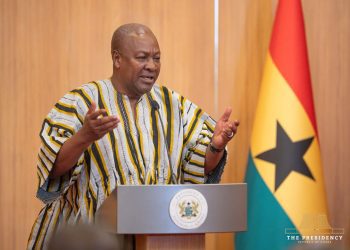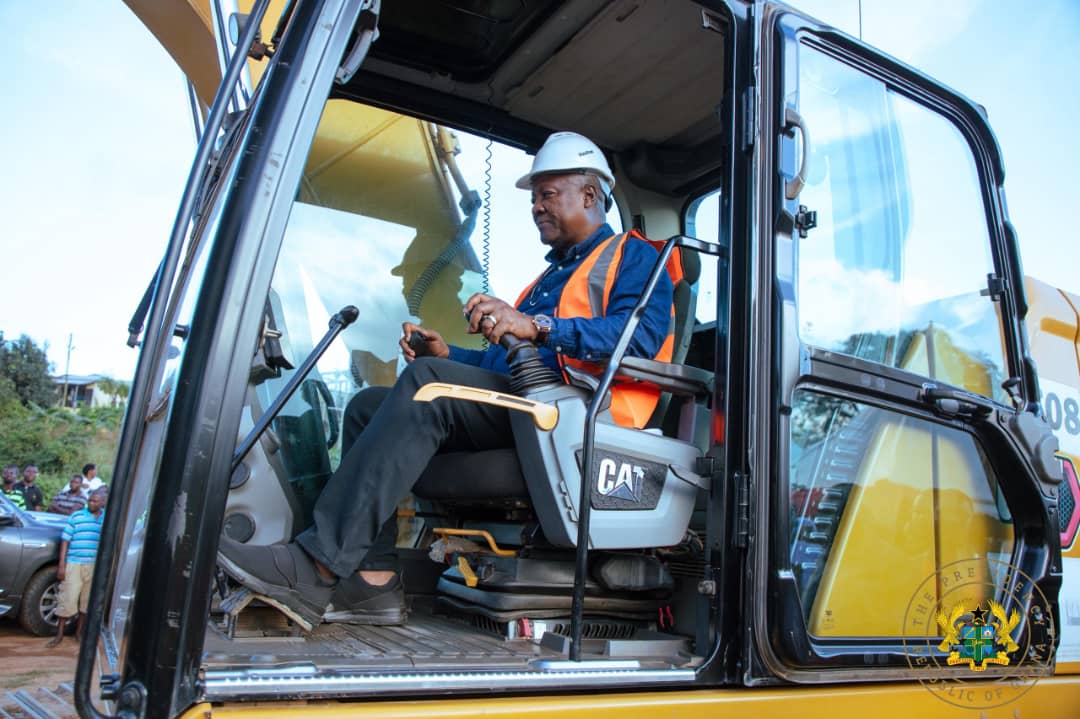
President John Dramani Mahama has cut the sod for the dualization of the Cape Coast to Takoradi Road, describing it as one of the most vital transport corridors in the country.
Speaking at the ceremony, President Mahama said the project represents more than just a road construction initiative, but a bold statement of Ghana’s commitment to modern infrastructure and inclusive economic growth.
“We’re gathered here today to turn the sod for the dualization of the Cape Coast to Takoradi Road. This is one of the most vital transport corridors in our country,” the President said.
“But let me add that it’s not only Cape Coast to Takoradi. The other contractors working on the Accra to Winneba Junction, Winneba Junction to Mankessim, and Mankessim to Cape Coast stretches are also progressing. So by the time we finish this road, they too will be finishing theirs. The road from Accra to Takoradi will be dual-carried all the way,” he explained.
The President emphasized that the project forms part of a broader national vision under the Big Push infrastructure program and the 24-hour economy policy, both designed to modernize transport systems, expand industrial access, and improve national productivity.
“This project is more than a road,” he said. “It is a declaration of our shared resolve to rebuild Ghana’s infrastructure as a foundation for jobs, for competitiveness, and for national unity and cohesion. It embodies the spirit of the Big Push and the 24-hour economy to make Ghana work again efficiently around the clock.”
The Cape Coast–Takoradi Road, part of the national N1 highway and the Trans–West African Highway, links Accra to Takoradi, Ghana’s major industrial and port city.
It carries over 90 percent of freight and passenger movement to the Western Region and connects key sectors including mining, oil, agriculture, and tourism.
President Mahama also noted the project’s significance for local communities along the corridor.
“This road links communities whose livelihoods depend on daily mobility traders, students, farmers, fishermen, and workers who spend countless hours in traffic every day because of congestion. This dualization will ease their burden and open new opportunities,” he stated.
Story: Patrick Asford Boadu