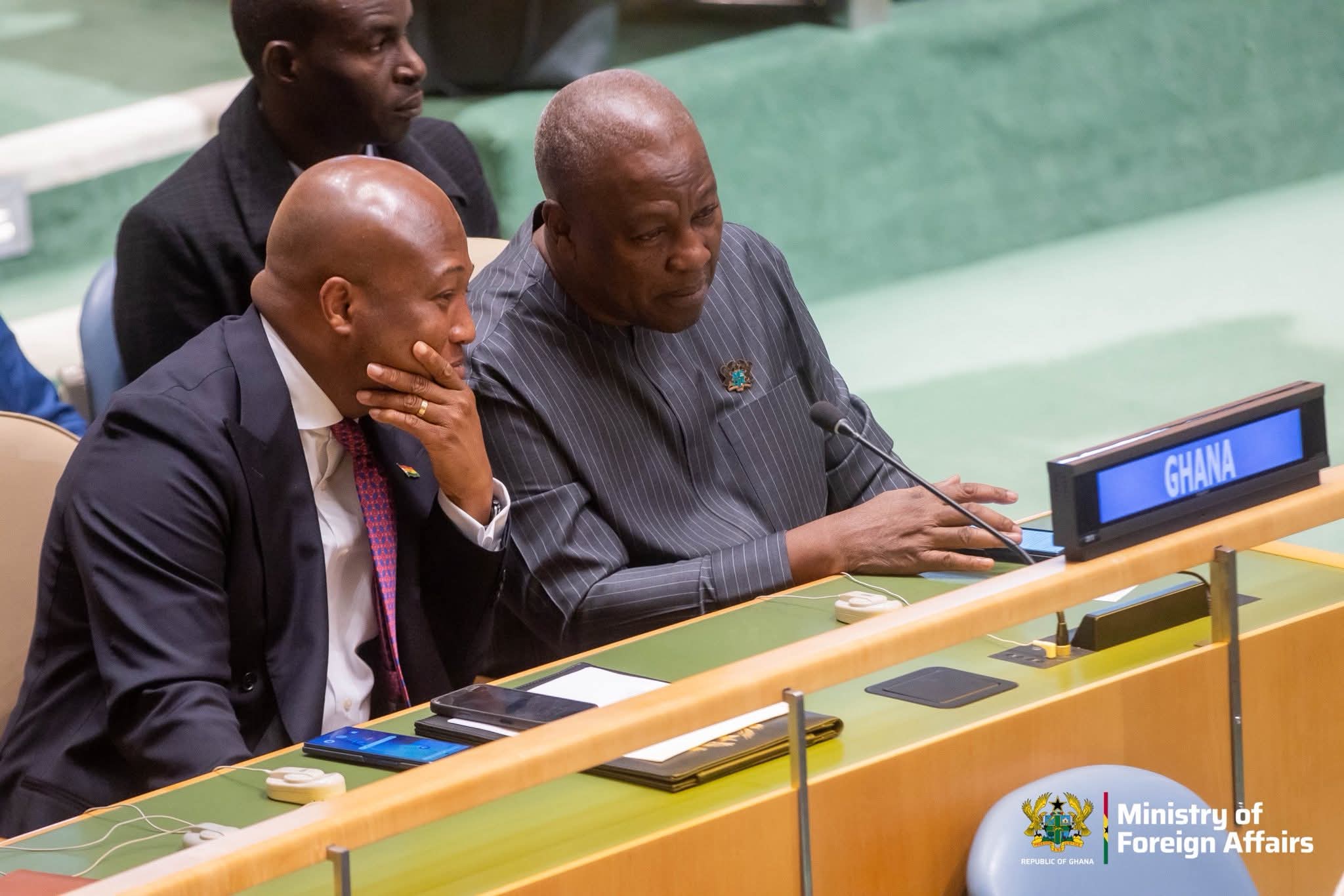
Ghana has secured a landmark resolution at the United Nations General Assembly despite intense last-minute diplomatic pressure from some partner states urging Ghana to postpone the motion, in what President John Dramani Mahama describes as one of the most challenging multilateral efforts tied to the transatlantic slave trade agenda.
“When I gave notice of this motion, I did not delude myself. It was always going to be a difficult task. We needed to build a broad coalition to get this through,” he said.
According to the president, several countries, some believed to be part of the negotiating coalition appealed for a postponement, warning that the resolution risked failing without broader consensus. Others urged Ghana to “take it easy” and dilute elements of the text to attract wider support.
“Even as I was preparing to travel, we received calls urging us to slow down, to delay, to tweak the language further, but we believed the moment had come to act,” he added.
Yet the president proceeded, mobilising what he described as a carefully constructed cross-regional alliance, culminating in an “emphatic victory” at the UN’s principal deliberative body on 25th March, 2026.
Addressing the coalition of experts who worked on the draft resolution, Mahama explained the decision to move ahead without delay.
“If we had postponed this resolution, I do not know when we would have had such an opportunity again. We had built the strongest coalition possible, and we had to move forward,” he said.
The resolution, which addresses the transatlantic slave trade and its historical legacy, has now been formally recognised within the UN system as a grave crime against humanity, an outcome Ghana has championed as part of a broader reparations and historical justice agenda.
President Mahama framed the outcome as both a diplomatic and symbolic milestone, linking it to earlier pan-African efforts led by Kwame Nkrumah, Marcus Garvey and W. E. B. Du Bois.
He expressed profound gratitude to the Minister for Foreign Affairs, Samuel Okudzeto Ablakwa for his dedication to the cuase of the agenda.
He also commended the team of experts for their contributions, broad consultations and research that led to the final draft.
“This victory belongs to all of us—but most importantly to those who were meant to be forgotten. The United Nations has recorded that this was among the gravest crimes against humanity,” he said.
The resolution received endorsement from 123 countries, while the United States, Israel and Argentina voted against it. A bloc of 52 European countries, along with the United Kingdom, abstained.
In a media interview, Foreign Affairs Minister, Samuel Okudzeto Ablakwa said countries that voted against or abstained “missed the golden opportunity” to acknowledge and apologise for historical injustices, though he maintained there remained scope for future engagement, particularly with the United States on reparations.
Ghana’s strategy relied on sustained technical consultations involving legal experts, historians and policymakers, led by the Foreign Affairs Ministry, to refine the resolution’s language, an effort aimed at minimising opposition while preserving its core intent.
The successful passage is expected to strengthen Ghana’s leadership role in ongoing global discussions on reparatory justice, particularly across Africa, the Caribbean and parts of Latin America.
For Ghana, the development carries both foreign policy and domestic resonance, reinforcing its positioning as a leading advocate for historical accountability within multilateral institutions. It also signals a shift in international discourse, as member states increasingly confront the enduring consequences of the transatlantic slave trade within formal diplomatic frameworks.