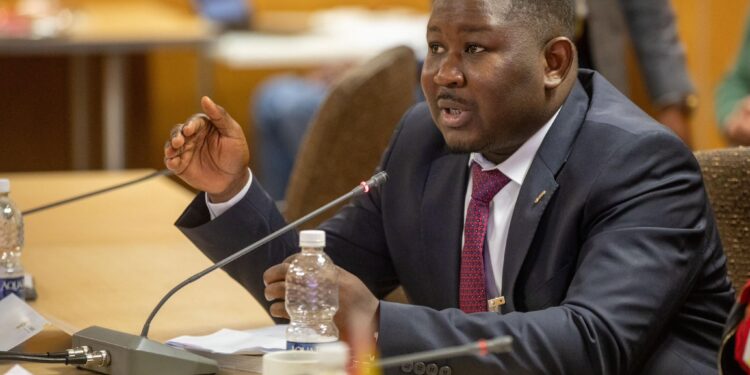
The Majority in Parliament says it is ready to support a probe into the Domestic Gold Purchase Programme (DGPP) but will push for the investigation to cover the programme from 2021 to 2025, including losses recorded under former Bank of Ghana Governor Dr Ernest Addison.
Member of Parliament for Sagnarigu and member of Parliament’s Finance Committee, Hon. Atta Issah, said Majority MPs would not seek to block the Minority’s proposed investigation but would instead pursue a counter-motion to broaden its scope.
“We are waiting for them in Parliament for one simple reason. They brought a motion that we needed to investigate the Domestic Gold Purchase Programme. We are rather trying to push for a counter-motion, not to shoot it down. We have to expand the investigation to cover 2021 to 2025,” Mr Issah said.
His comments follow allegations by the New Patriotic Party (NPP) that the state incurred approximately US$1.9 billion in losses in 2025 through the gold purchase programme.
Mr Issah rejected the Minority’s assessment, arguing that any evaluation of the programme must consider both its costs and the foreign exchange generated through gold exports.
“They are a group of people that are not principled. They are a group of people that keep shifting the goalposts. When you are doing an analysis, you don’t focus on only the cost. What has been its inflow? The thing has brought in US$10.89 billion,” he argued.
He also addressed questions surrounding the GH¢5.45 billion surplus reported by the Ghana Gold Board (GoldBod), explaining that the figure comprised an operational surplus as well as unutilised government funding.
“If you look at page 5 of the GoldBod annual report, it states it clearly that the GH¢5.4 billion can be decomposed into two. The operational surplus that is from the core mandate of the GoldBod is GH¢909 million. Now, when you add the unutilised government subvention of US$279 million, translated to about GH¢4.5 billion, that gives you the GH¢5.4 billion,” he said.
According to Mr Issah, the government subvention was received on December 31, 2025, and was therefore reflected in the agency’s accounts for the year.
He further rejected claims that the reported results were artificially boosted by foreign exchange revaluation gains. He argued that exchange-rate differences are treated in accordance with provisions governing the Bank of Ghana’s revaluation accounts.
“If you describe it as a paper gain, are you trying to say that the law that President Kufuor brought was a paper policy?” he asked.
Mr Issah also defended the discount applied to Ghana’s gold exports, explaining that the country exports doré gold rather than fully refined gold, making a discount to international refined-gold prices a normal part of the transaction.
“Everywhere in the world, doré gold has never been sold at a premium or above or at face value. You have to sell it at a discount so that the buyer will bear the cost of insurance, shipment from your country of origin, and then the smelting,” he explained.
Turning back to the proposed parliamentary investigation, Mr Issah insisted that a credible probe should examine the programme’s performance under both the previous and current administrations.
He said former Governor Dr Ernest Addison and officials of the Bank of Ghana should therefore be invited to explain losses he said were recorded under the programme before 2025.
“We have to bring in Dr Addison, the former Governor, and the entire Bank of Ghana to help Ghanaians understand why there were losses in 2022 of US$74.44 million, why there were losses in 2023 of US$1.37 billion, and why there were losses in 2024 of US$400 million,” he concluded.