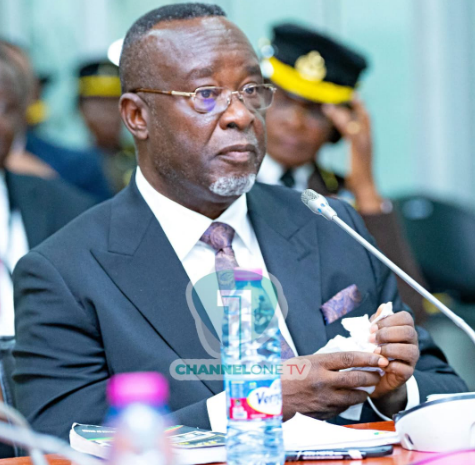
The vetting of President John Dramani Mahama’s nominee for Chief Justice, Justice Paul Baffoe-Bonnie, began today, Monday, November 10, 2025, but immediately descended into procedural deadlock.
The Appointments Committee convened at approximately 11:30 a.m., yet before questioning could commence, proceedings were abruptly interrupted by a sharp objection from the Minority Leader, Alexander Afenyo-Markin.
The Minority Leader sought to make a preliminary statement concerning outstanding legal challenges related to the removal of former Chief Justice Gertrude Torkornoo and the appointment of the Acting Chief Justice, Paul Baffoe-Bonnie.
On Friday, November 7, 2025, the Minority’s position, articulated in a motion submitted to the Speaker, Alban Sumana Kingsford Bagbin was that proceeding with the vetting while judicial matters remain pending would constitute a “fundamental irregularity” and risk undermining the integrity of the judicial appointment process.
This request, however, was formally rejected by the Speaker. He ruled the Minority’s motion inadmissible, citing Order 103, Rule F of Parliament’s Standing Orders, which prohibits motions that could prejudice parties involved in ongoing judicial proceedings.
The Speaker further emphasized that the Supreme Court holds adequate constitutional authority to address any unconstitutional actions by Parliament and accordingly returned the motion to the Minority Leader.
Meanwhile, the Minority Caucus described the issue as more than a dispute over a single nominee, framing it instead as a test of the foundational principles and integrity of Ghana’s judiciary. They argued that the Majority’s insistence on proceeding sets a dangerous precedent, stating that they would not be complicit in what they termed “a slippery slope away from constitutional standards.”
Despite the heated objection and procedural exchanges, the Majority Caucus, relying on the Speaker’s prior ruling pressed ahead with the vetting.
Faced with the dismissal of their preliminary concerns, the Minority Caucus staged a dramatic walkout, leaving the committee room in protest against what they viewed as a disregard for established parliamentary procedure and legal prudence.
“Be it known to you, Chairman, the Committee, and the country, that we, the Minority Caucus, hereby vote en bloc to reject the nominee,” the Minority Leader declared. “We wish to state on record that the Majority may proceed with the questions. We do not intend to take part in any questioning. However, we are registering, in the strongest terms, our rejection of the nomination. The records should reflect that the report of this committee be a Majority report.”
The Minority maintained that they would not participate in a process they deemed marked by “fundamental irregularities” and “pre-determined outcomes.” They described their walkout as a defense of constitutional principles and the independence of Ghana’s judiciary.
The Majority, utilizing its numerical strength, subsequently continued with the vetting proceedings. The fate of Justice Paul Baffoe-Bonnie’s nomination now rests with the committee’s final report and the approval of the full House.
By Eugenia Ewoenam Osei