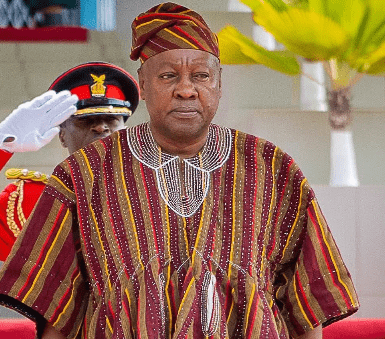
President John Dramani Mahama has disclosed that his administration inherited an energy sector in January 2025 that was on the brink of collapse, weighed down by a staggering GH¢80 billion debt and deep structural inefficiencies.
Delivering his State of the Nation Address in Parliament, the President said the financial crisis had severely undermined the operational viability of key power producers and destabilised electricity supply across the country.
According to him, the situation was compounded by the exhaustion of the $500 million World Bank Partial Risk Guarantee, a facility established in 2015 during his first term to safeguard nearly $8 billion in private investment in the Offshore Cape Three Points (OCTP) gas project. The guarantee had been fully drawn down due to prolonged non-payment for gas consumed.
At the distribution level, the President revealed that the Electricity Company of Ghana (ECG) was collecting only 62 percent of the energy it purchased from generators and declaring less than 50 percent of those collections into the sector’s cash waterfall mechanism, the structured payment system meant to ensure fair distribution of revenue across energy sector players.
The result, he said, was severe liquidity shortfalls and power challenges throughout 2024.
The President further disclosed that Ghana’s crude oil production declined by approximately 32 percent between 2019 and 2024, falling from 71.4 million barrels annually to 48.2 million barrels. He attributed the decline to years of policy inconsistency, regulatory inefficiencies, prolonged licensing processes, lack of transparency, and unresolved legal disputes over field unitisation, all of which eroded investor confidence.
President Mahama, however, announced significant progress in stabilising the sector. “As of December 31, 2025, government has fully repaid and restored the entire $500 million World Bank guarantee, including interest,” he told Parliament, adding that the restoration confirms Ghana’s credibility as a reliable partner on the global stage.
He further stated that between January and December 2025, government settled all outstanding gas invoices owed to ENI and Vitol, amounting to approximately $500 million, bringing Ghana fully up to date on its gas consumption obligations to the Sankofa partners.
The 2026 Budget, he said, makes adequate provision to ensure timely payments for all liquefied natural gas consumed going forward.
Government has also reached a comprehensive roadmap with Tullow Oil and the Jubilee Field partners to guarantee full payment for gas supplied, a move expected to support reliable electricity generation and industrial growth.
To reduce the high cost of electricity generation, President Mahama announced that government successfully renegotiated existing power purchase agreements with nine Independent Power Producers (IPPs), securing an immediate $250 million in savings.
In addition, $1.1 billion in legacy debts have been restructured for payment between 2026 and 2028. The revised agreements will be submitted to Parliament for ratification.
The President also disclosed that a robust framework has been established to strengthen and monitor implementation of the cash waterfall mechanism, alongside the operationalisation of ECG’s single holding account, jointly overseen by the Ministry of Energy and the Public Utilities Regulatory Commission (PURC). He said this intervention has significantly reduced revenue leakages and improved ECG’s capacity to meet payment obligations.
Despite the gains, President Mahama acknowledged that ECG continues to record high losses, with approximately 25 percent of generated power still lost through technical and commercial inefficiencies.
To address this, Cabinet has approved a multiple-lease concession model to introduce private sector participation in billing and collection within the distribution utilities.
President Mahama assured Parliament that reforms in the energy sector will continue unabated. “I remain fully committed to turning around the sector, strengthening its foundations, and ensuring reliable, affordable and sustainable energy security for our nation,” he said.