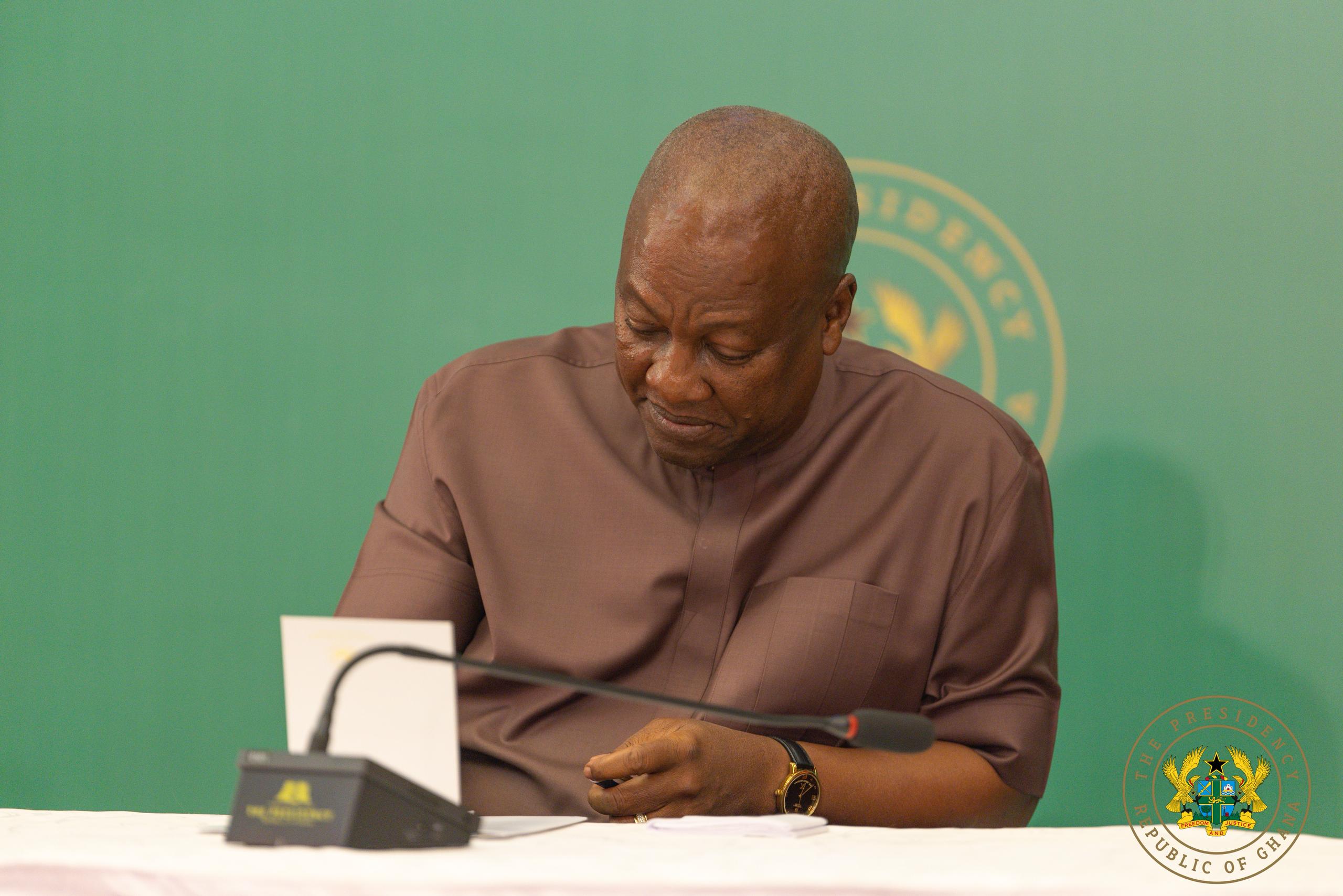
President John Dramani Mahama has outlined key policy directions on decentralisation, healthcare, education, and governance, emphasizing government’s commitment to improving service delivery and strengthening accountability.
Speaking during a stakeholder engagement, the President noted that the District Assemblies Common Fund (DACF) continues to be disbursed promptly, with a significant portion going directly to local authorities.
“We have ensured timely releases of the Common Fund and maintained the policy of allocating 80 percent directly to the districts, allowing them to decide their own priorities rather than having decisions imposed from the centre,” he said.
He explained that district assemblies are being guided to prioritise essential infrastructure such as basic schools and CHPS compounds, adding that early results are already visible across several districts.
Focus on Preventive Healthcare
On healthcare, President Mahama raised concerns about the rising burden of non-communicable diseases, which he said now account for a large share of illnesses in the country.
“This informed the establishment of the Ghana Medical Trust Fund, which will support diagnosis, treatment, and public education,” he stated.
He stressed a shift toward prevention through a free primary healthcare programme, where community volunteers will conduct house-to-house visits.
“They will check basic indicators such as blood pressure and blood sugar, helping detect conditions early and reduce avoidable deaths,” he added.
The President also highlighted the need to tackle lifestyle-related risk factors such as poor diet, physical inactivity, and substance abuse.
Policy Reviews and Social Concerns
Addressing concerns about taxation on family planning commodities, President Mahama revealed that steps are already being taken.
“I have directed the Ministers of Health and Finance to review the matter,” he confirmed.
On the role of non-governmental organisations (NGOs), he reaffirmed government’s openness to collaboration rather than imposing strict regulations.
“We encourage the sector to propose workable guidelines, while government remains open to collaboration, including outsourcing certain services to capable organisations,” he said.
Education and Global Advocacy
The President described the growing number of out-of-school children as a pressing concern, pledging renewed engagement with the Ministry of Education.
“We will review current programmes and scale up efforts to bring more children into the classroom,” he assured.
Touching on Ghana’s role in global advocacy, he highlighted the country’s leadership at the United Nations on the transatlantic slave trade.
“This is not only for Ghana but for Africa and the diaspora… to ensure that history is acknowledged and that the conversation on justice and restitution continues,” he said.
Governance and Rule of Law
On accountability, President Mahama underscored ongoing efforts by the Attorney General to handle multiple cases, noting that additional legal support is being considered.
“We must respect the rule of law. Investigations take time, and due process must be followed to ensure that justice is properly served,” he emphasized.
Regarding extradition matters involving former government officials, he clarified that such processes depend on foreign legal systems.
“Ghana has made its request, and we must allow the legal processes in those countries to take their course,” he explained.
Commitment to Continuous Engagement
President Mahama concluded by reaffirming his administration’s commitment to ongoing dialogue with stakeholders.
“This dialogue will not be a one-off event. We will continue to engage regularly and hold targeted discussions with stakeholders in specific sectors when the need arises,” he said.
He added: “Together, through continued dialogue and cooperation, we can shape policies that respond to the needs of our people and move our country forward.”
Story: Patrick Asford Boadu