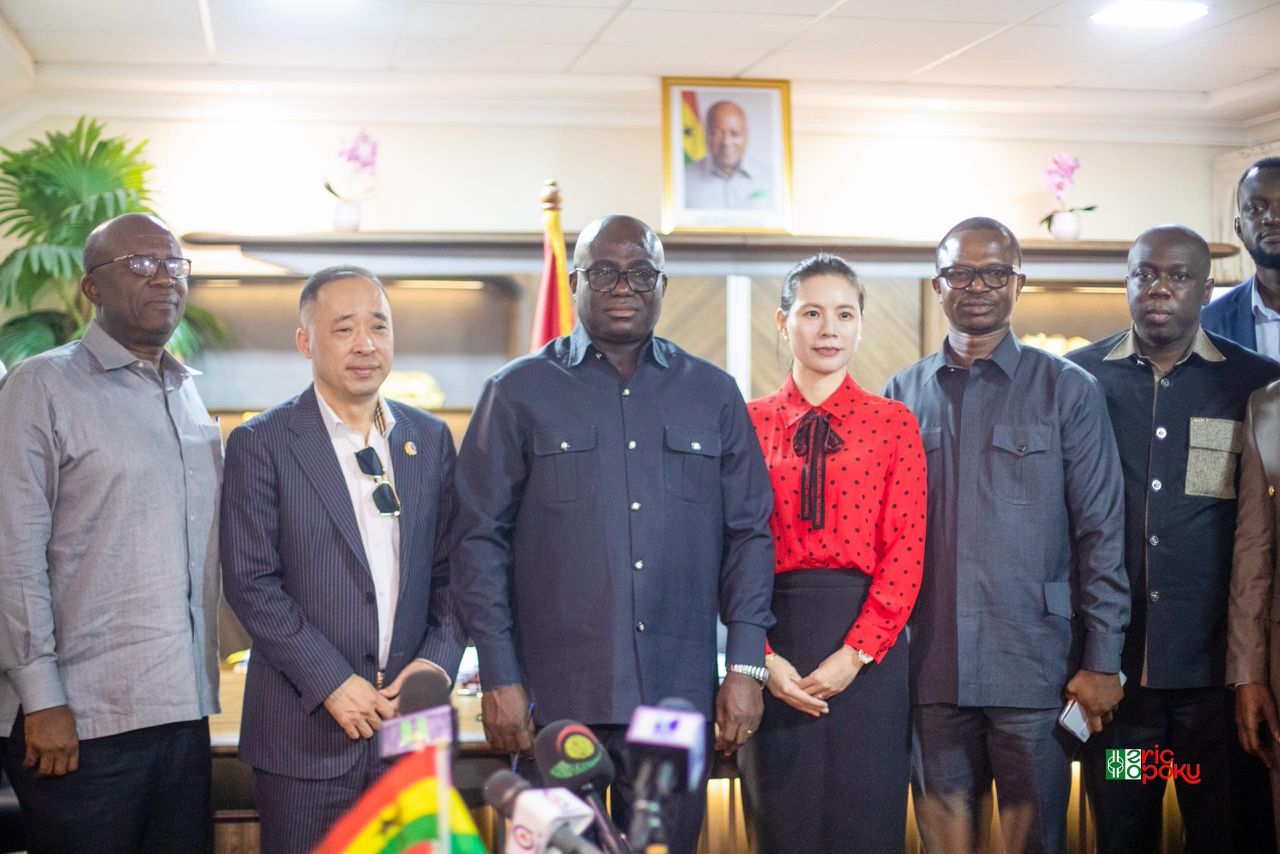
The Government of Ghana has signed a landmark agreement with Sentuo Group Limited aimed at transforming the country’s agricultural sector through large-scale fertiliser production and agro-industrial development.
Speaking at the signing ceremony in Accra, the Minister for Food and Agriculture, Eric Opoku, described the partnership as “a bold and deliberate step” toward repositioning Ghana’s agriculture into a modern, industrialised, and value-driven sector.
“This partnership represents a strategic shift under the leadership of His Excellency John Dramani Mahama to move Ghana from a raw commodity-based system into a fully integrated agricultural economy,” he said.
The agreement focuses on two key pillars: the development of agro-processing infrastructure for major crops such as cashew, maize, rice, soybean, and oil palm, and the establishment of a national fertiliser manufacturing plant alongside an integrated input supply system.
Mr. Opoku emphasised that the initiative would reduce Ghana’s long-standing dependence on imported fertilisers, which has exposed farmers to global price volatility and supply disruptions.
“For decades, our farmers have depended heavily on imported fertilisers. With this agreement, we are taking a decisive step toward fertiliser independence,” he stated.
He added that the project would enable local production of a wide range of fertilisers, including NPK, urea-based, organic, and specialty blends, supported by nationwide storage, logistics, and distribution systems.
The Minister also highlighted government’s ongoing investments in the sector, noting that the 2026 Budget includes the distribution of 272,000 metric tonnes of fertilisers, with additional targeted support for over 661,000 farmers.
“This is one of the largest fertiliser support programmes in our history. However, government alone cannot sustain this at scale without local production,” he said. “That is why this agreement is not just complementary it is transformational.”
The partnership, structured under a Public-Private Partnership framework, will see Sentuo Group finance, design, construct, and operate the facilities. According to the Minister, the arrangement reflects growing investor confidence in Ghana’s economic direction.
He welcomed the company’s commitment to technology transfer, job creation, and skills development for Ghanaian youth, as well as adherence to environmental and industrial standards.
Mr. Opoku clarified that the Memorandum of Understanding signed is a framework agreement and does not constitute a binding financial commitment.
“All subsequent phases will go through feasibility studies, environmental assessments, regulatory approvals, and Cabinet consideration where necessary,” he explained. “This ensures full transparency and protection of the national interest.”
Beyond fertiliser production, the agreement is expected to strengthen Ghana’s agro-industrial ecosystem through the establishment of processing plants, warehousing systems, and export-oriented production facilities.
The Minister outlined several anticipated benefits, including reduced post-harvest losses, increased export earnings, stabilised input costs, job creation, and improved food security.
“As a Ministry, we will ensure strong coordination across government institutions and align this initiative with key national programmes such as the Feed Ghana Programme and the 24-Hour Economy Policy,” he said.
Concluding his remarks, Mr. Opoku described the agreement as a strong signal of Ghana’s readiness for industrial investment.
“Today’s signing is not just an agreement it is a signal that Ghana is open for serious, long-term investment and committed to building a modern agricultural economy for future generations,” he said.
Story: Patrick Asford Boadu