President John Dramani Mahama has announced major reforms in Ghana’s education sector, including the expansion of STEM education, the elimination of the double-track system by 2027, and increased investment in technical and vocational training.
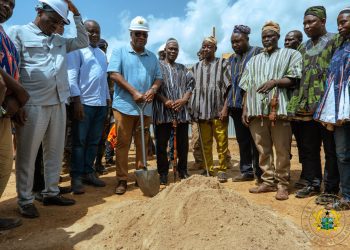
Speaking at the launch of the B-STEM Project at Sawla in the Savannah Region as part of his “Resetting Ghana” tour, President Mahama said government was committed to improving access to electricity, roads and quality education across the region.
“With regard to electricity, the Minister of Energy and Green has assured that the contracts have been awarded and the contractors are mobilising to begin work,” he stated, adding that electrification projects in several communities would commence within the next month.
The President described the Savannah Region as one of the most underserved regions in terms of electricity access and pledged to bridge the development gap.
“We want to bring Savannah up to the level of all the other regions in terms of access to electricity,” he said.
On infrastructure, President Mahama disclosed that the second phase of the government’s Big Push Programme was being prepared and would be captured in the 2026 budget statement.
“I can assure the chiefs and my fathers that your roads are contained in the Big Push project for next year,” he noted.
He explained that approximately 2,000 kilometres of roads were currently under construction across the country using Ghana’s own financial resources.
Touching on education reforms, the President revealed that government, through a World Bank-supported programme, would establish a new Technical and Vocational Education and Training (TVET) Centre of Excellence in the Sawla District.
“It is our intention to scale up technical and vocational education training. Instead of building more senior high schools, our intention is to build more technical and vocational schools,” he stated.
President Mahama further announced plans to abolish the double-track system in senior high schools by the end of 2027 through the expansion of school infrastructure, including dormitories, lecture halls, dining halls and auditoriums.
“By the end of 2027, no senior high school will be doing double track,” he assured.
As part of efforts to improve secondary education quality, the President disclosed that government would invest heavily in upgrading schools classified under Categories B and C.
“We are going to invest in 30 Category C schools to move them to Category B, and 30 Category B schools to Category A,” he explained, adding that the initiative would be funded with about 300 million dollars from the World Bank.
On STEM education, President Mahama criticised the previous approach of building only stand alone STEM schools, saying it limited access to a privileged few.
“Our idea is to democratise STEM and decentralise it so that every Ghanaian child has the opportunity to learn science, technology, engineering and mathematics,” he stressed.
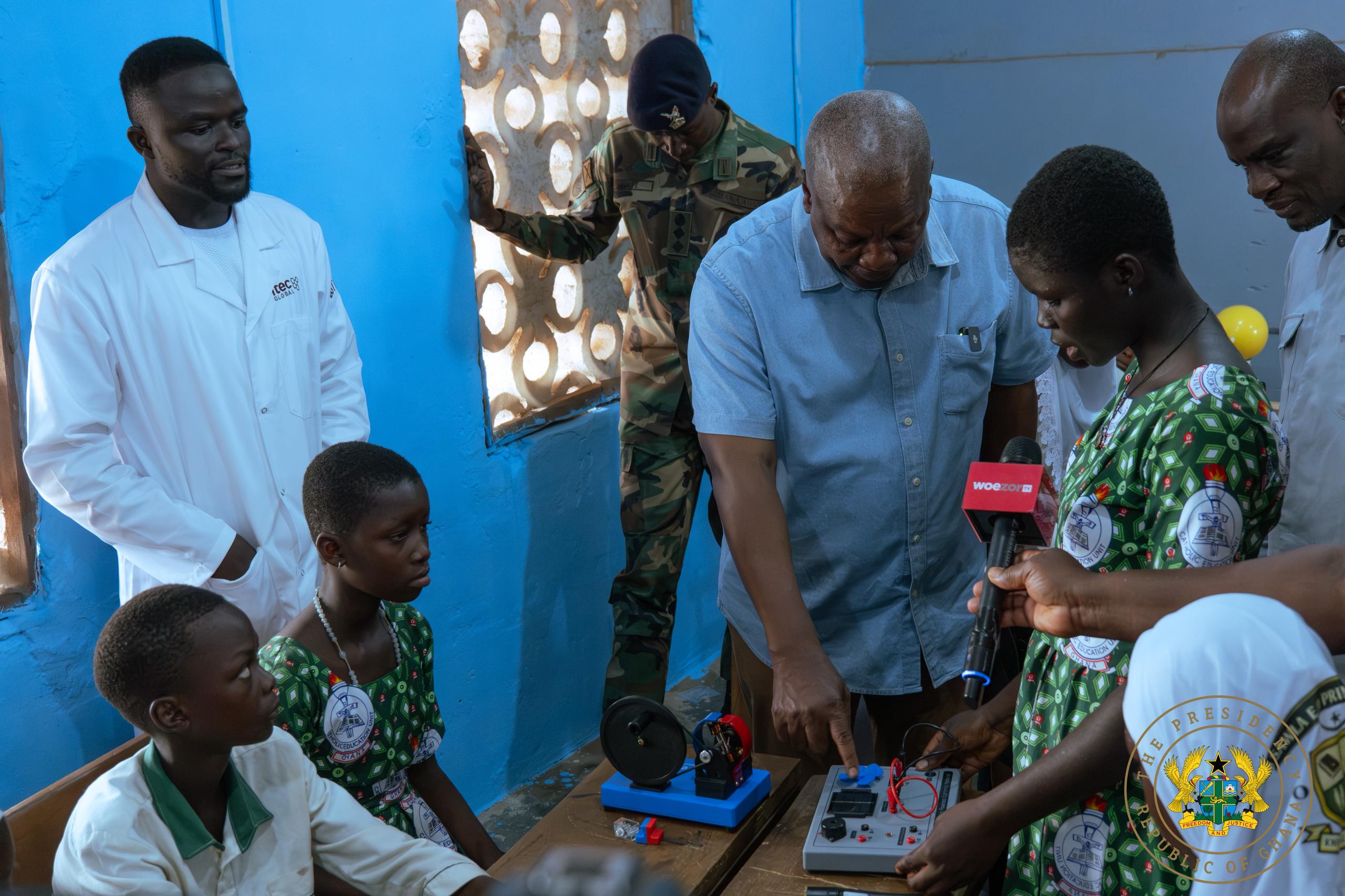
The President said the new approach would emphasise practical learning methods to make science and mathematics easier and more engaging for students.
“We have realised that it is the way science and mathematics are taught that discourages many children from taking the science and engineering route,” he noted.
President Mahama recounted his own experiences with traditional teaching methods, saying fear and pressure often discouraged students from embracing mathematics and science.
“Today our children have a better opportunity. They can learn robotics, they can learn AI,” he said after observing practical STEM demonstrations by students during the event.
He announced that a new national curriculum was being developed to integrate STEM, artificial intelligence and robotics into basic education.
According to him, over 5,000 schools had already benefited from STEM equipment under the programme, while teachers were also undergoing specialised training to support implementation.
The President further emphasised the importance of strengthening foundational learning at the basic school level. “Basic education is the foundation. If the foundation is not good, they house will not stand,” he stated.
He said government would focus on improving literacy, numeracy and critical thinking skills among children to ensure long-term academic success and national development.
Story: Patrick Asford Boadu