President John Dramani Mahama has called for comprehensive reforms to global governance institutions, greater African representation in international decision-making, and stronger economic self-reliance for developing nations, arguing that the post-World War II international order is increasingly unable to respond effectively to contemporary global challenges.
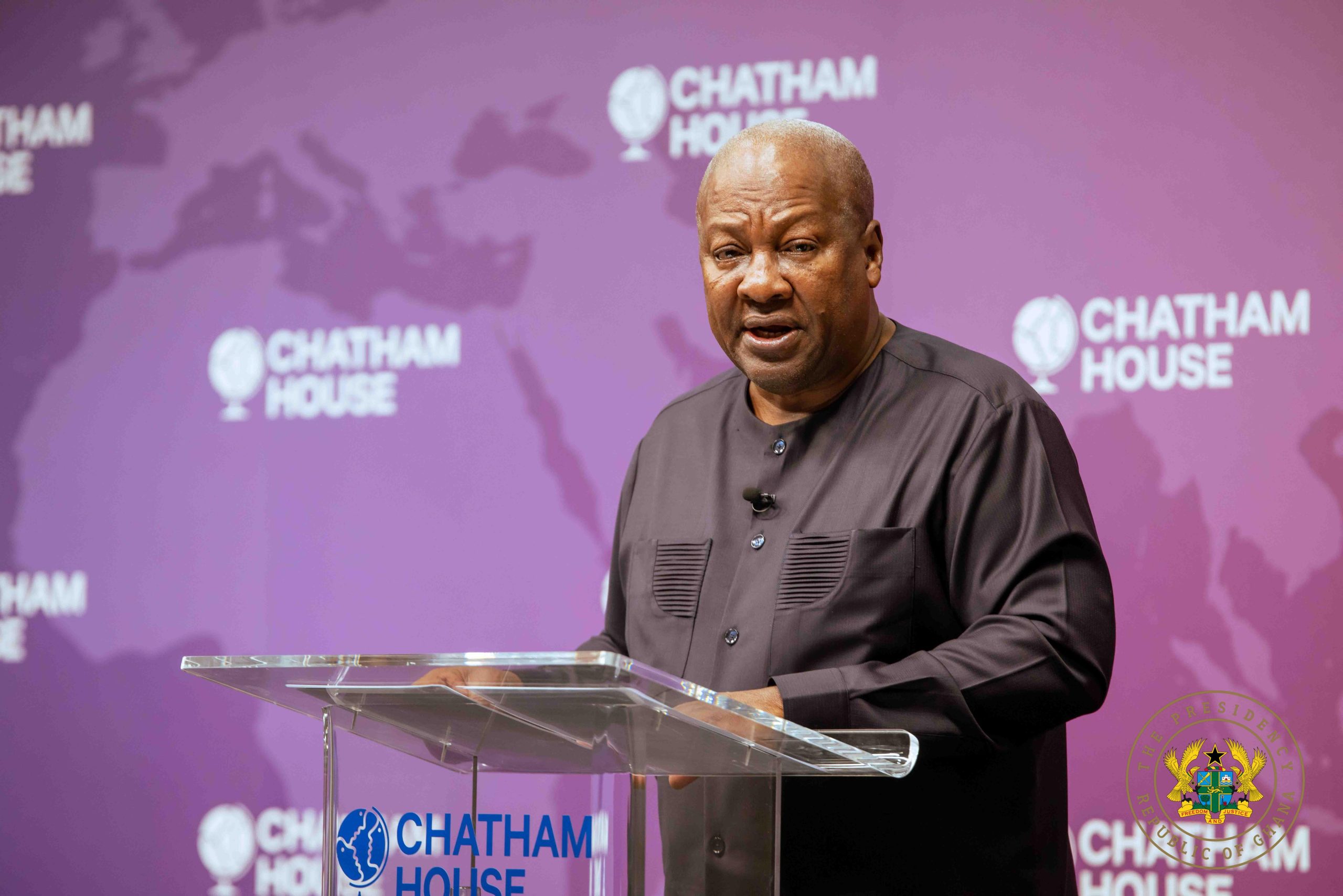
Speaking at Chatham House in London, President Mahama said the world is experiencing a profound period of transition marked by intensifying geopolitical competition, economic nationalism, technological disruption, climate change, and weakening multilateral cooperation.
“We meet today at a time of growing global uncertainty, as the post-war multilateral system we adopted is under severe strain,” he stated. “The global order established at the end of the Second World War is undergoing significant transformation.”
Drawing on historical examples, the President noted that no global order is permanent, citing the rise and decline of empires throughout history.
“What matters, however, is not simply that change occurs, but how nations respond to it,” he said.
President Mahama stressed that while the post-1945 international order had imperfections, it established important norms that enabled many formerly colonised nations, including Ghana, to secure their independence and sovereignty.
However, he warned that those principles are increasingly under threat. “Today, many of these norms are under stress. We increasingly witness a selective application of international law, the erosion of multilateral consensus, and the growing tendency for strategic competition to take precedence over collective responsibility,” he said.
The President identified four strategic priorities guiding Ghana’s response to the changing global environment: reforming global governance, promoting African integration, building balanced international partnerships, and strengthening domestic resilience.
On global governance reform, President Mahama argued that international institutions must evolve to reflect present-day realities rather than the power structures of 1945.
“Africa, with 54 member states at the United Nations and a population projected to constitute nearly one quarter of humanity by 2050, continues to be excluded from permanent representation on the United Nations Security Council,” he noted.
“This is not merely a procedural anomaly; it is a historical injustice and a structural imbalance that undermines the credibility of the multilateral system itself.”
He reiterated Ghana’s support for equitable representation for Africa on the Security Council and called for reforms to the international financial architecture to better address the debt challenges facing developing countries.
“The debt vulnerabilities facing many countries in the Global South are not merely fiscal challenges.
They constitute development constraints that limit investments in health, education, infrastructure, climate adaptation and industrial transformation,” he said.
President Mahama also highlighted the lessons learned from the COVID-19 pandemic, saying it exposed deep inequalities in the global system.
“The pandemic revealed that over-reliance on external systems in critical sectors can quickly become a national security vulnerability,” he stated.
He said Ghana’s Accra Reset Initiative was designed to strengthen sovereign capacity in public health, pharmaceutical manufacturing, food security, digital infrastructure and industrial development.
“The future of the multilateral system itself cannot be built on dependency. It must be built on dignity,” he emphasized.
Turning to continental integration, President Mahama described the African Continental Free Trade Area (AfCFTA) as one of the most important economic transformation projects of the modern era.
“If implemented successfully, the African Continental Free Trade Area has the potential to unlock intra-African trade, expand industrial production, strengthen regional value chains, and reduce Africa’s excessive exposure to external shocks,” he said.
The President stressed that Africa must move beyond its traditional role as an exporter of raw materials.
“For too long, African economies have remained overly dependent on exporting raw commodities while importing finished products at significantly higher value. That model is neither sustainable nor strategically viable,” he said.
On Ghana’s domestic development agenda, President Mahama said the country’s ability to influence global affairs depends on its internal strength and resilience.
“Our ability to navigate a changing global order is inextricably linked to the strength of our democratic institutions, economic governance, productive capacity and human capital,” he noted.
He highlighted ongoing reforms aimed at restoring macroeconomic stability, improving public financial management, and rebuilding investor confidence.
Central to these efforts, he said, are the government’s 24-Hour Economy Initiative and Accelerated Export Development Programme, which seek to transform Ghana into a productive, industrial and export-oriented economy.
“In an increasingly competitive world, nations that produce, innovate, industrialise and export will have greater strategic relevance. Ghana intends to be amongst them,” he declared.
President Mahama also underscored the importance of investing in Africa’s youthful population through education, digital transformation, entrepreneurship and innovation.
“We recognise that the global economy of the future will increasingly be shaped by artificial intelligence, advanced manufacturing, renewable energy, biotechnology and digital finance,” he said.
“Our objective is not merely for Ghanaian youth to participate in that future, but to help shape it.”
Addressing the issue of historical justice, the President called for greater recognition of the enduring impact of the Transatlantic Slave Trade.
“The Atlantic Slave Trade remains one of the gravest crimes against humanity. Its consequences continue to shape current global inequalities, racial disparities and structural underdevelopment across the world,” he stated.
He said Ghana would continue advocating for historical accountability and reparative justice within international discussions on inclusion and equity.
Concluding his address, President Mahama expressed optimism that the ongoing shifts in global affairs present opportunities for renewal and greater fairness.
“Ghana does not regard itself as a passive observer of these changes,” he said.
“We see ourselves as active participants in shaping a more balanced, equitable and cooperative international system.”
He added: “The future of the international system will not be determined by any single nation alone. Our collective choices will shape it and determine whether we possess the wisdom to build a world that is not only more stable, but also more just.”
Story: Patrick Asford Boadu