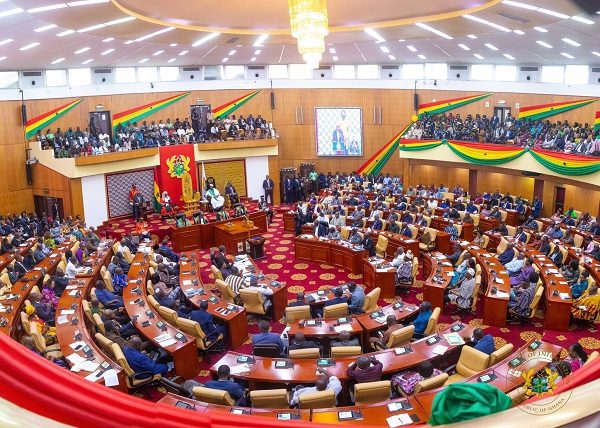
The Council of State has officially written to the Speaker of Parliament, Alban Bagbin, advising against the passage of the Constitution of the Republic of Ghana (Amendment) Bill, 2025. The proposed legislation seeks to remove existing legal restrictions that prevent dual citizens from holding certain public offices in the country.
The bill, commonly referred to as the Dual Citizenship Bill, had previously received the Council’s endorsement during the Eighth Parliament. However, it failed to reach the consideration stage before the dissolution of the House, necessitating its reintroduction in the current legislative session.
Delivering a formal statement on Tuesday, Speaker Bagbin disclosed that the Council of State had raised critical constitutional questions regarding the proposed amendments.
”While the Council’s advice does not automatically block Parliament from considering the Bill, it is imperative that the issues raised are thoroughly interrogated,” Speaker Bagbin noted, reaffirming that Parliament retains the constitutional power to amend provisions of the supreme law.
To ensure due process, the Speaker has referred the Council’s advisory opinion, alongside his own guidance on the matter, to the Constitutional, Legal, and Parliamentary Affairs Committee for detailed consideration and reporting.
Background
The battle over Ghana’s dual citizenship law is a decades-long saga driven by a deep tug-of-war between national security and the immense power of the Ghanaian diaspora.
The story begins shortly after Ghana returned to democratic rule. Under the original 1992 Constitution, dual citizenship was completely illegal. If a Ghanaian took up a foreign passport, they had to forfeit their Ghanaian birthright.
Recognizing the immense value of its citizens abroad, Parliament moved to change this, passing a historic constitutional amendment in 1996. For the first time, Ghanaians could proudly hold dual nationality. But this victory came with a heavy catch. Driven by fears of “divided loyalty” and foreign interference, lawmakers baked strict restrictions into Article 8(2) of the Constitution.
Dual citizens were strictly barred from holding top-tier public offices. Overnight, the diaspora was welcomed back as economic pillars, but locked out as political leaders. They could send billions of dollars home in remittances, but they could not serve as Members of Parliament, Ambassadors, Cabinet Secretaries, or Chiefs of Defense Staff.
For over two decades, this restriction remained a quiet grievance until it exploded into a major political crisis. The catalyst was the high-profile case of James Gyakye Quayson who won the Assin North parliamentary seat in the 2020 elections.
Opponents dragged him to court, alleging that he had not fully processed the renunciation of his Canadian citizenship before filing his nomination. The case dragged on for years, culminating in a dramatic Supreme Court ruling that ousted him from Parliament and triggered a highly polarized by-election.
Though Quayson eventually cleared his paperwork and won his seat back in a tense re-election, the saga exposed a harsh reality where the dual citizenship law had become a political weapon, capable of overturning elections and alienating the very diaspora Ghana sought to embrace.
It was out of this political firestorm that the Constitution of the Republic of Ghana (Amendment) Bill was born. Championed as a Private Member’s Bill, its mission was simple yet radical: erase the decades-old restrictions and allow dual citizens to hold any public office.
The bill initially gained momentum, securing a crucial nod from the Council of State during the Eighth Parliament. But the clock ran out. Before lawmakers could finalize it, the House was dissolved, sending the bill back to square one.
When the bill was reintroduced in the current legislative session, the political winds had shifted. The Council of State, the nation’s highest advisory body issued a stark reversal, officially advising Speaker Alban Bagbin against passing the legislation.
With the Speaker now referring the matter to the Constitutional and Legal Affairs Committee, the bill stands at a critical crossroads, waiting to see if Ghana will rewrite its rules of allegiance or leave the door firmly shut to its citizens abroad.
Eugenia Ewoenam Osei