The Ghana Revenue Authority (GRA) has uncovered what it describes as a sophisticated customs fraud scheme involving falsified trade documents, misdeclaration of goods, incorrect tariff classification, questionable consignee identities and possible internal collusion following the interception of 18 transit trucks earlier this year.
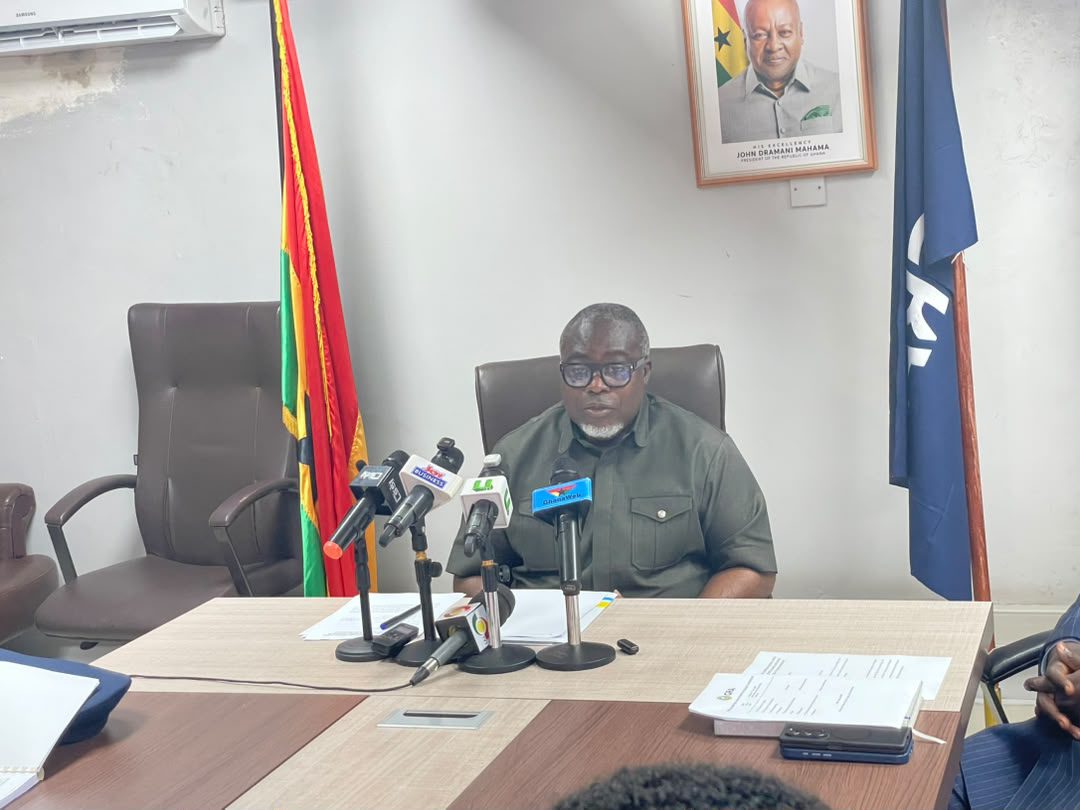
Addressing a media briefing in Accra on Tuesday, July 7, Commissioner-General of the GRA said investigations into the attempted transit diversion had revealed multiple breaches of customs procedures, leading to the interdiction of four customs officers while further disciplinary processes continue.
Background
The Commissioner-General recalled that in February 2026, a joint team from the Preventive Unit of Customs, the GRA and National Security intercepted 18 trucks transporting cargo declared as transit goods from Togo through the Akanu border to Niger.
The trucks were stopped along the Kpone barrier after intelligence suggested the cargo was being diverted into the Ghanaian market instead of continuing to its declared destination.
Following the interception, the Ministry of Finance directed the GRA to investigate the matter.
According to the Commissioner-General, the investigation involved reviewing arresting officers’ reports, statements from customs officials, declarants, escort officers and drivers, examining the goods, scrutinising transit bond issuers, conducting correspondence with the Nigerian Chamber of Commerce, and carrying out site visits to the Akanu border post and the Togolese Customs station at Noepe.
Key findings
Falsified trade documentation
Investigators found that export documents, including T1 transit certificates obtained from Togolese Customs, indicated the cargo originated in Malaysia and Indonesia before being discharged at the Port of Lomé.
The shipment was declared as destined for Niger but had reportedly been consigned to two Ivorian companies for delivery to Abidjan, Côte d’Ivoire, not Niger.
The companies identified in the documents were Prestige Yma Sarl (Commercial Import Export, Abidjan, Côte d’Ivoire) and Dao Et Freres (Vente De Pièces Moto Et De Lubrifiant, Abidjan).
However, customs officers reported that the goods neither reached Abidjan nor the named companies. Instead, the declaration processed on the Ghanaian side identified Adamou Moumouni as the consignee.
Investigators further established that the Akanu declaration was not supported by the original bill of lading or export documents. Instead, it relied on an invoice which falsely suggested the goods had been purchased on the open market in Togo.
Quantity and description discrepancies
Physical examination of the shipment also uncovered inconsistencies between the declaration and the actual cargo.
While customs documents declared 35,246 jerrycans of vegetable cooking oil, officers counted 39,256 during re-examination.
Investigators also discovered a separate declaration for 4,010 units of tomato flavour seasoning that had been falsely described as tomato paste, a misdescription that affected the applicable bond value.
Incorrect tariff classification
The Commissioner-General said the cooking oil had been classified under HS Code 1517.90.90.00, which attracts a 20 percent duty.
Investigators, however, determined that the correct classification should have been HS Code 1511.90.99.00, attracting a 35 percent duty.
The incorrect classification significantly understated the bond guarantee value against suspended taxes.
Questions over consignee identity
The investigation also raised concerns about the identity of the declared consignee.
Correspondence with the Nigerian Chamber of Commerce confirmed that the Taxpayer Identification Number (TIN) used for Adamou Moumouni could not be verified.
The Chamber also stated that it could neither confirm nor deny that the goods belonged to the named consignee, noting that Adamou Moumouni is a common Nigerian name.
The GRA said the findings raise concerns about possible impersonation of a genuine Nigerian businessman.
Evidence of prior activity
Investigators also traced 44 previous transit declarations linked to the same consignee over the past two years.
A review of ICUMS records showed that several of those transactions were processed without accompanying bills of lading and exhibited similar irregular exit patterns at Kulungugu, suggesting the intercepted consignment may not have been an isolated incident.
Internal accountability
The Commissioner-General disclosed that four customs officers who handled the consignment have been interdicted.
He said internal disciplinary proceedings are underway and any officer found culpable will face sanctions in accordance with the Authority’s policies and the law.
Immediate actions
The GRA has confirmed the confiscation of the intercepted consignment pending the conclusion of investigations.
The Commissioner-General also announced that, on the directive of the Ministry of Finance, the consignment has been allocated to the National School Feeding Programme.
Assurance to the public
The GRA assured the public that the attempted diversion demonstrates the effectiveness of its border surveillance and revenue protection systems.
The Authority said it has intensified compliance monitoring and revenue mobilisation efforts at the country’s borders to curb illicit trade and protect national revenue.