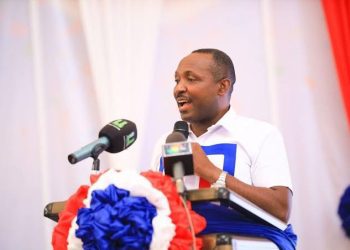
Ghana’s Ninth Parliament has officially adjourned its Second Meeting of the Second Session following an intense eleven-week sitting focused on legislative reform, fiscal stability, and robust executive oversight. Delivering his closing address to the House, Majority Leader Mahama Ayariga offered a comprehensive account of the parliamentary business conducted, praising lawmakers from both sides of the House for their patriotism, swift responsiveness, and dedicated service to the nation.
A central highlight of the meeting was the presentation of the Mid-Year Review of the Budget Statement and Economic Policy for the 2026 Financial Year, delivered by Minister for Finance, Dr. Cassiel Ato Baah Forson on behalf of President John Dramani Mahama. Addressing the House, Ayariga emphasized that the Ghanaian economy has successfully transitioned from basic macroeconomic stabilization to sustained growth while maintaining strict fiscal discipline.
A clear manifestation of this progress is the sharp drop in inflation from 22.85 percent in 2024 down to 5.3 percent in 2026. Coupled with the successful conclusion of the International Monetary Fund Extended Credit Facility Programme and full compliance with international financial commitments, the Majority Leader noted that domestic fiscal consolidation is restoring investor confidence and strengthening the country’s economic standing globally despite broader global uncertainties.
Legislative productivity remained at the absolute core of the session. Out of sixteen bills introduced, including four Private Members’ Bills, Parliament successfully passed ten major acts designed to modernize key institutions, protect national resources, and upgrade social policy. In the agricultural sector, lawmakers passed the Ghana Cocoa Board Bill, 2026, which modernizes the governance and financing framework of the cocoa industry while guaranteeing fair producer prices for farmers.
To support ongoing fiscal reforms, Parliament enacted a suite of revenue laws, including the Customs Bill, 2026, the Excise Bill, 2026, the Income Tax Amendment Bill, 2026, and the Value Added Tax Amendment Bill, 2026, all aimed at simplifying tax procedures, cutting the cost of doing business, and enhancing border efficiency.
The House also made significant strides in national security, judicial administration, and social legislation. Lawmakers approved the Community Service Bill, 2026, introducing non-custodial sentencing to promote restorative justice, while the Tribunals Bill, 2026 re-established local tribunal structures to advance judicial delivery.
Defense architecture was bolstered through the passage of the National Defence University, Ghana Bill, 2026, and maritime security was reinforced via the Maritime and Related Offences Bill, 2026. Additionally, the House passed the Human Sexual Rights and Family Values Bill, 2025 to regulate matters surrounding human sexual rights while upholding traditional Ghanaian family values.
Although ten acts were successfully finalized, ten additional pieces of legislation advanced through critical preliminary stages and remain pending for future sittings. These include the Minerals and Mining Bill, 2026, the Public Procurement Amendment Bill, 2026, the Constitution Amendment Bill, 2025, the Criminal Offences Amendment Bill, 2026, the Budget Bill, 2026, the Parliament Bill, 2026, the Conduct of Public Officers Bill, 2026, the Economic and Organised Crime Office Bill, 2026, the Parliament Transition Bill, 2026, and the Interstate Succession Bill, 2025.
In exercising its constitutional duty of executive oversight, Parliament engaged in extensive scrutiny throughout the sitting. Ministers of State appeared before the House to respond to 173 scheduled Questions, comprising 168 Oral Questions and 5 Urgent Questions, providing clarity on government policies and addressing constituency concerns.
Lawmakers also delivered 41 Statements on matters of urgent public interest, many of which were referred to specialized committees to form the basis of new policy proposals. Beyond primary legislation, the House considered vital regulations covering Social Protection, National Health Insurance, Affirmative Action, and Educational Regulation, alongside reviewing international agreements, statutory instruments, and mining leases.
In his concluding remarks, Ayariga expressed deep gratitude to the Speaker of Parliament for his steady leadership, the Deputy Speakers, the Minority Caucus for their rigorous debate and constructive contributions, as well as the Clerk, parliamentary staff, and the Parliamentary Press Corps.
He reminded Members that democracy is strengthened through the respectful resolution of differing opinions, urging all MPs to maintain a “Ghana First” mindset as they return to their respective constituencies to serve their citizens.
Eugenia Ewoenam Osei