President John Dramani Mahama has called for a fundamental shift in how African governments approach healthcare, arguing that health must be treated not merely as a social expenditure but as an investable economic sector capable of driving manufacturing, job creation and economic stability.
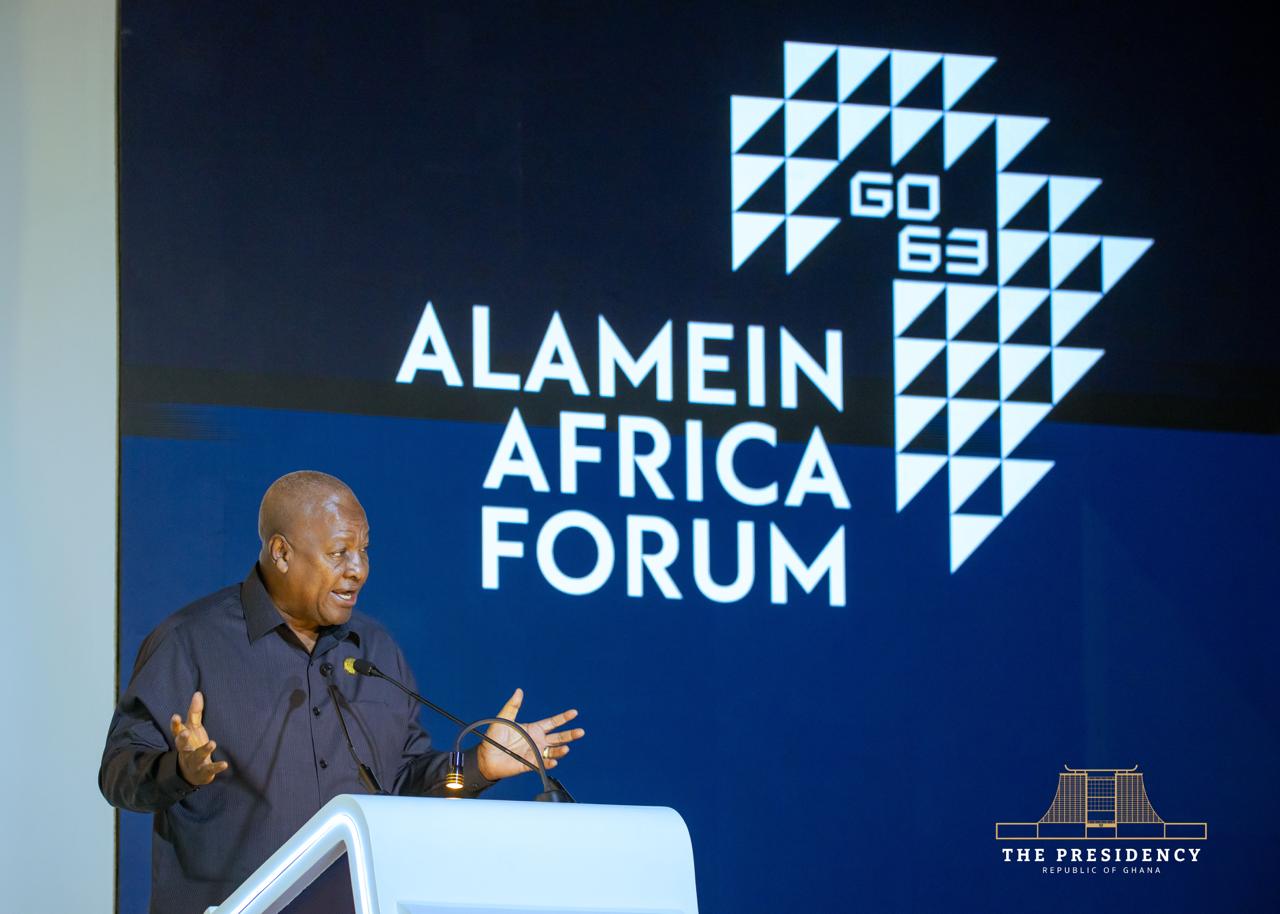
Addressing the maiden Alamein Africa Forum in Egypt on the theme “Investing in Health Manufacturing and Regional Value Chains,” President Mahama said African governments and the private sector must work together to achieve health sovereignty for the continent.
He said Africa could no longer depend excessively on external financing and imports to meet its healthcare needs at a time when traditional development assistance was declining
President Mahama recounted how former Nigerian President Olusegun Obasanjo approached him to champion the cause of health sovereignty and the broader “Accra Reset” agenda.
He explained that his thinking at the time had been shaped by the withdrawal of US$154 million in support to Ghana, including US$74 million that had supported the country’s health budget.
“That is how I got into the business of health sovereignty and the whole Accra Reset, and I think that is a thing whose time has come,” he said.
Health as an economic investment
President Mahama said Africa’s approach to healthcare financing needed to change because governments could not achieve health sovereignty on their own.
“We came to talk about how we can work with the private sector, because governments cannot do it alone,” he said.
“Governments and the private sector must work together in order that we achieve the kind of sovereignty that Africa needs in its health outcomes.”
He said health was the “most precious possession” of citizens and that African countries needed to maximise domestic resources while strategically using international support.
According to the President, treating healthcare as an investment could generate significant economic and social returns.
He cited the Copenhagen Consensus as showing that a targeted package of basic emergency maternal and newborn care could yield US$87 in economic and social returns for every US$1 invested.
He also referenced findings from the Lancet Commission that declining mortality rates accounted for nearly a quarter of total income growth in developing economies in the early 2000s.
“Investing in healthcare strengthens our balance sheets rather than depleting resources,” President Mahama said.
Africa’s pharmaceutical import dependence
President Mahama said Africa’s heavy dependence on imported medicines and vaccines presented both a vulnerability and an investment opportunity.
He stated that Africa imports more than 70 percent of its pharmaceuticals and nearly 99 percent of its vaccines, resulting in billions of dollars leaving African economies annually to purchase health products from outside the continent.
At the same time, he said traditional donor assistance was declining, creating an urgent need to mobilise domestic and private capital.
He identified four key pillars supporting the case for pharmaceutical manufacturing in Africa: a growing market, import substitution and foreign-exchange protection, the size of the African market, and coordinated continental demand.
He said Africa’s population was projected to reach 2.5 billion by 2050, creating growing demand for essential medicines, chronic disease treatments and biologics.
The President also pointed to the African Continental Free Trade Area as an opportunity for manufacturers to access a continental market rather than being restricted to individual national markets.
He cited a recent pooled tender by the Africa Centres for Disease Control and Prevention for maternal and child health products, saying aggregated demand across borders had resulted in price reductions of more than 30 percent while African manufacturers secured 50 percent of the product lines. “Coordinated demand guarantees cash flows for products,” he said.
He urged bankers, institutional investors and industrial leaders to view African pharmaceutical manufacturing as a sector capable of attracting long-term investment.
Health sovereignty and jobs
President Mahama said greater domestic manufacturing capacity would also address Africa’s employment challenges and reduce the loss of skilled professionals.
He cited World Health Organization figures indicating that Africa faces a shortage of about six million health workers, while nearly one million trained healthcare professionals and science graduates remain unemployed on the continent.
According to him, expanding local manufacturing would create opportunities in research and development, clinical trials, engineering and biotechnology.
“It means high-value jobs in Africa,” he said, adding that local production could also help retain skilled African professionals.
He further argued that manufacturing medicines locally could reduce logistics costs and intermediary margins, improving affordability and access for patients.
Lessons from Egypt and Nigeria
President Mahama highlighted Egypt’s experience in tackling hepatitis C as an example of what could be achieved through domestic production and technology transfer.
He said Egypt had reduced hepatitis C prevalence from about 10 percent to below 0.5 percent and had treated approximately four million citizens locally.
He attributed the achievement partly to Egypt’s decision to negotiate technology transfer and build domestic production capacity, including through pharmaceutical companies such as Pharco.
He also cited Nigeria’s African Medical Centre of Excellence in Abuja, pioneered by Afreximbank and King’s College Hospital, as an example of efforts to reduce the estimated US$6 billion lost annually through outbound medical tourism.
“By keeping high-end specialised care on the continent, we retain skills, wealth and consumer confidence,” he said.
Ghana’s Accra Reset
President Mahama said Ghana was also implementing measures under the Accra Reset aimed at strengthening the country’s health sector and domestic production capacity.
He cited the expansion of the National Health Insurance Scheme, the introduction of the Free Primary Healthcare Programme, the establishment of the Ghana Medical Trust, and efforts to empower the Food and Drugs Authority and the National Vaccine Institute.
The objective, he said, was to move Ghana from being predominantly a consumer of health products to becoming a producer.
To support a wider continental ecosystem, President Mahama announced the proposed Health Investment and National Gateway (H-Enabler), developed in collaboration with the African Medicines Agency, Institut Pasteur and Afrochampions.
He said the platform would streamline regulatory processes, clinical validation and commercialisation for innovators and investors.
He also said that through the Accra Reset Presidential Council, dedicated task forces and reform interlock observatories were being deployed to track capital flows, monitor policy commitments and address non-tariff barriers affecting regional value chains.
Mahama challenges financiers, regulators and industrialists
President Mahama said governments alone could not finance Africa’s transition towards health sovereignty and called for greater participation from private capital, industrial developers, commercial banks and sovereign wealth funds.
He also highlighted the Business United for Mothers, Babies and Youth initiative, which he said seeks to encourage Corporate Africa to integrate health investment into capital allocation and corporate strategy.
Before concluding his address, President Mahama posed three questions to key stakeholders.
To financiers, he asked what de-risking instruments and blended-finance structures governments needed to provide to encourage patient capital into African pharmaceutical manufacturing.
To regulators, he asked how quickly the African Medicines Agency could be operationalised so that a single drug approval could facilitate access across all 54 African Union member states.
And to industrialists, he asked what strategic partnerships were required to move African pharmaceutical production beyond basic packaging and fill-and-finish operations towards full active pharmaceutical ingredient synthesis on African soil.
“These are the three questions we need to answer to bring governments and business together to assist in creating health sovereignty for Africa,” he said.
President Mahama concluded by urging African leaders and businesses to move away from treating healthcare simply as a budgetary expense.
“Let us build the factories, integrate supply chains, fund innovators and secure our citizens’ future,” he said.
He called on participants at the Alamein Africa Forum to leave the gathering with a concrete plan for advancing African health sovereignty.
Story: Patrick Asford Boadu