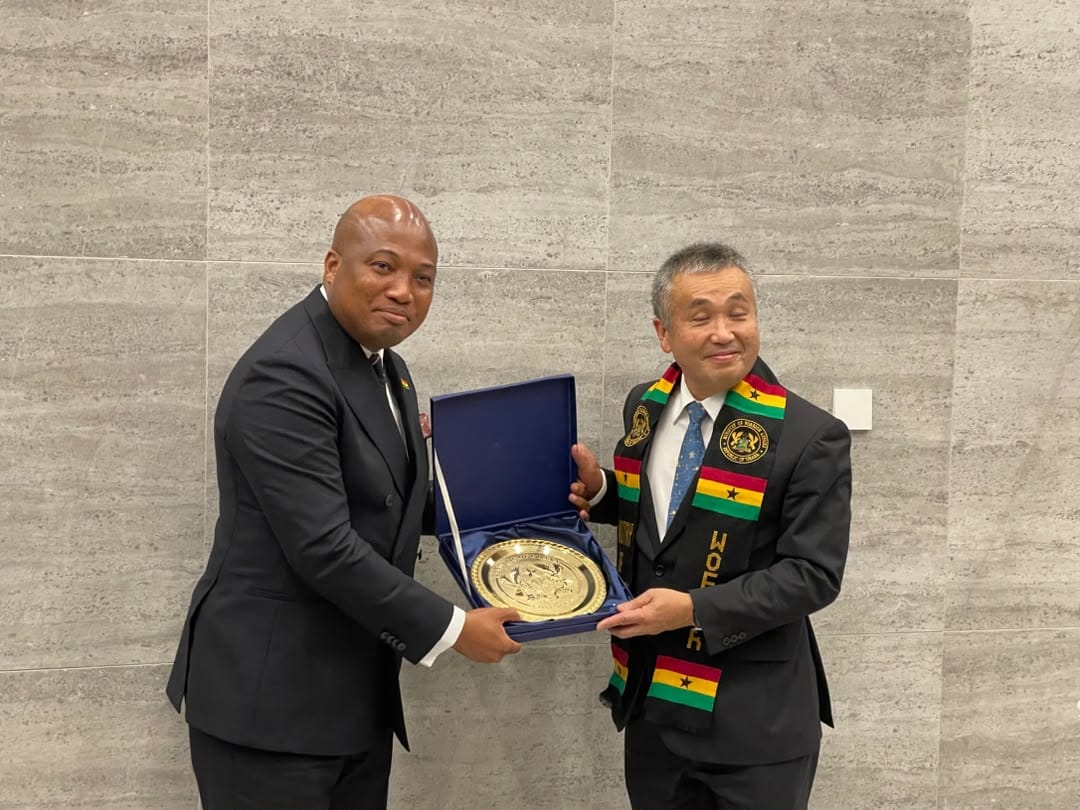
Renowned Japanese astronaut and Chief Technology Officer for Asia Pacific at Axiom Space, Dr. Koichi Wakata, has called for strengthened international collaboration and sustainable space practices to enable future generations to participate in global space exploration.
Speaking during a three-day official visit to Ghana, Dr. Wakata shared insights from his extensive spaceflight career, emphasizing that geographical and technological boundaries should not limit young people from pursuing careers in science, technology, engineering, and mathematics (STEM).
Reflecting on his childhood, Dr. Wakata recalled watching the Apollo Moon landing at age five, a time when Japan lacked its own space program.
”As a young boy, I thought working and flying in space was completely beyond my reach,” Dr. Wakata said. “However, through international collaboration, I joined motivated and talented professionals from across the globe in human space exploration. What once felt impossible became achievable.”
During his visit, Dr. Wakata engaged with high school and university students, including participants and winners of the National Science & Maths Quiz (NSMQ), to spark interest in space science and innovation.
Highlighting the mechanics of spaceflight, he noted that orbiting the Earth every 90 minutes at the International Space Station (ISS) exposes astronauts to 16 sunrises and sunsets daily, completing roughly 3,000 orbits during a standard six-month mission.
Addressing the logistics and sustainability of long-duration missions, Dr. Wakata explained the advanced life-support systems onboard the ISS, where 98 percent of water including sweat and humidity is recycled.
”In space, we recycle everything possible because transporting water from Earth is extremely costly,” he explained. “We convert yesterday’s coffee into tomorrow’s coffee. Similarly, we recycle carbon dioxide into oxygen, yielding methane as a byproduct. In our next-generation commercial space stations at Axiom Space, we plan to utilize that methane as fuel for orbital maneuvers.”
Dr. Wakata raised urgent concerns regarding space debris, comparing orbital pollution to ocean contamination. He warned that discarded rocket bodies and non-functional satellites pose significant risks to active spacecraft and future missions, stressing that mitigation strategies are essential for sustainable space utilization.
He emphasized that technological solutions must be paired with policy frameworks, commending the role of global diplomacy and agreements like the Intergovernmental Agreement (IGA) in enabling peaceful cross-border space endeavors. Expressing appreciation to Ghana’s Ministry of Foreign Affairs, diplomatic partners, and educational institutions, Dr. Wakata reiterated his commitment to fostering space science opportunities for African youth.
”Engineers and scientists need robust international frameworks to turn vision into reality,” Dr. Wakata stated. “I hope this visit inspires young Ghanaian scholars to leverage space science, explore the universe, and eventually fly into space alongside us.”
Eugenia Ewoenam Osei