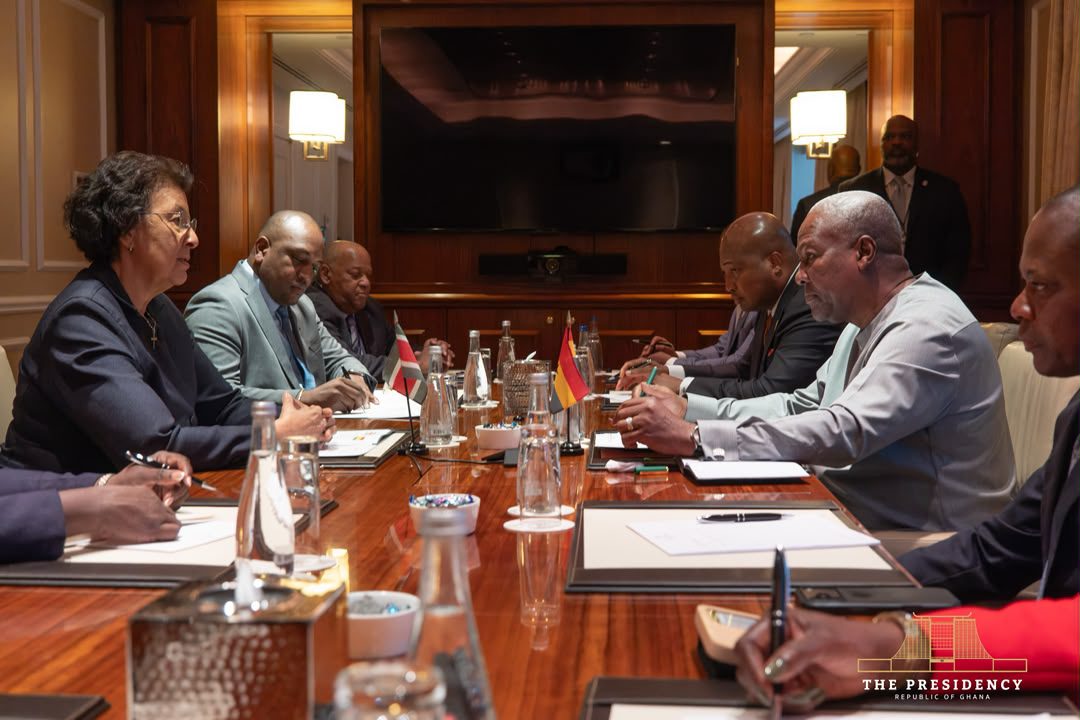
President John Dramani Mahama has called for a new chapter in Ghana–United States economic relations, with greater emphasis on trade, investment, technology transfer and productive enterprise.
Addressing the US-Ghana Presidential Roundtable in New York, President Mahama said Ghana’s improving macroeconomic conditions, strategic location and access to the wider African market provided significant opportunities for American businesses.
He said his administration was committed to creating an investment environment in which businesses could expand production, create jobs and contribute more significantly to Ghana’s economic transformation.
President Mahama cited the passage of the Ghana Investment Promotion Authority Act, 2026 (Act 1173) as evidence of his government’s commitment to addressing barriers to investment.
“When we identify an obstacle to investment, we must remove it. And when we commit, you should expect us to return and account for what we’ve done,” he said.
According to the President, the new legislation removes the blanket minimum capital requirements that previously applied to most foreign investors and establishes what he described as a more responsive framework for investment in Ghana.
He said Ghana’s foreign direct investment recorded in 2025 reached approximately US$2.6 billion, about four times the level recorded in 2024.
President Mahama, however, stressed that the volume of investment was only one measure of success, saying greater attention must be paid to the economic outcomes generated by investments.
“Does it build a factory? Does it expand the farm? Does it introduce new technology? Does it increase our exports and create decent jobs? These are outcomes that matter to us,” he said.
Macroeconomic stability
President Mahama said Ghana’s economic recovery was beginning to yield encouraging results, citing growth of 6 percent in 2025 and 6.4 percent year-on-year growth in the first quarter of 2026.
He also pointed to the decline in inflation, saying the rate had fallen sharply before subsequently rising to about 5 percent.
He said the gains in macroeconomic stability must now translate into lower costs of doing business, greater access to long-term financing and increased investment in productive sectors.
“Interest rates must come down. Long-term financing must become more available,” President Mahama said.
He identified agriculture, manufacturing, energy, infrastructure and technology as sectors requiring increased capital investment.
According to him, businesses also require reliable power, efficient transportation and logistics systems, as well as industrial infrastructure that enables them to compete.
24-hour economy
The President also outlined the government’s 24-hour economy as a major component of its strategy to increase production and create employment.
He clarified that the initiative was not a directive requiring every business to operate around the clock.
“The 24-hour economy is not a directive requiring every business to remain open 24 hours a day. It is a framework that enables enterprises with a market and commercial basis to create additional shifts, raise outputs and employ more people,” he explained.
He said the government had established a 24-hour economy authority to coordinate the programme and was implementing measures to support qualifying businesses, including duty-free importation of plant and equipment and faster clearance procedures at the ports.
President Mahama said increased production would also create opportunities in transport, logistics, warehousing, cold-chain facilities and digital services.
Ghana as a production hub for Africa
President Mahama urged American companies to look beyond Ghana’s domestic market and consider the country as a production base for the wider African market.
He pointed to the African Continental Free Trade Area (AfCFTA), headquartered in Accra, as providing access to a continental market of more than 1.4 billion people.
“Do not look at Ghana’s 34 million population only for what you can sell there. Look at Ghana for what you can produce and sell across Africa and to the world,” he said.
He said Ghana’s planned chairmanship of the African Union in 2027 would also provide an opportunity to support Africa’s agenda on infrastructure, industrialisation, regional integration and implementation of the AfCFTA.
Value addition
The President said Ghana must move away from exporting raw commodities while importing finished products that could increasingly be produced locally.
He cited cocoa, gold, manganese, cashew, fruits, vegetables and grains as examples of commodities with significant opportunities for local value addition.
“Agriculture provides a good example. Ghana is one of the world’s leading cocoa producers, but our interest cannot end with just exporting raw cocoa beans,” he said.
He identified cocoa processing, cashew, horticulture, grains, poultry, livestock and food manufacturing as areas where investors could partner with Ghanaian businesses.
According to him, processing more agricultural produce locally would create markets for farmers while generating opportunities for processors, suppliers, transporters and other businesses along the value chain.
Stronger Ghana-US economic partnership
President Mahama said trade in goods and services between Ghana and the United States reached approximately US$4.6 billion in 2025, while Ghana had benefited from the African Growth and Opportunity Act (AGOA) for more than two decades.
He said the next phase of the bilateral relationship should place greater emphasis on trade and investment, technology and productive enterprise.
“American capital, American technology and experience can work with Ghanaian businesses and skills to produce goods and services for Ghana, Africa and the world market,” he said.
President Mahama encouraged American companies to increase their presence in Ghana by producing locally, purchasing from Ghanaian suppliers and sharing technology and knowledge.
He said Ghana offered political stability, a strategic location in West Africa, natural and mineral resources, improving macroeconomic conditions and access to the wider African market.
He added that American businesses brought technology, experience and expertise in building and managing major enterprises.
“By bringing our strengths together, we can build a partnership that is both commercially rewarding and developmentally meaningful,” President Mahama said.
Story: Patrick Asford Boadu