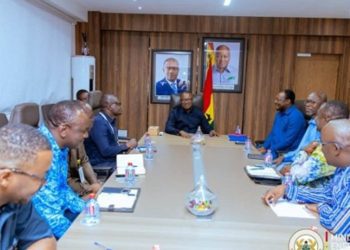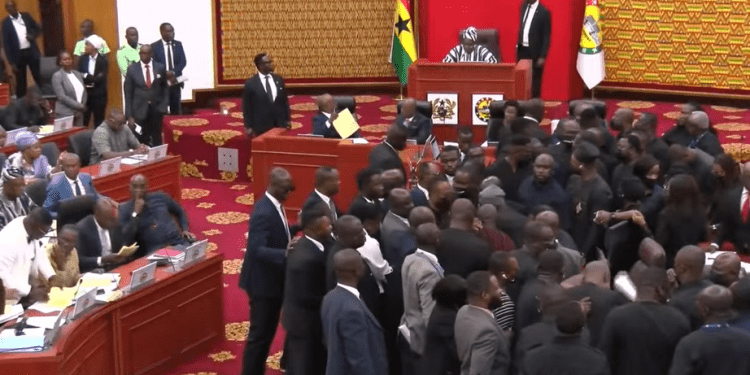
The Minority in Parliament, yesterday intensified its protest over the declaration of the Kpandai parliamentary seat as vacant, insisting that the Speaker acted unlawfully and prematurely while legal processes remain pending before the Court of Appeal and the Supreme Court.
This is despite Justice Manuel Bart-Plange Brew’s order for a rerun of the Kpandai parliamentary election, after ruling that the scale and nature of the irregularities uncovered in the pink sheets made it impossible to isolate the problems to only the contested polling stations.
The disturbance erupted during heated exchanges on the matter, with the Minority arguing that Justice Brew’s ruling was being misrepresented and improperly enforced. The NPP Minority caucus maintains that the court’s findings on the “irregularities” should be fully accepted and allowed to run their course through the judicial process, rather than being used as the basis for declaring the seat vacant.
Justice Brew had stated that evidence presented by both Mathew Nyindam of the NPP and the NDC candidate, Daniel Nsala Wakpal, showed numerical inconsistencies, conflicting tallies, illegible figures, unexplained cancellations and discrepancies between the EC’s pink sheets and the petitioner’s copies, irregularities he said “went to the roots of the results”.
The judgment has been criticised by the NPP, with the Minority in Parliament questioning how a petition concerning 41 polling stations resulted in an order for a rerun across all 150 polling stations.
However, the Judge, in his written judgment, noted that even within the 41 pink sheets tendered in evidence, several entries showed significant mismatches. One pink sheet recorded 1,422 votes in a column that did not correspond with any related figures, while in other instances the EC’s version of the results differed markedly from those held by the petitioner.
Before the confrontation, Majority Leader Mahama Ayariga dismissed what he described as the Minority’s “continuous and orchestrated protest”, adding that he was not surprised by what he viewed as attempts to obstruct parliamentary business.
The Bawku Central MP accused the Minority of deliberately derailing parliamentary work over the contested Kpandai seat, arguing that the caucus had resorted to noise-making and unruly behaviour to prevent the Speaker from delivering rulings.
However, Minority Chief Whip Frank Annoh-Dompreh countered sharply, warning that government business would “continue to suffer” until the Kpandai matter is resolved.
Moments after his remarks, tensions escalated. Despite the Speaker’s attempts to proceed, Minority MPs intensified their protest, rising from their seats, marching into the middle of the chamber and chanting in opposition. The sudden movement triggered a chaotic confrontation, with MPs from both sides surging towards the centre of the floor.
Parliament nevertheless approved reports on allocations from the 2026 Budget, despite the scenes of disorder. The Majority succeeded in adopting the report moments after tensions peaked, with Minority MPs abandoning their seats and massing in the centre of the floor in a chant-filled protest that briefly sparked a scuffle.
The uproar forced parliamentary marshals to intervene as MPs from both sides shouted over one another, drowning out proceedings and temporarily stalling the House. Despite the chaos, the Majority pressed ahead with the adoption of the budget allocation report, a key step in the approval process for the 2026 fiscal policy.
The Minority maintained that until the Kpandai issue is resolved, they will continue to obstruct government business. They insist the Speaker acted prematurely by directing communication to the Electoral Commission regarding the seat, while appeals remain active before the higher courts.
Following the contentious approval, the Speaker adjourned the House, bringing an end to a dramatic sitting marked by accusations, protests, and fierce exchanges between the two sides.
After the sitting, First Deputy Minority Whip Habib Iddrisu described the manner in which the reports were approved as “shameful”.
According to him, no government business was legitimately conducted from the Minority’s perspective. The Tolon MP added that when the House resumes today, Wednesday, the caucus will “advise itself” on the way forward.
In his judgment, Justice Brew stressed that if such errors could arise in the 41 sheets scrutinised in court, the court had “no way of knowing” the extent of similar irregularities in the remaining 111 polling stations whose pink sheets were not tendered in evidence.
He further pointed to the destruction, loss or unavailability of certain electoral materials, including BVD machines and original collation documents, which made cross-verification impossible.
At Kpalung Primary School, for example, the EC’s pink sheet recorded 261 votes in a slot where the petitioner’s version listed 325.
The Judge criticised what he described as the Electoral Commission’s “tainted” copies, marred by “interpolations, deepened ink, cancellations” and handwriting irregularities that rendered the records unreliable.
The court also highlighted procedural concerns during collation, including the relocation of the collation centre to Tamale without notice to the petitioner, conflicting accounts of when violence disrupted the process, and the absence of key officials during parts of the tallying.
Justice Brew wrote that while even one vote can be decisive, dismissing discrepancies running into the hundreds as “trivial” would compromise electoral justice.
He argued that “scientific arithmetic leaves no room for such fundamental mistakes”, especially from a constitutionally mandated body like the EC.
“The pink sheet recordings raise substantial questions as to what has happened,” he said, adding that the court could not “whitewash” the inconsistencies or assume the remaining unexamined stations were free of similar problems.
He concluded that because the errors were potentially widespread and the court could not rely on incomplete or inconsistent documentation, the only lawful remedy was a full rerun in every polling station in the Kpandai constituency.
Meanwhile, former Kpandai MP Mathew Nyindam has filed an application at the Supreme Court seeking to quash the Tamale High Court ruling that annulled his parliamentary election victory.
Nyindam, through his counsel Gary Nimako Marfo, argues that the High Court erred in assuming jurisdiction over the petition filed by NDC candidate Daniel Nsala Wakpal, who challenged the 7 December 2024 parliamentary election results.
The petition, filed on 25 January 2025, was submitted 32 days after the results were gazetted on 24 December 2024, exceeding the 21-day statutory limit under Section 18 of the Representation of the People Law, 1992 (P.N.D.C.L. 284).
Nyindam contends that the delay rendered Wakpal’s petition invalid and that the High Court had no authority to entertain it.
“The Parliamentary Election Petition filed by the 1st Interested Party on 25th January 2025… was invalid and could not have properly invoked the jurisdiction of the High Court,” Nyindam’s affidavit submitted to the Supreme Court states.
The High Court ruling, delivered on 24 November 2025, annulled the entire Kpandai election and ordered a rerun within 30 days. Nyindam is now seeking a judicial review in the nature of certiorari to quash the judgment and all related proceedings arising from the allegedly invalid petition.
The Supreme Court is expected to hear the matter on Tuesday, 16 December 2025.
His legal team argues that the case raises a fundamental jurisdictional issue, asserting that allowing the High Court’s decision to stand would undermine the administration of justice and the statutory limits governing election petitions.
The December 2024 Kpandai parliamentary election saw Nyindam, representing the New Patriotic Party (NPP), declared the winner with 27,947 votes (53.47%) against Wakpal of the National Democratic Congress (NDC), who polled 24,213 votes (46.33%).
Source: theheraldghana.com