A In a major effort to overhaulGovernment Disburses Over GH¢65 Billion for Public Sector Salaries, Debt Service, and Key Social Infrastructure
The Government of Ghana has disbursed over GH¢65 billion in the first six months of 2026 to cover public sector compensation, honor debt obligations, and fund critical social and infrastructure projects. Among the primary expenditures are GH¢48.8 billion allocated for public sector worker compensation, GH¢10 billion paid to domestic bondholders, and $700 million deployed for Eurobond debt servicing.
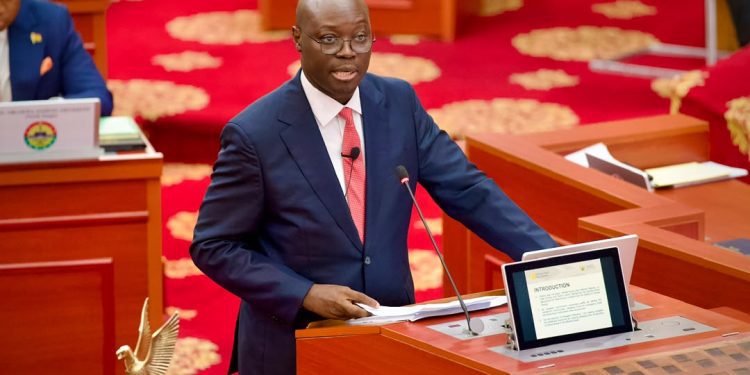
Presenting the Mid-Year Fiscal Policy Review of the 2026 Budget in Parliament on Thursday, July 23, 2026, the Minister for Finance, Dr. Cassiel Ato Forson, outlined the government’s spending performance. Dr. Ato Forson stressed that presenting these figures was part of the administration’s commitment to transparency, accountability, and the disciplined execution of approved budget line items.
A significant portion of state expenditure went toward public sector compensation, where GH¢48.8 billion was paid out to employees. This total includes key statutory allocations, notably GH¢4 billion in contributions to Tier-1 social security and GH¢2 billion directed toward Tier-2 pension schemes.
Addressing debt servicing and financial sector stability, Ato Forson revealed that GH¢2.5 billion was spent on domestic interest payments, alongside $700 million allocated to cover Eurobond principal and interest obligations. To bolster domestic market confidence following recent economic restructuring, the government also released GH¢10 billion to domestic bondholders.
On local governance and social protection, the Finance Minister reported that GH¢4.4 billion was released to the District Assemblies Common Fund (DACF) to cover the first two quarters of the year, accelerating fiscal decentralization. Additionally, GH¢4.5 billion was injected into the National Health Insurance Scheme (NHIS) to ensure uninterrupted healthcare delivery across the country.
Further detailed breakdowns presented to the House highlighted extensive releases for human capital and infrastructure development, totaling over GH¢10.7 billion. Education received substantial backing, with GH¢4.2 billion disbursed to the Ghana Education Trust Fund (GETFund) and GH¢1.8 billion allocated to support the Free Senior High School program.
To address national infrastructure and youth employment, the government disbursed GH¢1.7 billion to the Road Maintenance Trust Fund and GH¢459 million to the Youth Employment Agency (YEA). Meanwhile, the energy sector received targeted support through a GH¢961 million release to the Ghana National Petroleum Corporation (GNPC) to sustain critical operations
Eugenia Ewoenam Osei
Ghana’s cocoa sector, the Minister for Finance, Dr. Cassiel Ato Forson, has announced that the government will introduce a Ghana Cocoa Board Bill to Parliament. The proposed legislation seeks to repeal and replace the decades-old Ghana Cocoa Board Act, 1984 (PNDC Law 81), bringing sweeping governance and financial reforms to the country’s cocoa industry.
Presenting the 2026 Mid-Year Budget Review to Parliament, Dr. Forson explained that the comprehensive legal framework is designed to restore financial sustainability, maximize returns for local producers, and aggressively expand domestic processing capacity.
Central to the proposed legislation is a direct economic boost for local growers, as the Bill guarantees cocoa farmers a minimum of 70% of the gross Free on Board (FOB) price. To support this payout structure, the law will establish a dynamic producer pricing mechanism designed to continuously align farmgate prices with international market trends, exchange rate fluctuations, and prevailing economic conditions.
In a strong push toward domestic industrialization, the Bill also mandates that at least 50% of Ghana’s raw cocoa beans must be processed locally before export. This requirement aims to retain higher economic value within the country rather than relying heavily on raw bean exports.
Furthermore, the legislation introduces a modernized financing model for the Ghana Cocoa Board (COCOBOD) while explicitly prohibiting the institution from engaging in quasi-fiscal activities. This measure is intended to curb off-budget expenditures, enforce strict fiscal discipline, and rebuild COCOBOD into a transparent, financially viable institution.
Dr. Forson emphasized that these structural changes are essential for securing the long-term future of the industry, reassuring Parliament that the reforms will safeguard farmer livelihoods while positioning the cocoa sector as a resilient engine of national economic growth.
Story By: Eugenia Ewoenam Osei