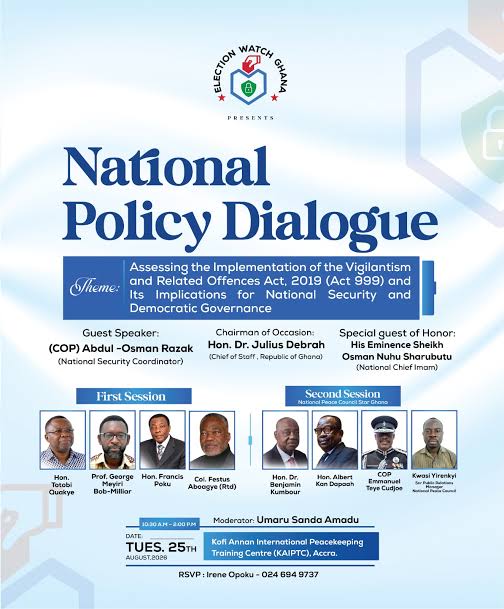
Security Officers, legal practitioners, civil society leaders, and political stakeholders convened today, August 25, 2026, at the Kofi Annan International Peacekeeping Training Centre (KAIPTC) for a National Policy Dialogue evaluating seven years of enforcing the Vigilantism and Related Offences Act, 2019 (Act 999).
Organized by non-partisan advocacy body Election Watch Ghana under the theme “Assessing the Implementation of the Vigilantism and Related Offences Act, 2019 (Act 999) and Its Implications for National Security and Democratic Governance,” the event addressed systemic enforcement bottlenecks, political impunity, and evolving threats to democratic stability ahead of future electoral cycles.
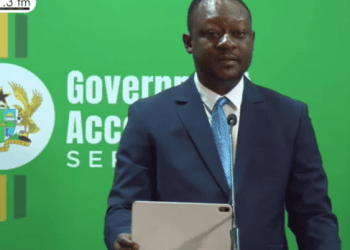
Delivering the Guest Address, National Security Coordinator COP Abdul-Osman Razak warned against treating the reduced public presence of armed political groups as evidence of their eradication. He cautioned that violent political elements are changing tactics to evade law enforcement.
”We must not mistake reduced visibility of these groups as complete eradication,” Razak stated. “We are very much aware that some groups are rebranding as internal security teams, volunteer task forces, or community security initiatives. Again, mobilization has moved online on social media, encrypted chats, local disputes, private security arrangements, or other informal channels”.
Opening the dialogue, Executive Director of Election Watch Ghana, Rose Osteen, raised concerns regarding the consistency, impartiality, and overall enforcement of Act 999. She warned that perceptions of selective prosecution for political actors risk entrenching impunity and weakening public trust in state security and judicial bodies.
Panelists and security analysts highlighted that while open displays of named vigilante groups in uniform have decreased, prosecutions under Act 999 remain sparse and legal processes delayed. To preserve the law’s statutory deterrence, speakers called for uniform, non-partisan enforcement coupled with adaptive intelligence operations to address digital recruitment.
To address these emerging threats, the National Security Secretariat outlined a strategic pre-electoral security model. The Secretariat urged state authorities to launch intelligence mapping 12 to 18 months prior to elections, initiate youth civic engagements 9 to 12 months out, and enforce active monitoring of political mobilization at least 6 months before polling.
The policy dialogue was chaired by Chief of Staff Dr. Julius Debrah, with the National Chief Imam, His Eminence Sheikh Osman Nuhu Sharubutu, in attendance as Special Guest of Honour.
The proceedings featured two high-level panel sessions moderated by broadcast journalist Umaru Sanda Amadu, bringing together insights from former security ministers, security analysts, Star-Ghana, and the National Peace Council.
Story By: Eugenia Ewoenam Osei