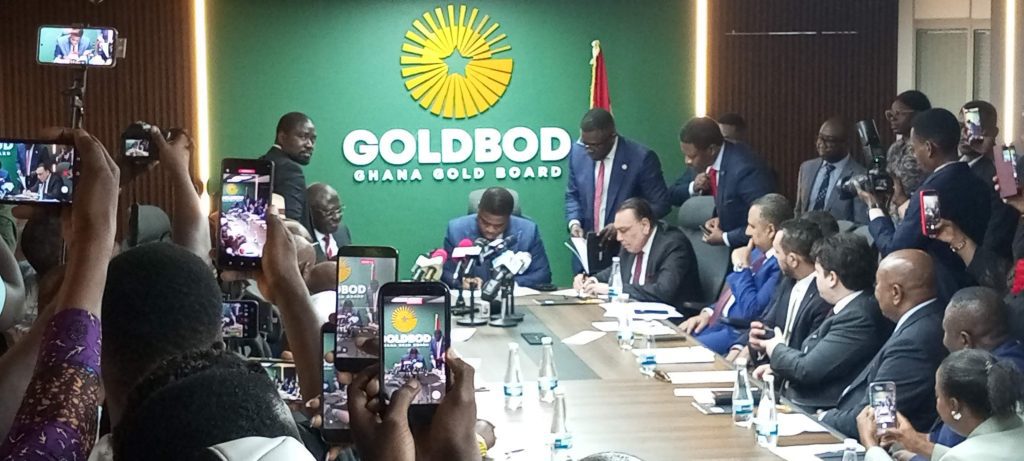
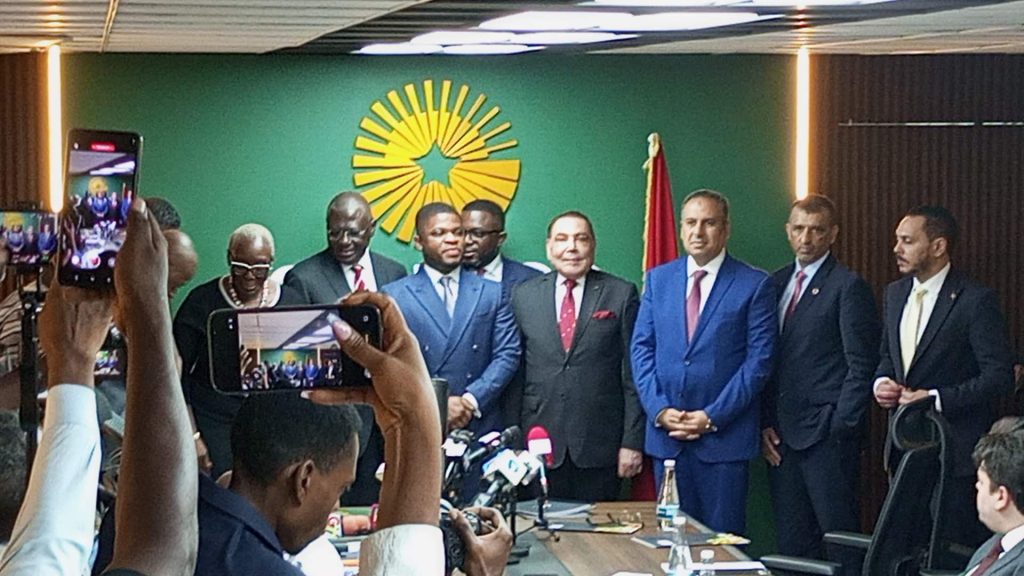
Chief Executive Officer of the Ghana Gold Board (GoldBod), Sammy Gyamfi, Esq., says Ghana is taking a decisive step to shift from exporting gold in its raw state to full value optimisation and local refining, following a landmark agreement with Gold Coast Refinery, supported by Rand Refinery, Africa’s only LBMA-accredited refinery.
Speaking ahead of the signing ceremony, Mr Gyamfi described the moment as “a great day,” announcing that the agreement “will change the phase of the management of our gold resources, particularly in relation to value addition.”
He traced the deal to presidential directives issued when he was appointed to head the then Precious Minerals Marketing Company (PMMC), now GoldBod, saying the President’s instructions were “very clear” — to “move Ghana away from destruction to full value optimization, true value addition.”
Mr Gyamfi said a visit by GoldBod officials to Gold Coast Refinery on April 9, 2025, exposed a troubling national contradiction. Ghana hosts what he described as “the largest gold refinery in the sub-region,” yet it was “being underutilized and was operating far below its operational capacity.”
“The state of affairs that I witnessed firsthand was very troubling,” he told the gathering, explaining that GoldBod reported the situation to the President and began engagements aimed at getting the facility back to full production.
He questioned why Ghana continued to export almost all its gold in raw form despite owning strategic infrastructure capable of refining gold locally.
“It didn’t make sense to us as government that we will have such critical assets in our country, and yet 99.9% of all the gold we export out of our country were exported in its raw form,” he said, referencing both small-scale and large-scale gold exports.
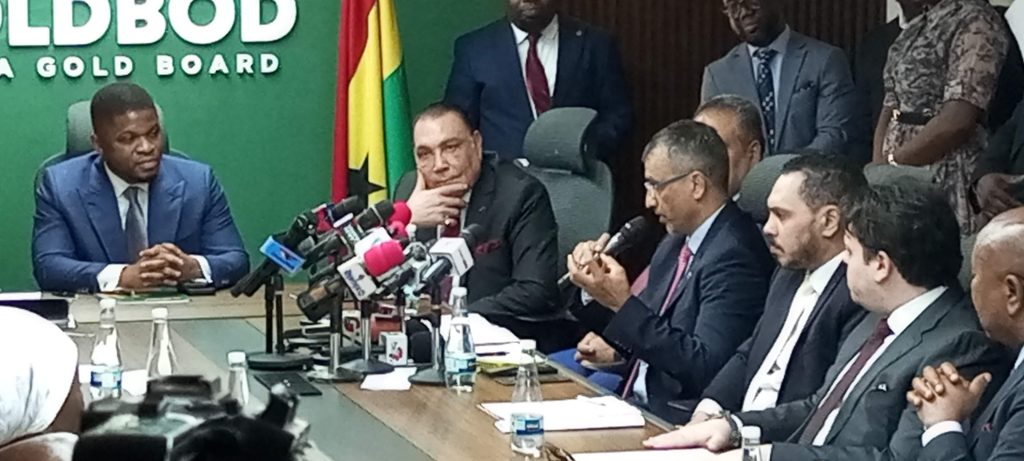
Under the agreement, GoldBod will deliver up to one metric tonne (1,000 kilograms) of gold every week for refining locally.
“This agreement is going to ensure that up to one metric ton of gold will be refined here in Ghana at Gold Coast Refinery every single week,” Mr Gyamfi announced.
He said the process will begin effective February 1, 2026, with a plan to scale up gradually to achieve “total local refining of all the gold we export out of the country.”
Mr Gyamfi also disclosed that Gold Coast Refinery has agreed to operate 24/7, aligning with the government’s 24-hour economy agenda, which he said would create “more direct and indirect jobs.”
A key highlight of the agreement, Mr Gyamfi noted, is the collaboration with Rand Refinery, which he described as “the only LBMA accredited refinery in the whole of Africa.” He said Rand’s involvement is expected to strengthen both technical and management capacity at Gold Coast Refinery and support Ghana’s ambition to secure “an LBMA-accredited refinery here in Ghana.”
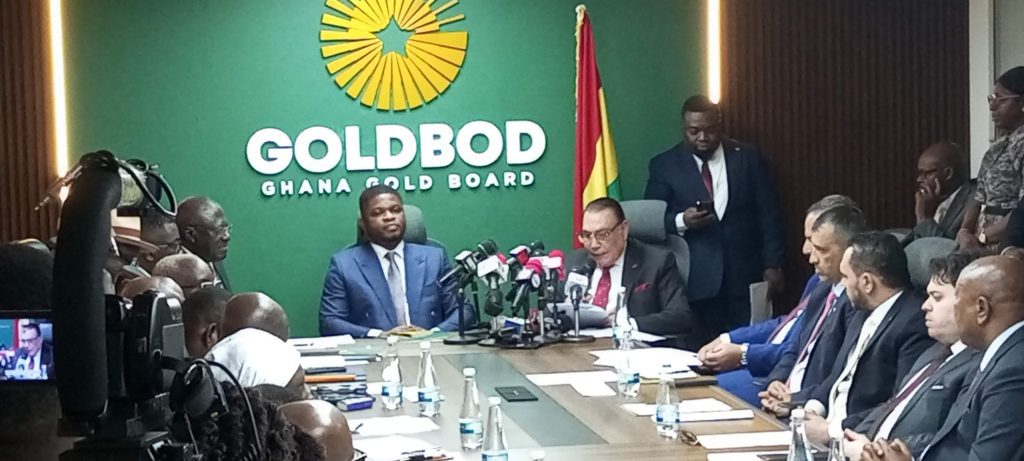
“The coming on board of Rand Refinery signals one thing: that we are interested to refining our gold in a sustainable manner that promotes traceability,” he said, adding that the process will ensure gold refined under the scheme is “responsibly mined and responsibly sourced, in line with the OECD and LBMA guidelines.”
He pointed to GoldBod’s soon-to-be-launched “track and trace system,” which he said will make verification “very, very easy.”
Mr Gyamfi argued that refining locally will address longstanding losses linked to export valuation and assay limitations.
“One of the challenges that has plagued our nation is purity losses and the undervaluation of gold exports,” he said, adding that Ghana currently lacks the capacity to independently determine the “true value” of its gold because it relies largely on XRF testing.
“XRF assay cannot accurately determine the value of gold,” he said, noting that Ghana often depends on foreign refineries to refine the gold, determine purity, and then “come and tell us that your gold purity is X, Y, and that this is the value.”
According to him, the new agreement will change that system because Gold Coast Refinery will conduct fire assay, which he described as “the golden standard of assay,” both before and after refining, enabling Ghana to determine the “accurate purity and value of our gold.”
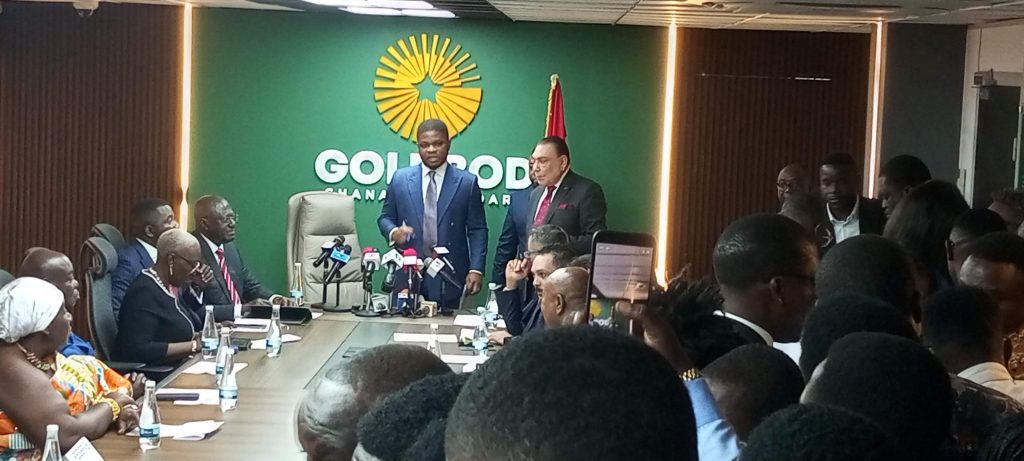
He also raised concerns about discrepancies between purity levels recorded locally and those recorded abroad, saying “most often than not, the purity figure is always lower than what we record here,” leading to “millions and millions of Ghana cedis” in losses, a situation he said will become “a thing of the past.”
Mr Gyamfi further announced that refined gold bars exported under the deal will carry a hallmark featuring the emblems of Gold Coast Refinery, GoldBod, the Ghana Standards Authority, and the Bank of Ghana, describing it as “very, very refreshing.”
In addition, he revealed that the Republic of Ghana has secured a 15% free carried interest in Gold Coast Refinery, held by GoldBod on behalf of the state.
“Gold Coast Refinery has been gracious enough to give the Republic of Ghana a free carried interest of 15% and the Ghana Gold Board is proud to hold that for and on behalf of the Republic of Ghana,” he said.
He explained that the state is “leading by example,” noting that the one tonne of gold expected weekly is gold “we buy, we own, and we control.”
Beyond ASM gold, the GoldBod CEO signalled a push to include large-scale miners in Ghana’s refining drive, saying the country must end the practice where gold is refined abroad while domestic facilities struggle.
“We must start from somewhere and not continue to refine their gold in refineries in Europe while refineries in Ghana continue to suffer,” he said, stressing: “Excuses from our big brothers in the large-scale sector must stop.”
Mr Gyamfi said the benefits are “numerous,” pointing to savings from refinery charges currently paid to foreign destinations.
“The millions of dollars we pay as refining charges to refineries in Dubai, India, Switzerland, Hong Kong will now stay in our banking sector,” he said. “That money will now stay in our economy.”
He added that the agreement will generate “higher tax revenue for the people of Ghana,” and could produce dividends for the state due to its 15% interest.
Mr Gyamfi assured stakeholders that the agreement will not be symbolic: “This agreement will not be just ideas on paper,” he said, stressing GoldBod’s commitment to implementation: “Effective 1st February, you’ll be getting a minimum of a ton of gold every week.”
He credited the President’s vision and the support of GoldBod’s governing board for what he called a “landmark” shift in Ghana’s gold management and value addition agenda.