The Government has reaffirmed its commitment to transforming Ghana’s oil palm industry, with plans to support the establishment of 100,000 hectares of new oil palm plantations as part of efforts to boost domestic production, create jobs and reduce the country’s dependence on imported palm oil.
The Minister for Food and Agriculture, speaking at the National Oil Palm Multistakeholder Roundtable Forum in Accra on Wednesday, said the expansion programme would form part of a broader strategy to move the industry from policy commitments to measurable results.
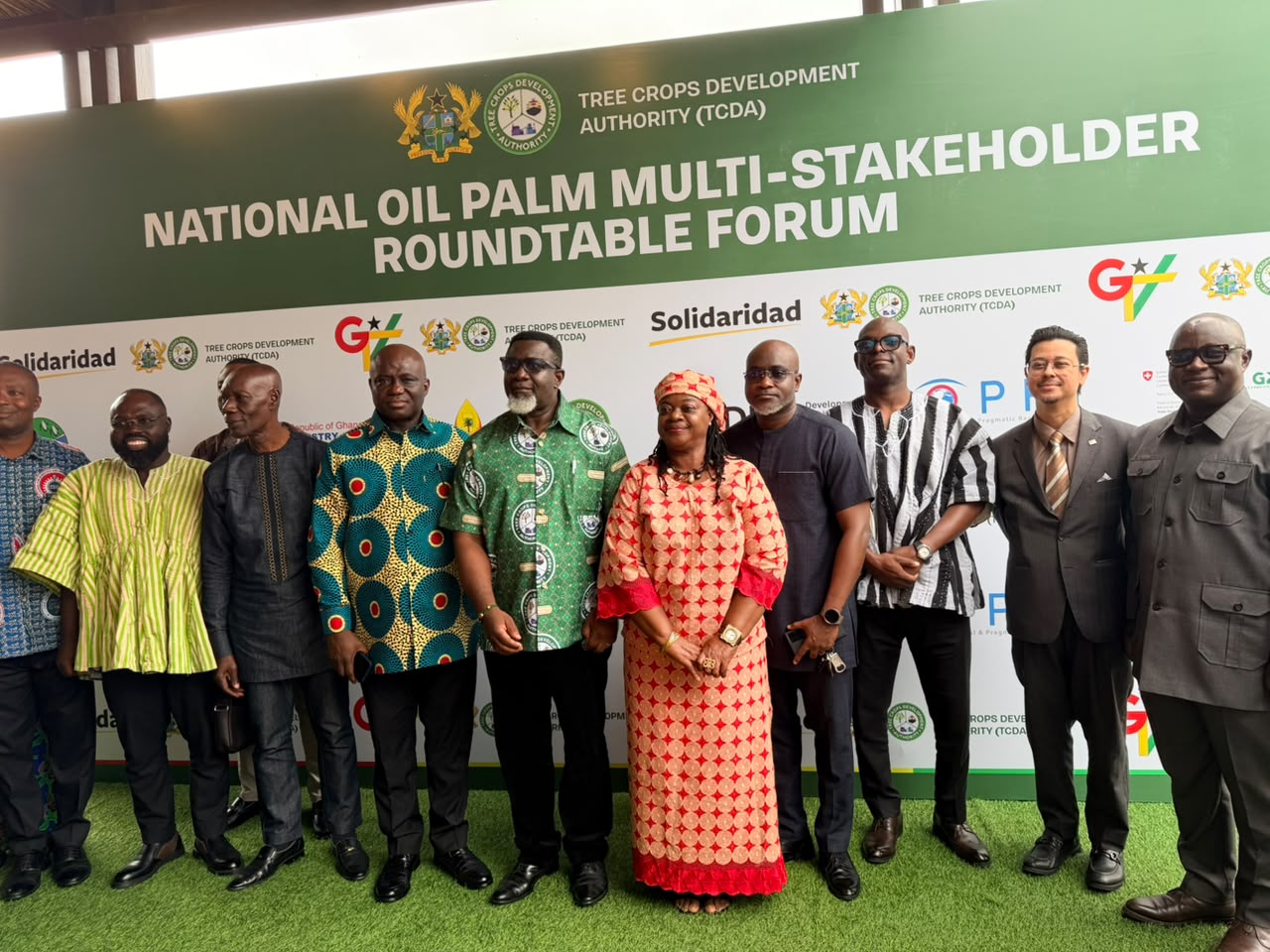
Held under the theme “From Policy to Practice: The Role of TCDA in Resetting Ghana’s Oil Palm Industry,” the forum brought together government officials, the Tree Crops Development Authority (TCDA), farmers, processors, investors, research institutions, development partners, traditional authorities and other actors across the oil palm value chain.
The Minister said Ghana had no shortage of policies and studies on agriculture, but stressed that the priority should now be implementation, coordination and accountability.
“Policy acquires value only when it changes lives,” the Minister said, stressing that the forum should produce clear commitments on responsibilities, timelines, resources and measurable targets.
Closing the production gap
According to the Minister, oil palm remains a strategic crop because of its links to both agriculture and industry. The crop supports farmers, nursery operators, transporters, processors, traders and manufacturers, while also providing opportunities for women and young people.
Beyond edible oil, palm products serve as raw materials for industries including soap and cosmetics manufacturing, pharmaceuticals, confectionery, animal feed and bioenergy.
However, Ghana continues to face a significant gap between domestic palm oil production and national demand, resulting in substantial imports.
The Minister described the deficit as more than a supply problem, saying it represents lost employment opportunities, underutilised processing capacity, reduced farmer incomes and foreign exchange that could otherwise remain in the domestic economy.
The situation, he added, also creates opportunities for smuggling and unfair competition, which undermine legitimate businesses and reduce government revenue.
TCDA to anchor industry transformation
The Minister identified the Tree Crops Development Authority, established under the Tree Crops Development Authority Act, 2019 (Act 1010), as the institutional anchor for the oil palm transformation agenda.
TCDA is expected to strengthen registration and licensing, production planning, industry data collection, traceability, quality assurance and coordination among stakeholders.
The Minister said formalisation should not be viewed by businesses as an administrative burden, but as a foundation for credibility, investor confidence, traceability and access to premium markets.
Government, he said, would support TCDA in enforcing industry standards fairly and consistently to protect compliant businesses, consumers and the reputation of Ghanaian palm oil.
Focus on productivity and smallholders
The Minister stressed that the proposed 100,000-hectare expansion should not be measured simply by acreage.
Success, he said, would depend on the quality of planting materials, farm productivity, farmer incomes, inclusion of smallholders, women and young people, secure land arrangements, environmental protection, access to finance, processing efficiency and stronger market linkages.
He called for increased access to high-yielding, climate-resilient and disease-tolerant planting materials, backed by research, certified nurseries, extension services and improved farm management.
Smallholder farmers, he said, must remain at the centre of the industry, with large-scale investment complemented by well-organised and adequately supported smallholder and outgrower schemes.
Farmers must also have access to secure markets, transparent pricing, extension services and affordable inputs, while receiving a fair share of the value generated along the chain.
Land, finance and processing
The Minister also highlighted land tenure and access to finance as major constraints to oil palm development.
Because oil palm is a long-term investment, he called for patient financing arrangements that take into account the crop’s gestation period. Financial institutions, he said, should develop suitable products for nurseries, farmers, aggregators and processors.
Traditional authorities, landowners, district assemblies and investors were urged to promote transparent land arrangements that benefit local communities while reducing potential conflicts.
The Minister further called for investments in efficient processing facilities, storage, logistics, quality control and reliable off-take arrangements.
He said Ghana should move beyond increasing production of fresh fruit bunches to developing more finished palm-based products for domestic consumption and export.
Sustainability and inclusion
Sustainability and traceability were also identified as critical to the industry’s future.
The Minister said Ghana’s oil palm expansion must avoid the destruction of forests and environmentally sensitive landscapes while improving productivity on existing plantations and bringing suitable new areas into production.
He noted that international markets increasingly demand evidence of product origin, environmental responsibility, decent labour practices and quality.
Women and young people, he added, should have deliberate opportunities across production, aggregation, processing, technology, logistics and enterprise development.
Call for coordinated action
The Minister emphasised that the transformation could not be achieved by government alone.
He called for stronger collaboration among the Ministry of Food and Agriculture, TCDA, other government institutions, research organisations, financial institutions, development partners, district assemblies, traditional authorities, farmer organisations and the private sector.
Government, he said, would focus on creating an enabling environment and providing strategic public investment, while the private sector would be expected to contribute capital, technology, innovation, efficiency and access to markets.
The Minister urged participants to ensure that partnerships translated into clear commitments, shared risks, defined responsibilities and measurable outcomes.
He said future assessments of the programme should focus on tangible results, including certified nurseries, productive farms, functioning mills, new businesses, decent jobs, increased domestic palm oil supply and reduced imports.
The Minister said Ghana had the land, climate, knowledge, entrepreneurial capacity and market opportunities required to become a leading producer and processor of sustainable palm oil.
He described the proposed industry reset as a shift from fragmented interventions to coordinated action, low productivity to higher yields, informal operations to a traceable industry, and import dependence to greater national self-reliance and export competitiveness.