
The Ghana Revenue Authority (GRA) has officially launched a National Compliance and Enforcement Team to ensure the effective implementation of the country’s new Value Added Tax (VAT) Act, marking a significant step toward strengthening tax administration and safeguarding public revenue.
Speaking at the launch, the Commissioner of the Domestic Tax Revenue Division (DTRD), Dr. Martin Kolbil Yamborigya, described the initiative as a decisive institutional reform aimed at improving compliance, enhancing fairness in the tax system, and supporting Ghana’s long-term development agenda.
According to Dr. Yamborigya, the introduction of the new VAT Act reflects government’s commitment to modernising the tax system, broadening the tax base, and promoting transparency and efficiency in domestic revenue mobilisation. He stressed, however, that legislation alone is insufficient without consistent and credible enforcement.
“Today’s event marks more than the unveiling of a new team,” he said, adding that “It represents a decisive step in our collective commitment to strengthening tax administration, improving compliance, and safeguarding public revenue.”

The National Compliance and Enforcement Team brings together officers with specialised expertise in audit, investigation, intelligence, legal enforcement, and taxpayer services. Its mandate includes promoting voluntary compliance, detecting and deterring non-compliance, and ensuring that the provisions of the VAT Act are applied consistently and professionally across all sectors of the economy.
VAT remains one of Ghana’s most important sources of domestic revenue, but challenges such as underreporting, informality, and weak enforcement have historically constrained its full potential. Strengthening enforcement mechanisms while maintaining taxpayer confidence is critical to improving fiscal sustainability and reducing revenue leakages.
Dr. Yamborigya was keen to emphasise that enforcement under the new regime is not punitive but grounded in fairness and equity.
“Enforcement is not about punishment for its own sake. When everyone pays what is due under the law, the burden is shared equitably, honest businesses are protected from unfair competition, and government is better equipped to provide essential services,” he explained.
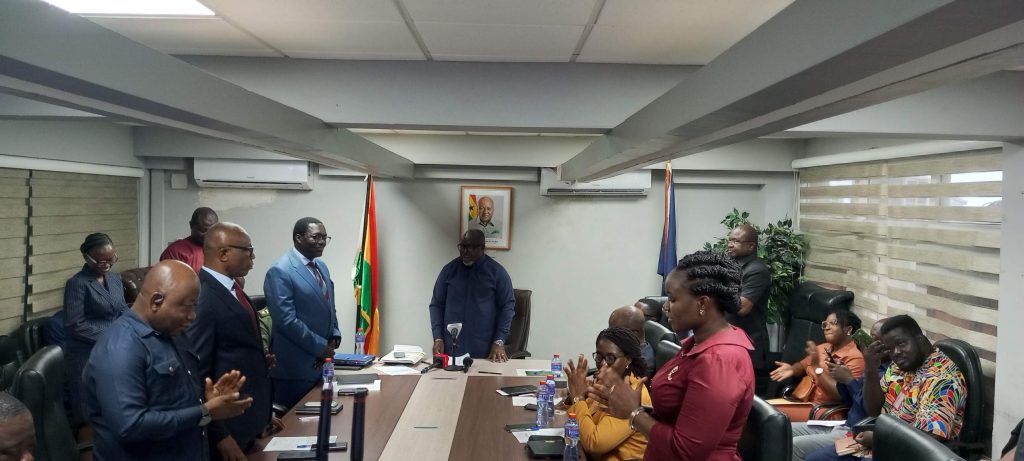
He assured the business community that the DTRD remains a partner in growth and development, noting that the VAT regime is designed to be predictable and transparent. Taxpayers, he said, are encouraged to seek guidance, engage openly with the Authority, and make use of available support channels to ensure compliance.
While the Compliance and Enforcement Team will act firmly where necessary, Dr. Yamborigya said its work will always be guided by professionalism, impartiality, and respect for taxpayers’ rights.
Turning to members of the newly inaugurated team, the Commissioner charged them to uphold the highest standards of integrity and accountability, stressing that public confidence in the VAT system would depend largely on their conduct.
“You are entrusted with upholding the integrity of the tax system,” he said, adding that the credibility of both the VAT Act and the DTRD would be measured by the standards the team upholds in carrying out its mandate.
Dr. Yamborigya added that the launch of the National Compliance and Enforcement Team sends a strong national signal, that compliance is not optional, the rule of law will be upheld, and Ghana’s VAT system will be implemented in a manner that supports economic stability, sustainable development, and shared responsibility.