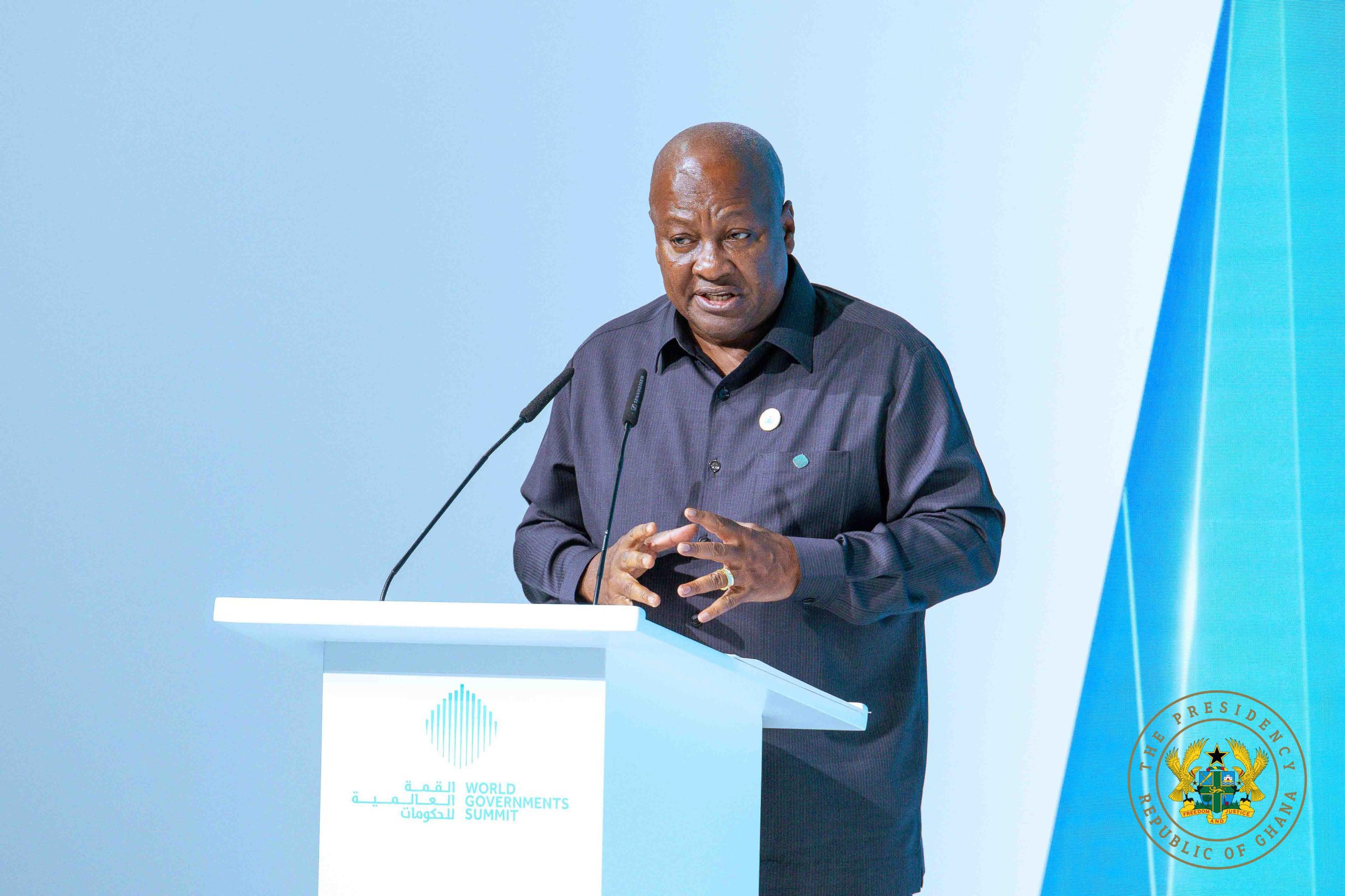
President John Dramani Mahama has called for a fundamental reimagining of global alliances, urging world leaders to move beyond outdated geopolitical blocs and rivalries toward partnerships grounded in solidarity, shared responsibility, and collective progress.
Speaking at the World Governments Summit 2026 in Dubai, President Mahama told an audience of heads of state, leaders of international organisations, and policymakers that the world is at a pivotal moment shaped by rapid transformation, geopolitical realignments, and deep global interconnectedness.
According to him, the key challenge confronting the international community is no longer whether alliances will endure, but whether they can evolve quickly enough to address today’s complex and interlinked global threats.
President Mahama observed that traditional alliances were largely forged in response to military confrontations, ideological divisions, and economic competition.
However, he argued that such frameworks are inadequate in an era defined by climate change, food and energy insecurity, terrorism, global health threats, fragile supply chains, technological disruption, and widening inequality.
“These challenges do not respect borders and cannot be solved by unilateral action,” he stressed, adding that cooperation has become not merely an option, but an imperative.
Africa at the Centre of a New Global Order
A central theme of the President’s address was Africa’s growing strategic importance in shaping the future global order.
He rejected narratives that portray the continent as merely a theatre for geopolitical competition, instead positioning Africa as a continent of solutions, opportunity, and rising influence.
With the world’s youngest population, vast natural resources, expanding innovation ecosystems, and a market of more than 1.3 billion people, President Mahama said Africa will be decisive in shaping the global economy of the 21st century.
Consequently, he argued, future global alliances cannot be meaningfully designed without Africa’s full participation.
He emphasized that Africa is open to partnerships not only for trade, but for transformation—alliances that build industries, strengthen supply chains, and generate shared prosperity.
In this regard, he highlighted the Accra Reset initiative, convened across Accra, New York, and Davos, as a roadmap for transitioning Africa from aid dependence to trade-driven and investment-led global partnerships.
At the same time, President Mahama acknowledged that Africa must also reset internally, stressing the importance of accountable governance, transparency, strong institutions, respect for human rights, and selfless leadership as the foundations of credible and sustainable partnerships.
Ghana’s Economic Vision and Resource Sovereignty
Turning to Ghana’s domestic reforms, President Mahama outlined his administration’s commitment to ensuring that Africa’s natural resources deliver tangible economic value to its people.
He cited the establishment of the Ghana Gold Board (GoldBod), which he said has generated over US$10 billion in less than a year, as evidence of Ghana’s drive toward greater resource sovereignty and value addition.
Ghana’s medium- to long-term vision, he explained, is to process and add value to minerals and agricultural products including gold, manganese, bauxite, lithium, petroleum, cocoa, oil palm, cashew, cassava, fruits, and soya rather than exporting raw materials.
He also praised the strengthening Ghana–UAE and broader Africa–Gulf partnerships, describing them as an emerging pillar of the new global order and a model of mutually beneficial economic diplomacy.
Security, Stability, and Regional Cooperation
President Mahama warned that sustainable development cannot be achieved without peace, particularly in West Africa, where terrorism and instability in parts of the Sahel continue to pose serious threats.
Reaffirming Ghana’s commitment to regional peace and democratic stability through ECOWAS, he stressed that security in the sub-region is indivisible.
He disclosed that Ghana recently convened a High-Level Consultative Conference on Regional Cooperation and Security in late January 2026, bringing together heads of state and regional institutions.
The meeting, he said, resulted in renewed consensus on collective security, counter-terrorism, border cooperation, humanitarian response, and human-centred governance as the basis for lasting peace in West Africa.
Technology, Climate Justice, and Multilateralism
On emerging technologies, President Mahama highlighted the transformative impact of artificial intelligence, biotechnology, and digital systems, cautioning that governance frameworks have lagged behind innovation.
While noting Ghana’s progress in digital transformation through mobile financial services, national identification systems, and e-governance, he warned against a digital future dominated by a few privileged nations.
Future alliances, he argued, must promote ethical AI governance, cybersecurity cooperation, technology transfer, and inclusive digital capacity-building to prevent new forms of global inequality.
Addressing climate change, President Mahama underscored the injustice faced by Africa, which contributes the least to global emissions but bears a disproportionate share of climate impacts.
He called for climate action to be matched with climate justice, including the fulfilment of commitments on climate finance and equitable energy transitions.
He cited the US$30 million Ghana–UAE climate partnership as a practical example of forward-looking cooperation.
Renewing Multilateralism
In concluding his address, President Mahama defended multilateralism, acknowledging that the post-war, rules-based international system is under severe strain from rising unilateralism.
Nonetheless, he expressed confidence that the system can be renewed through fairness, representation, and dialogue.
He reaffirmed Ghana’s commitment to an international order based on cooperation rather than confrontation, rules rather than coercion, and shared progress rather than zero-sum rivalry.
Ultimately, he said, the future of global alliances is not defined solely by treaties and institutions, but by the kind of world nations choose to build—one where cooperation triumphs over division and countries rise together, not apart.
Story: Patrick Asford Boadu