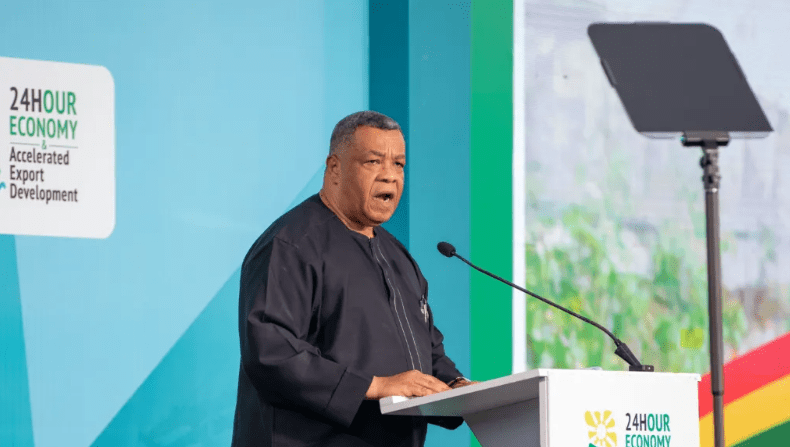
Presidential Advisor on the 24-Hour Economy, Mr. Goosie Tanoh, has delivered a strong message to Ghana’s Ministries, Departments and Agencies (MDAs), urging them to abandon siloed approaches and adopt a unified, integrated strategy to implement the 24-Hour Economy.
Addressing the Strategic Integration Workshop in Accra, Mr. Tanoh underscored the critical importance of alignment among all government agencies, describing integration as the foundation for delivering results under the President’s transformative economic policy.
“Integration is not a bureaucratic preference; it is an existential requirement. Only by working as one government with one agenda can we mobilise resources efficiently, attract investment credibly, and deliver services effectively,” he said.
He warned that disjointed operations among ministries risk derailing the 24H+ vision.
“Too often, Ministries and Agencies have operated as separate fortresses, each with its own plans, budgets, and timelines, sometimes overlapping, sometimes contradictory, and too often duplicative. That model cannot deliver transformation,” he stated.
Citing past failures, Mr. Tanoh said Ghana cannot afford to repeat mistakes where ambitious national programmes failed due to institutional fragmentation and poor coordination.
“This call for integration is not new. For decades, Ghana has launched ambitious programmes that stumbled because the machinery of government was fragmented. We cannot afford that mistake again.”
He called on participants to think beyond their individual portfolios and focus on collective impact.
“A whole-of-government approach demands that we think and act as one machine. It means aligning our sectoral programmes with a shared national agenda. It means that Transport must speak to Trade, Energy must link with Industry, and Agriculture must integrate with Finance and Infrastructure,” he posited.
Mr. Tanoh reiterated President Mahama’s position that the 24-Hour Economy is not a pilot project or experimental idea, but a national mandate that must produce measurable outcomes.
“It will be judged not by reports or speeches, but by results—jobs created, exports increased, productivity rising, and Ghanaians feeling the difference.”