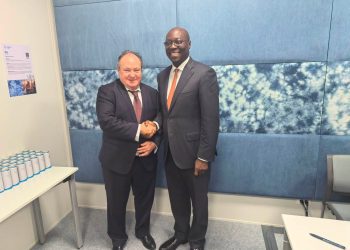
The Minister for Lands and Natural Resources, Emmanuel Armah Buah, has announced the government’s intention to introduce a sliding scale royalty mechanism for the Royal Lithium Project, replacing the current static system. The move is aimed at balancing the necessity of safeguarding foreign investment and jobs against the national imperative to maximize returns during commodity price surges.
Addressing a press conference following weeks of intense national discourse involving traditional leaders, the Mankesim community, and civil society organizations, Armah Buah acknowledged the public’s voices demanding transparency and maximal national benefit from the asset.
The Minister clarified the historical ambiguity surrounding the current royalty regime for mining operations, including lithium. He stated that the applicable royalty rate for mining operations, including lithium, as stated by law, is technically five percent.
He explained that while the law was amended to specify the royalty rate would be “applicable by law,” the required legislative instrument (LI) to guide that application was never put in place.
To permanently resolve this regulatory gap, the Minister confirmed that the government has collaborated with the Attorney General and will soon send a new, comprehensive legislative instrument to Parliament. This instrument is expected to provide a clear guideline on royalties for all minerals, not just lithium, addressing the limitations of static rates observed during previous commodity booms, such as when gold prices soared.
He linked the urgency of reform directly to the current global market volatility, noting that a recent downturn in global lithium prices has stalled similar projects worldwide, and the Royal Lithium Project is no exception.
The Minister revealed that the Central Region House of Chiefs, Members of Parliament, and other key stakeholders had previously petitioned His Excellency the President to ensure the project does not stall, emphasizing its critical importance for job creation and the local economy.
In response, according to the Minister, the government is proposing the lawful sliding scale royalty mechanism. He explained the dual benefit of this structure, the scale will ensure a competitive base royalty during periods of low prices, which is essential for maintaining the project’s viability and preventing investment flight, as Ghana competes globally for mining capital; concurrently, the mechanism will automatically increase the royalty rate when lithium prices exceed an agreed-upon threshold, ensuring the nation secures a greater share of the value during market upswings.
Armah Buah assured the public that the government’s proposal is not a concession, but a strategic tool. He projected that at a high price point, such as $3,000 per unit, the new structure is designed to yield a royalty rate that will not only meet or exceed previous demands of 10% but potentially rise to if prices continue to climb.
Concluding his statement, the Minister gave an assurance that the government will not shortchange the people of Ghana, and that the new legislative instrument will be fully effective before the final approval of the lithium agreement, guaranteeing Ghana receives full value for its endowed resources.
Story By: Eugenia Ewoenam Osei