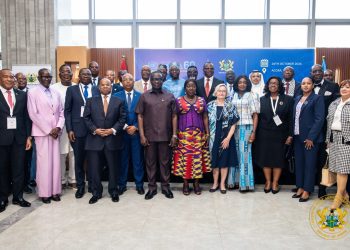
Chief of Staff Dr. Julius Debrah, speaking on behalf of President John Dramani Mahama, has called on Ghana’s legal fraternity to steer systemic legal reform toward practical, real-world outcomes for ordinary citizens and the business community.
Delivering an address at the maiden edition of the Ghana Law Society Annual Bar Conference in Accra, Dr. Debrah stated that public confidence in the judicial system relies directly on its everyday accessibility and efficiency. He observed that while a legal framework may appear elegant in theory, it ultimately fails if justice remains delayed, overly expensive, or out of reach for average Ghanaians.
Addressing the leadership and members of the newly formed Ghana Law Society, Dr. Debrah acknowledged the historic contributions of the Ghana Bar Association while welcoming the emergence of additional professional spaces for legal scholarship, policy debate, and mentorship.
He cautioned, however, that professional legal bodies must guard against political capture and partisan conflict, emphasizing that credibility for both new and established institutions is earned through consistent conduct and impartial service to the public.
Highlighting the administration’s broader national agenda, the Chief of Staff linked comprehensive legal reform directly to economic strategy and investment growth. He noted that commercial enterprise, agricultural investment, and technological innovation require swift contract enforcement, clear land tenure, and predictable regulatory frameworks governing emerging sectors such as digital assets and artificial intelligence.
Julius Debrah pointed to several recent legislative and administrative milestones, including the Legal Education Act 2026, the Community Service Act 2026, the Tribunal Act 2026, and the Judiciary’s ongoing expansion of virtual hearings and digital case management systems.
To build on these measures, he outlined five priority areas for the conference to address, beginning with expanding access to justice through strengthened legal aid, court-connected alternative dispute resolution, small claims procedures, and improved accommodations for non-English speakers and persons with disabilities.
He further highlighted the need for commercial and regulatory certainty to support a competitive 24-hour economy, as well as strict constitutional discipline in public finance and statutory fund allocation, referencing the Supreme Court’s landmark ruling in Kpodo and Kwashie v. Attorney-General.
Rounding out the priorities, Dr. Debrah stressed criminal justice reform through the execution of non-custodial options under the Community Service Act 2026, and called for a future-ready legal profession equipped to navigate complex legal frontiers like cybersecurity, data protection, and climate risk.
In closing, he urged the Ghana Law Society to move beyond broad post-conference communiqués by submitting actionable policy proposals with draft clauses and cost estimates directly to the Office of the President and the Attorney General.
He emphasized that the true measure of legal reform occurs at police stations, local courts, and regulatory offices, where improved everyday encounters build lasting public confidence in the Republic.
Eugenia Ewoenam Osei