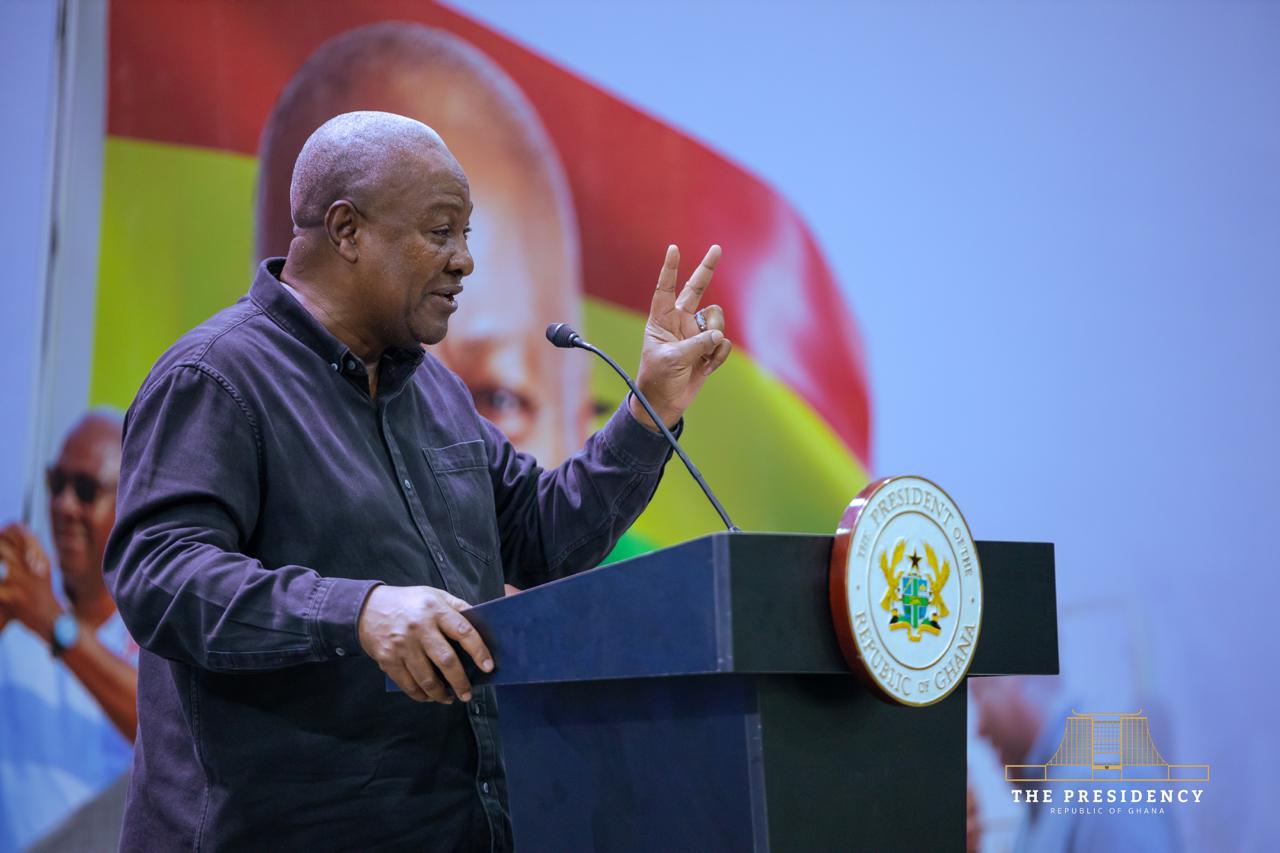
President John Dramani Mahama has announced plans for a US$10 billion investment in seven strategic sectors of Ghana’s economy over the next four years, with agriculture and agro-processing expected to receive half of the investment.
Speaking at a Resetting Ghana Community Engagement in the Upper East Region, President Mahama said the government’s economic stabilisation programme had created the foundation for a new phase focused on growth, job creation and expanded opportunities for young people
“Now that we have completed the stabilisation of the economy, our next focus is on creating jobs and opportunities for our young people. We have finished stabilisation and are now looking at growth and job creation. That is our next target.”
According to the President, the proposed New Economy policy will involve an annual investment of US$2.5 billion across seven key sectors for the next four years.
He said agriculture and agro-processing would be the largest beneficiary, receiving 50 per cent of the total US$10 billion investment.
“Five billion dollars will therefore go into agriculture and agro-processing, and I can assure you that the Upper East Region will receive its fair share of that five billion dollars.”
President Mahama said the investment would support irrigation development and create opportunities for young people to engage in agricultural production throughout the year.
Upper East Airport
The President also disclosed that the proposed Upper East Regional Airport at Sumburungu, near Bolgatanga, is currently undergoing procurement for the selection of a contractor.
He said the airport would significantly improve connectivity between the Upper East Region and Accra while stimulating economic activity.
“The airport will allow direct flights from Accra to Sumburungu, which is close to Bolgatanga, and will enhance economic activity within the region.”
President Mahama said the journey between Bolgatanga and Accra, which currently takes about 11 hours by road, could be reduced to approximately one hour and five minutes by air.
He added that the runway would be long enough to accommodate both turboprop aircraft and jets operating on domestic routes.
“Anytime I come to visit you, I will fly straight to Sumburungu, and from there we will be here in about 50 minutes.”
E-Blocks and new secondary schools
On education, President Mahama said the government would complete 30 abandoned E-Blocks initiated during his previous administration.
He explained that E-Blocks located in rural communities would be converted into boarding schools, complete with boys’ and girls’ hostels and dining halls, while those in densely populated urban areas would remain community day schools.
The government, he added, would construct another 30 E-Blocks under the STAR-J Project, targeting districts without secondary schools and high-population-density areas.
“Aside from that, we are also building 16 completely new secondary schools across the country, and the Upper East Region has also been targeted for some of these new schools.”
Major road projects
President Mahama said significant progress was also being made on road projects under the government’s Big Push programme, including the Chichuliga-Nakum and Chichuliga-Sandema roads.
He expressed confidence that the Bolgatanga-Wa route would be substantially improved by the end of next year.
“By the end of next year, we should be able to drive from Bolgatanga to Wa in complete comfort, without dust or potholes. It will be a first-class road and will solve the problem of commuting between Wa and Bolgatanga.”
He said the government was also working to reconnect the corridor through Sandema, Kumbisi, Daboya and Busunu, creating an alternative route for travellers between the Upper East and southern parts of the country.
Free Primary Healthcare
The President highlighted the newly launched Free Primary Healthcare programme, describing it as a key intervention towards achieving universal health coverage.
He said nearly 40 per cent of Ghanaians were not enrolled on the National Health Insurance Scheme when his government assumed office, making it necessary to introduce additional interventions.
“If you are a Ghanaian citizen, you are entitled to free healthcare. If you go to any CHPS compound, you simply identify yourself as a Ghanaian and you will receive free healthcare. Nobody will charge you.”
President Mahama said the programme would strengthen preventive healthcare by deploying nurses to visit households and monitor the health of residents.
He said particular attention would be given to pregnant women to help reduce maternal mortality.
“This will help us with preventive healthcare and also reduce maternal mortality because part of the nurses’ responsibility will be not only to conduct medical screening but also to check on pregnant women.”
He said an antenatal book would be introduced to help healthcare workers track pregnant women’s antenatal visits and ensure that they receive the required care.
The programme would also provide opportunities for routine health screening, including checks for blood pressure and blood sugar.
Agriculture and tomato production
President Mahama said the Upper East Region had enormous potential to become a major agricultural and agro-processing hub.
He cited the government’s Tomato Revitalisation Project, which is expected to bring about 2,500 acres under tomato production.
He said the Pwalugu Tomato Factory would serve as the centre of the initiative after rehabilitation.
“We are going to rehabilitate the Pwalugu Tomato Factory so that we can process the tomatoes produced in the Upper East Region to feed the rest of the country.”
The President also announced plans to complete the rehabilitation of the Tono irrigation facility, which covers about 850 acres.
He said the project would support dry-season farming, particularly onion production, and help reduce Ghana’s dependence on imported onions from Niger.
“If we put enough land under irrigation, we should be able to substitute those imports and produce our own onions.”
Constitutional reforms
On governance, President Mahama said a Constitutional Review Implementation Committee would soon be inaugurated to harmonise the government’s position with proposals contained in the Constitutional Review Commission’s reports.
He said the proposals would be divided into non-entrenched and entrenched provisions.
While non-entrenched provisions would require parliamentary approval, entrenched provisions would require a referendum.
“We therefore want to add the referendum to the District Assembly elections next year.”
He said voters would consequently vote for their Assembly Members and also participate in the referendum on the proposed constitutional amendments.
Improved security in Upper East
President Mahama commended the Inspector-General of Police and security personnel for what he described as significant improvements in security across the Upper East Region.
He said incidents of motorbike snatching, armed robbery and other crimes had reduced considerably.
“As the Regional Minister said, the Upper East Region is safer now than it was before.”
GH¢1bn Bawku Revitalisation Fund
A major announcement at the engagement was President Mahama’s commitment of GH¢1 billion for the Bawku Revitalisation Fund.
He welcomed the relative calm in Bawku and expressed hope that sustained peace would enable the town to regain its position as a major commercial centre.
“Bawku is finally calm. The guns have stopped sounding, and people are beginning to go about their normal business.”
The President noted that insecurity had previously forced teachers, health professionals and other public servants to leave the area, while National Service personnel and doctors could not be posted there.
He said the government would devote a significant portion of the revitalisation funds to roads and healthcare.
“We want to improve the road network and bridges in the Bawku area so that traders and farmers can move their goods and services easily. We will also improve healthcare in the area.”
President Mahama said the government would complete one of the Agenda 111 hospitals in the area and construct a new hospital in Bawku township.
He also disclosed that work had already begun on some township roads, health facilities and other projects ahead of the formal inauguration of the Bawku Revitalisation Committee.
The President said the government’s broader agenda was to build on the gains from economic stabilisation by investing in productive sectors, infrastructure, healthcare, education and job creation.
“We will continue to be very prudent in the management of the economy so that it can create opportunities for our people.”
Story: Patrick Asford Boadu