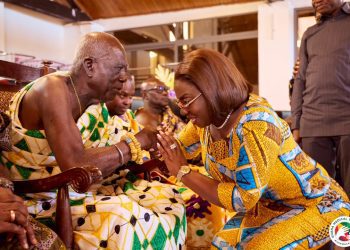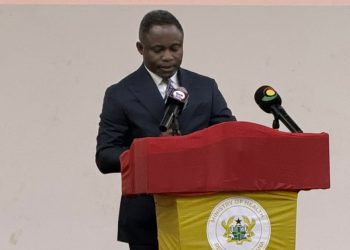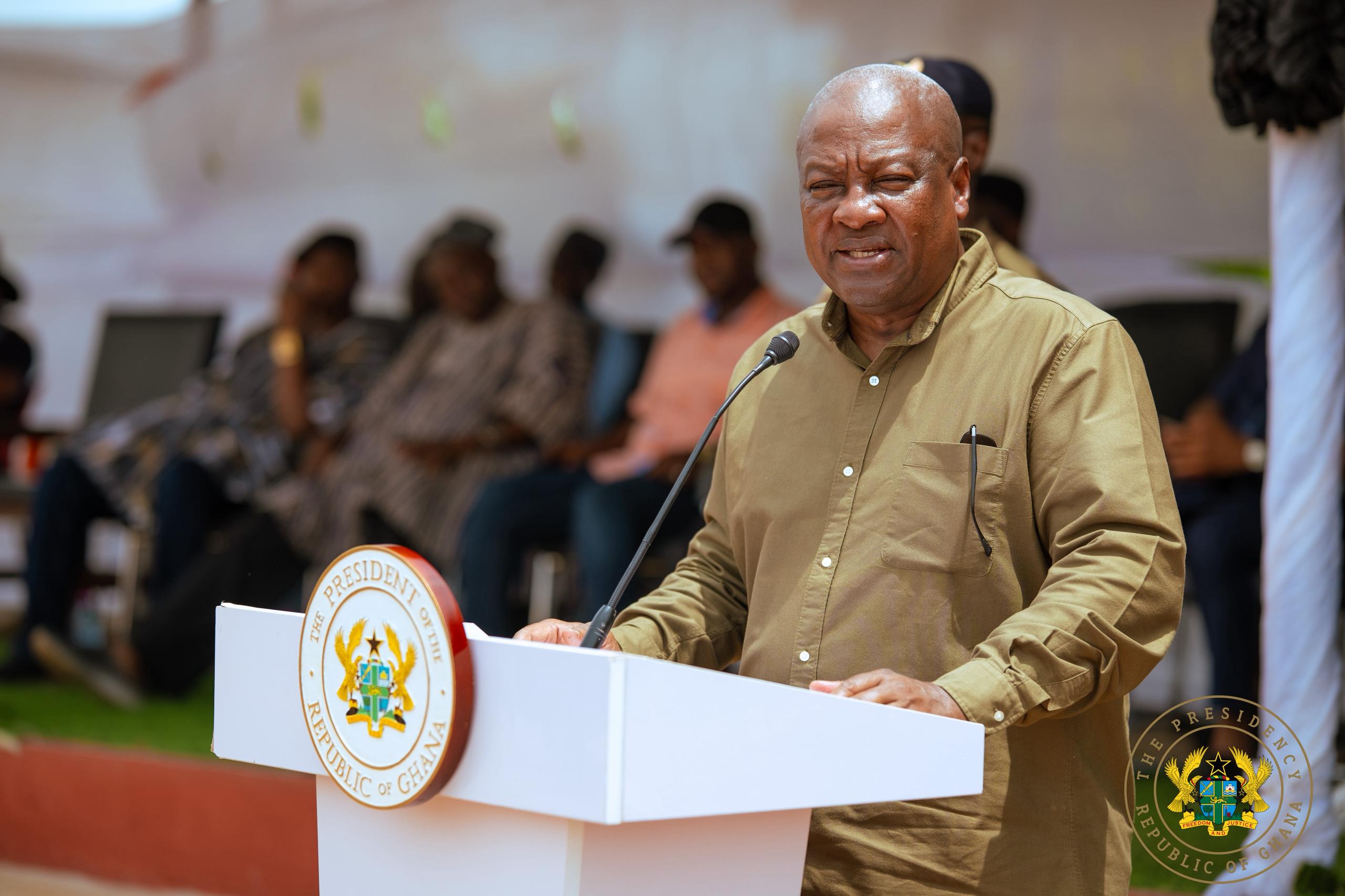
President John Dramani Mahama has cut sod for the construction of a major 24-hour economy market at Kukuo in the Tamale Metropolitan Area, as part of his ongoing #ResettingGhana tour of the Northern Region.
The ceremony followed earlier activities in Bimbila, where the President also launched a similar market project and inspected infrastructure developments, including a hostel at the Bimbila College of Education and sections of the Tamale Outer Ring Road.
Addressing residents, President Mahama described the Tamale project as one of the largest models under the 24-hour economy initiative, noting its strategic importance to urban commerce.
“I did not believe that in Tamale we would be able to get land as large as this three and a half acres for this market. I thank the traditional authorities and all those who made this possible,” he said.
He explained that the 24-hour economy programme goes beyond markets, positioning them as hubs to drive continuous economic activity and link farmers directly to consumers.
“The markets are only one component of a much bigger 24-hour economy concept. They will serve as the link between the farmers and households, ensuring that produce is sold and consumed efficiently,” he stated.
Modern Market with Extensive Facilities
The Tamale market will operate around the clock and include a wide range of facilities designed to support traders and customers at all hours.
These include a police station, fire service post, clinic with admission capacity, pharmacy, banking services, and administrative offices.
The facility will also feature 71 lockable shops, 132 open sheds, and space for about 160 traders on open pavements. Additional infrastructure includes warehouses, a lorry terminal, commercial transport stations, a meat shop with cold storage, and a crèche for children.
“There will be a market manager, environmental officers, and an information centre to ensure smooth operations. This market is designed to function efficiently day and night,” the President said.
Other amenities will include restaurants, guest rooms, sanitation facilities, solar-powered backup systems, a biodigester for waste treatment, and a structured waste management system.
Boosting Agriculture and Addressing Food Gluts
President Mahama acknowledged concerns from farmers about overproduction and falling prices, particularly for maize and rice.
He announced that government has increased funding for buffer stock operations to GH¢200 million this year to purchase excess produce from farmers.
“We will buy the surplus maize and rice, store it, and supply it to schools, hospitals, prisons, and other institutions,” he said.
He further revealed plans to expand agro-processing, including new rice mills and five maize processing factories to absorb excess production and create export opportunities.
“There is an export market for processed maize. We will process it locally and bring foreign exchange into Ghana,” he added.
Infrastructure and Water Supply Commitments
On infrastructure, the President highlighted the importance of the Tamale Outer Ring Road, which is expected to ease congestion by diverting through-traffic away from the city centre.
He also addressed the long-standing water challenges in Tamale, announcing that government will self-finance a €277 million water project after external financing fell through.
“I am a citizen of Tamale. If I don’t solve this water problem, nobody will come and do it. We are committed to fixing it,” he assured.
The project is expected to deliver 30 million gallons of water daily, alongside interim upgrades to existing pumping systems.
Healthcare and Economic Outlook
President Mahama disclosed that a new catheterization laboratory (Cath Lab) has been procured for the Tamale Teaching Hospital to improve treatment for heart-related conditions.
On the economy, he expressed confidence in Ghana’s resilience, citing an increase in foreign reserves and government interventions to stabilize fuel prices.
“Our economy is resilient. Despite global tensions, we have managed to maintain stability and even reduce petroleum prices,” he said.
He added that Ghana is nearing the end of its programme with the International Monetary Fund (IMF), but emphasized the need to maintain fiscal discipline beyond the programme.
“We must continue to manage our finances prudently to invest in the priorities of our people,” he noted.
The Tamale 24-hour market is expected to become a major commercial hub, boosting trade, supporting farmers, and strengthening the broader 24-hour economy agenda in the Northern Region.
Story: Patrick Asford Boadu