President John Dramani Mahama says education remains central to his government’s “reset agenda,” insisting that Ghana’s future depends on building an empowered, knowledgeable, and skilled population.
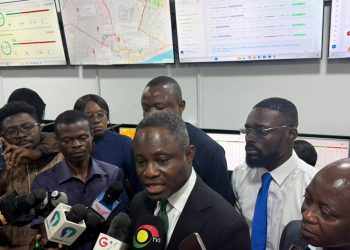
Speaking at a media encounter at the Jubilee House, the President outlined sweeping reforms aimed at making education more accessible, equitable, and forward-looking.
“The education sector remains central to our reset agenda, as we firmly believe that the future of our country hinges on an empowered, knowledgeable, and skilled population,” Mahama said.
No-Fee Stress Policy and Student Loan Plus
The President highlighted the introduction of the No-Fee Stress Policy, which refunds admission fees for first-year students in public tertiary institutions. Since its launch three months ago, over 120,000 students have benefited.
“It signaled a decisive break from the painful era when dreams of brilliant but vulnerable young Ghanaians were cut short simply because they could not afford fees at the critical period of admission,” Mahama explained.
He added that the policy is linked to the broader Student Loan Plus Policy, designed to provide flexible financing options for students from low-income households throughout their studies.
“Under this policy, no student will be left behind.
They will complete their tertiary education without the burden of unbearable debt or financial uncertainty,” he assured.
Inclusion and Special Initiatives
Mahama announced that the Free Tertiary Education Policy for Persons with Disabilities had commenced, “removing a key barrier to higher learning” and affirming education as a right for all.
On gender equity, he revealed that over six million sanitary pads had been distributed to girls in primary and secondary schools.
“This intervention is to keep our girl children in school and end period poverty,” he said.
Research, Innovation, and Scholarships
To drive a knowledge-based economy, the government has set up the Ghana National Research Fund with an initial allocation of ₵50 million.
“For far too long, much of our research has been funded by foreign institutions, with intellectual property often owned abroad. With this fund, Ghana will own the knowledge and innovations of its intellectuals,” Mahama noted.
The fund is complemented by full scholarships for five PhD candidates annually in every university across the country.
“By investing in our thinkers, we are investing in our future and asserting our intellectual sovereignty,” he added.
Free SHS and Basic Education
Responding to criticisms prior to the 2024 elections, Mahama clarified that the Free SHS policy has not only been maintained but strengthened. His government has allocated a record ₵3.5 billion to sustain it.
To ensure quality, he announced the decentralization of the feeding policy, allowing schools to manage their own feeding arrangements to provide nutritious meals for students.
At the basic level, the sector has received its highest budget allocation in almost a decade, including ₵564.6 million for textbooks.
“We are determined to rebuild the educational ladder from the ground up,” Mahama said. “Access without quality is inadequate, and we are fixing long-standing challenges caused by years of reduced funding.”