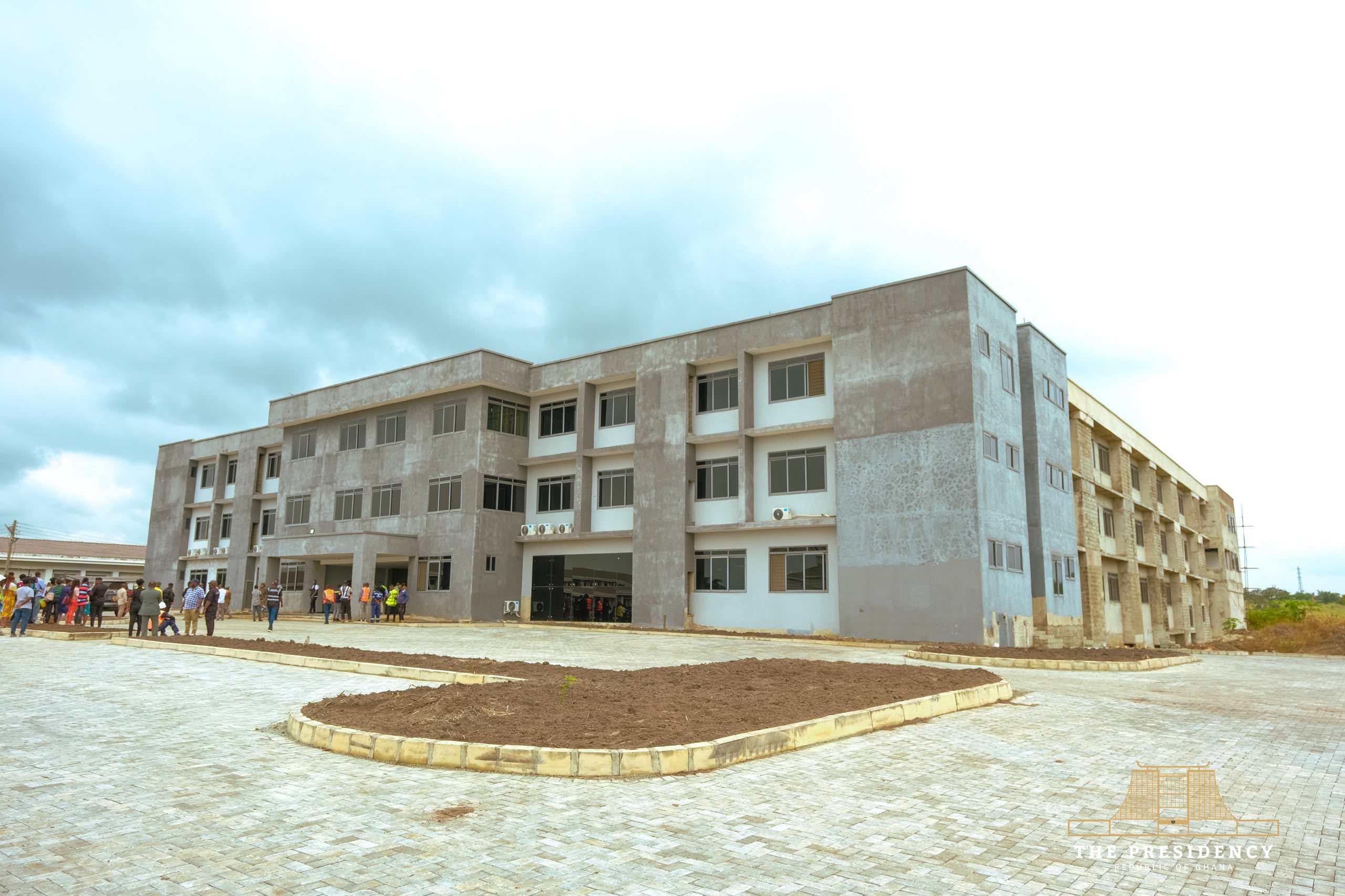
President John Dramani Mahama has reaffirmed his government’s commitment to transforming the University of Health and Allied Sciences (UHAS) into a leading centre for health research and innovation in Africa following an inspection of the university’s newly completed laboratory complex during his two-day Resetting Ghana Tour of the Volta Region.
Addressing university management, staff and students, President Mahama described the completion of the project as a significant milestone, while expressing disappointment over the lengthy delay that saw the facility take 12 years to complete.
“I do not really know where to start because this is a project that began in 2014, and we are now in 2026. That means this project has taken 12 years to complete. Ideally, it should have been completed within the original timeframe. Unfortunately, the delays have increased the overall cost of the project. But as they say, better late than never,” the President stated.
President Mahama said government envisions UHAS becoming a centre of excellence in health sciences education, research and innovation, capable of developing solutions to Ghana’s and Africa’s public health challenges.
He noted that modern research infrastructure is central to achieving that vision and described the newly completed laboratory complex as one of the largest and most advanced in the sub-region.
“Universities require strong research infrastructure, and laboratories are at the heart of that vision. I am pleased that UHAS now has what is probably the biggest laboratory complex in the sub-region,” he said.
The President highlighted the facility’s specialised laboratory for pathogen research and vaccine development, explaining that it would work closely with the National Vaccine Institute to strengthen Ghana’s capacity in disease surveillance, biomedical research and vaccine development.
“This laboratory will work closely with the National Vaccine Institute and will contribute greatly to Ghana’s ability to conduct research into diseases, develop vaccines and strengthen our health security,” he noted.
Reflecting on the country’s scientific progress, President Mahama recalled that vaccine trials in the Volta Region once faced public resistance but said Ghana has now reached a stage where it is investing heavily in advanced research infrastructure capable of supporting the development of life-saving vaccines.
“It was through such research efforts that vaccines, including the Ebola vaccine, were eventually developed, and I am pleased that UHAS is taking up this important responsibility,” he added.
Beyond the laboratory complex, President Mahama acknowledged concerns raised by the university regarding inadequate student accommodation, lecture halls and library facilities.
He explained that government has already restructured the Ghana Education Trust Fund (GETFund) to prioritise critical infrastructure projects in tertiary institutions.
“We have readjusted the GETFund arrangements to focus more on priority projects and critical needs within our educational institutions. We have also uncapped GETFund to allow more resources to flow into education infrastructure development,” he announced.
According to the President, UHAS will receive sustained annual support to address its infrastructure deficits, expressing confidence that many of the university’s outstanding needs will be met over the next four to five years.
President Mahama said the long-term objective is to fulfil the vision of the university’s founder, the late President Professor John Evans Atta Mills, who established UHAS to become a world-class institution dedicated to health sciences education and research.
“Our goal is to see UHAS rise to the level envisioned by its founder, Professor John Evans Atta Mills. We want him to rest well knowing that the university he envisioned has become one of the best not only in Ghana but across the African continent,” he stated.
The President also announced plans to improve road infrastructure within the university, revealing that government is currently assessing the campus road network while work continues on the nearby bypass project.
He indicated that government would explore extending the existing road construction contract to include the university’s internal roads in order to improve accessibility across the campus.
“Our objective is to ensure that UHAS has the infrastructure required to support teaching, research, innovation and the overall development of a world-class university,” President Mahama concluded.
Story: Patrick Asford Boadu