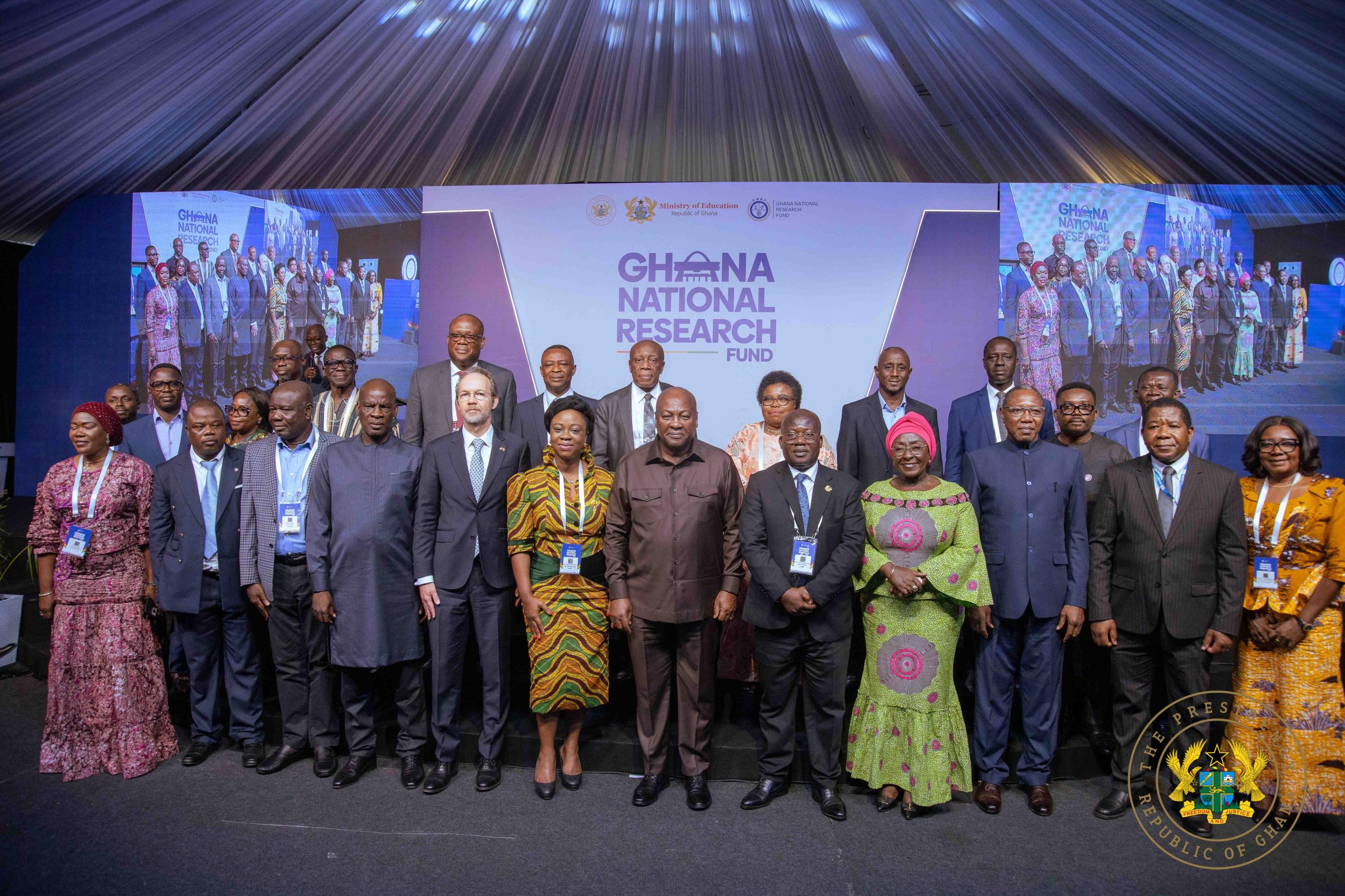
President John Dramani Mahama has launched the Ghana National Research Fund (GNRF), describing research and innovation as critical drivers of Ghana’s economic transformation, competitiveness, and long-term development.
Speaking at the launch ceremony, President Mahama emphasized that research could no longer be viewed as a peripheral activity but rather as a central pillar of national development.
“Research is no longer a peripheral activity. It might become one of the engines that drive our economic growth, our social progress, and our national competitiveness,” he stated.
The President traced Ghana’s commitment to scientific research and innovation to the vision of Ghana’s first President, Kwame Nkrumah, who believed that national development required the generation of homegrown knowledge, technologies, and solutions.
According to him, Nkrumah understood that countries seeking industrialization could not depend indefinitely on imported expertise and innovations but had to build their own capacity for research and development.
President Mahama also paid tribute to former President John Evans Atta Mills, describing the establishment of the Ghana National Research Fund as the realization of a vision he championed during his tenure.
“The Ghana National Research Fund vision was a central dream of Professor John Evans Atta Mills, and on this day, we acknowledge him and remember him, that his vision has come to fruition,” he said.
The President acknowledged the role of the previous administration led by Nana Addo Dankwa Akufo-Addo in facilitating the passage of the legislation that established the Fund.
“That architecture came in Act 1056 of 2020, and we acknowledge the previous administration of Nana Akufo-Addo for piloting it through Parliament and passing it into law,” he noted.
Research Key to Economic Transformation
President Mahama stressed that modern economies compete on ideas, innovation, and knowledge rather than solely on natural resources or capital.
He argued that every major technological breakthrough from modern medicine and telecommunications to artificial intelligence, biotechnology, renewable energy, and advanced manufacturing had been driven by deliberate investments in research and development.
“Ghana cannot aspire to industrial transformation while underinvesting in knowledge creation,” he said.
The President lamented the challenges faced by Ghanaian researchers, many of whom have relied on fragmented funding sources and external grants that often shape research priorities from outside the country.
He said the establishment of the Fund would address this structural challenge and support the government’s broader transformation agenda, including the 24-hour economy initiative, agricultural modernization, industrial expansion, healthcare improvement, digital transformation, and renewable energy development.
Focus on Problem-Solving Research
President Mahama indicated that the Fund’s mission-based framework would prioritize research in areas such as food systems transformation, agricultural resilience, health innovation, biosecurity, digital and industrial transformation, climate sustainability, governance, and data systems.
He cited practical challenges facing Ghanaian farmers, including fall armyworm infestations in maize, swollen shoot disease in cocoa, boll weevil attacks on cotton, and post-harvest losses caused by storage pests.
The President also highlighted the need to commercialize locally developed innovations, pointing to research into non-toxic organic pesticides as an example of discoveries that require support to reach farmers and industry.
“The objective is not simply to produce more research. The objective is to produce research that solves problems, informs policy, creates jobs, strengthens industries, and improves the lives of Ghanaians,” he emphasized.
Call for Increased Investment in Research
President Mahama observed that scientific sovereignty was becoming increasingly important for Africa’s development, arguing that countries dependent on imported technologies and expertise would remain vulnerable.
While noting that the African Union recommends that member states invest at least one percent of GDP in research and development, he pointed out that Ghana’s current legal framework caps funding at 0.5 percent of GDP.
“The African Union’s target of investing at least 1% of GDP in research and development must be viewed not merely as a spending target, but as a strategy for competitiveness, productivity, and ultimately sovereignty,” he said.
GH¢100 Million Allocated for Operational Launch
As part of government’s commitment to research financing, President Mahama announced an immediate allocation of GH¢100 million to support the operational launch of the Ghana National Research Fund in 2026.
“I am pleased to announce an immediate catalytic allocation of 100 million Cedis to support the operational launch of the Ghana National Research Fund for 2026,” he announced.
The funding will support competitive research grants, doctoral and postdoctoral programs, digital grants management systems, strategic innovation initiatives, and research projects aligned with national development priorities.
The President directed the Ministry of Education, the GETFund, and the Fund’s governing board to ensure transparent and accountable management of the resources.
Building on Existing Successes
President Mahama praised several research institutions for demonstrating the impact of sustained investment in scientific excellence, including the West Africa Centre for Crop Improvement (WACCI), the West Africa Centre for Cell Biology of Infectious Pathogens (WACCBIP), and the West African Genetic Medicine Centre.
He urged universities and research institutions to use the Fund to pursue ambitious solutions in food security, climate-smart agriculture, tropical disease research, artificial intelligence, and public service innovation.
“Our objective is not simply to publish more papers. Our objective is to solve more problems,” he said.
The President also called on flagship institutions such as the Council for Scientific and Industrial Research (CSIR) and the Ghana Atomic Energy Commission (GAEC) to utilize the Fund to accelerate innovation, create jobs, and support economic growth.
Commitment to Ghana’s Knowledge Economy
Concluding his address, President Mahama described the launch of the Ghana National Research Fund as a strategic investment in Ghana’s future scientists, innovators, engineers, entrepreneurs, medical researchers, and problem solvers.
“Let history record that on this day, Ghana chose to invest deliberately in knowledge creation. Let history record that we strengthened the foundations of our knowledge economy,” he declared.
He assured the Fund’s governing board, chaired by Professor Eric Yirenkyi Dankwa, and Acting Administrator Professor Abigail Opoku-Mensah of his government’s full support.
President Mahama concluded that with integrity, consistent financing, and effective utilization, the Ghana National Research Fund could become one of Ghana’s most important instruments for strengthening productivity, innovation, competitiveness, and national development for generations to come.
Story: Patrick Asford Boadu