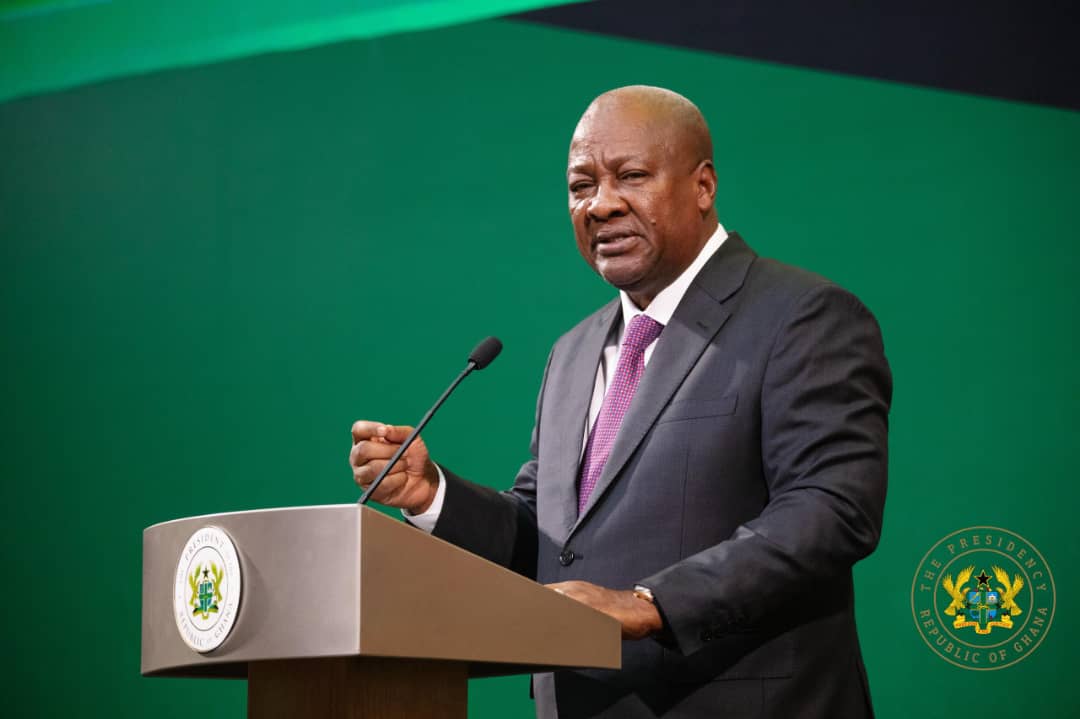
President John Dramani Mahama has urged African leaders, policymakers, and investors to take decisive action to transform the continent’s vast oil and gas resources into engines of industrial growth, job creation, and energy security.
He made the call in his keynote address at the Africa Oil Week Summit in Accra.
Mr. Mahama pointed to Africa’s paradox of abundance amid scarcity, stressing that the continent holds nearly 10 percent of the world’s proven oil reserves and significant gas deposits, yet more than 600 million Africans remain without electricity, while one billion lack clean cooking systems.
“These resources are key to achieving the African Union’s Agenda 2063 and the UN Sustainable Development Goals. We cannot allow them to become stranded assets. Africa must take ownership of its resources and its destiny,” he said.
The President underscored the role of African institutions including the African Petroleum Producers Organisation (APPO), the African Continental Free Trade Area (AfCFTA), and the emerging African Energy Bank—in mobilising capital, technology, and markets.
He called for deeper intra-African collaboration to ensure energy resources drive African development.
Ghana’s Energy Opportunities
Outlining Ghana’s energy prospects, Mahama highlighted both proven and emerging basins, including the Western Basin home to the Jubilee, TEN, and Sankofa fields as well as the Central Saltpond, Eastern Keta, and Voltaian Basin.
He announced a $2 billion investment agreement with Jubilee and TEN partners, ongoing talks with Sankofa operators, and preparations by GNPC’s subsidiary, Exploco, to drill two onshore wells by the third quarter of 2026.
“The Voltaian Basin presents one of the most exciting frontiers on the continent. This is a unique farming opportunity for investors seeking to pioneer Ghana’s onshore potential,” Mahama noted, inviting investors to engage with Ghana’s petroleum data room.
Reforms and Investor Confidence
Mahama reaffirmed Ghana’s commitment to a pro-business environment, noting that the upstream sector is “open for business.”
He revealed that the government is reviewing the Petroleum Exploration and Production Act (2016) to make it “more competitive, transparent, and investor-friendly.”
He added that three supermajors are in advanced negotiations with GNPC and the Ghana Negotiations Team, calling it a strong signal of investor confidence.
Integrated Energy Strategy
The President John Dramani Mahama also presented Ghana’s broader energy strategy, spanning upstream, midstream, and downstream initiatives.
Midstream: Ghana is renegotiating an LNG supply agreement with Shell and partners to deliver gas within 18 months, alongside investments in pipelines, processing plants, and storage facilities to cut reliance on expensive liquid fuels.
Downstream: Ghana aims to become a regional petroleum hub, anchored on a gas-to-power policy for energy reliability. Plans include expanding petrochemical capacity, mooring systems, and refineries for value addition and industrialization.
Balanced Transition
Acknowledging the global energy transition, Mahama emphasized Ghana’s determination to balance oil and gas development with renewable energy investments.
“The future of energy is a balanced transition. That is why we established the Ministry of Energy and Green Transition earlier this year, to underline our commitment to sustainability and climate action,” he explained.
Call to Action
Closing his address, President Mahama urged summit participants to move from dialogue to tangible action.
“African Oil Week must not be just a platform for ideas, it must be a platform for action.
The partnerships forged here must translate into concrete projects that end energy poverty, add value to our resources, and ensure Africa fully benefits from the wealth beneath its soil,” he declared.
Story: Patrick Asford Boadu