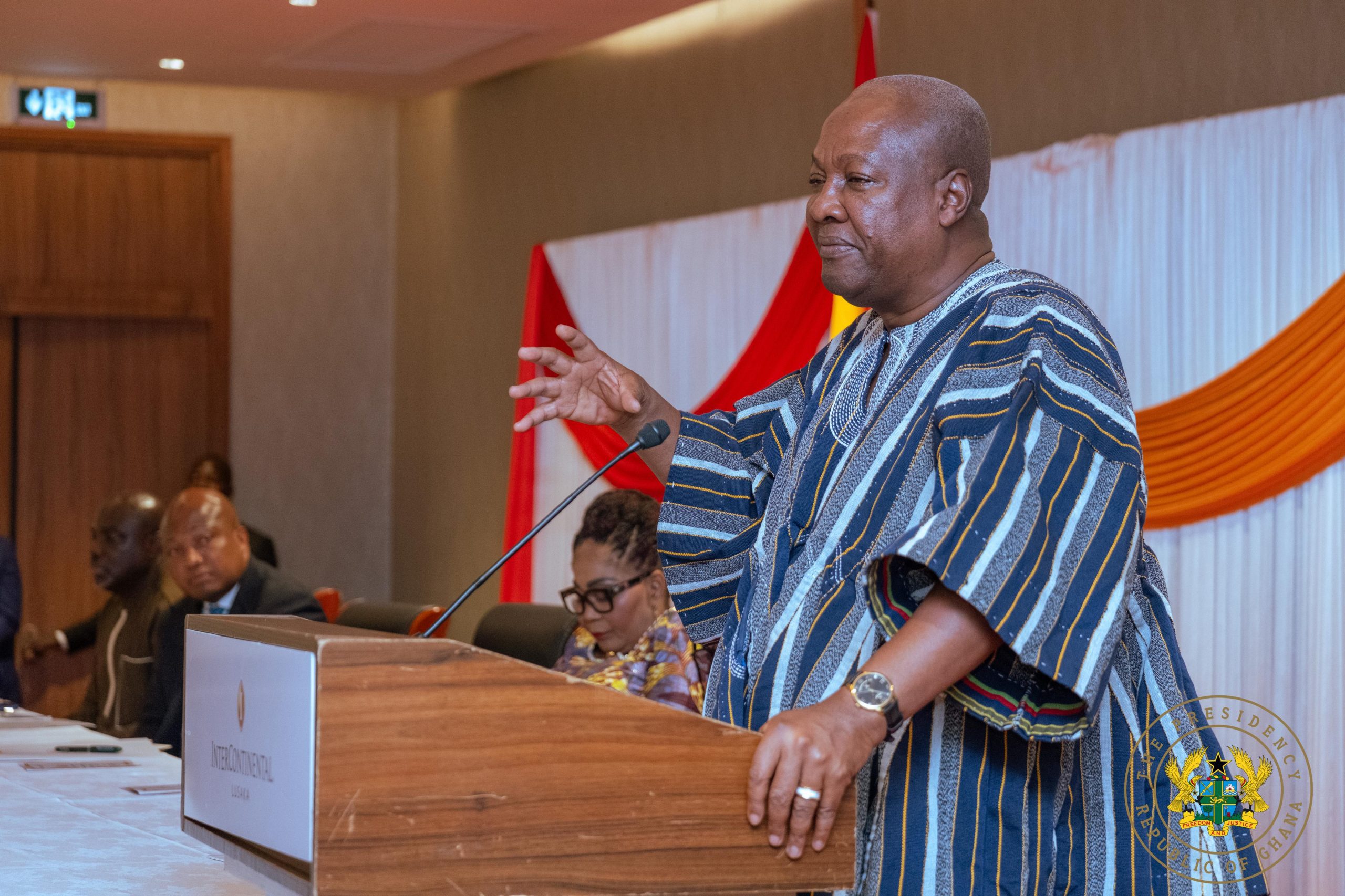
President John Dramani Mahama has announced an ambitious plan to supply two million desks to basic schools across Ghana by the close of 2026, in a move aimed at improving learning conditions and ending the practice of pupils sitting on the floor in classrooms.
The President made the pledge while addressing members of the Ghanaian community in Zambia during his three-day state visit to the Southern African nation.
He described the initiative as a critical intervention to correct years of neglect in basic school infrastructure.
“The basic school level has been neglected,” President Mahama said. “The previous government focused mainly on SHS because of their flagship Free SHS programme.
Many basic schools lack textbooks and furniture, and you often find children sitting on the floor.”
According to the President, an estimated 1.2 million pupils across the country currently attend school without desks, a situation he said undermines effective teaching and learning.
With firm resolve, President Mahama assured that his administration is determined to close the gap and prioritise foundational education.
“This year, we are going to provide two million school furnishings,” he stated. “By 2028, no Ghanaian pupil will have to sit on the floor to study.”
The announcement has been welcomed by education stakeholders, who have long advocated for improved infrastructure at the basic school level.
Kofi Asare, Executive Director of the education think tank Africa Education Watch (Eduwatch), praised the government’s renewed focus on student welfare.
“We hope that the desks will arrive soon because this is long overdue,” Mr. Asare said. “Improving furniture and learning conditions is fundamental to improving learning outcomes.”
Education analysts say the desk initiative, if fully implemented, could significantly enhance classroom environments, boost student morale, and support Ghana’s broader education reform agenda focused on equity and quality.
President Mahama reiterated that investing in basic education is essential to national development, stressing that strong foundations at the early stages of learning are key to producing a skilled and competitive workforce for the future.
Story: Patrick Asford Boadu