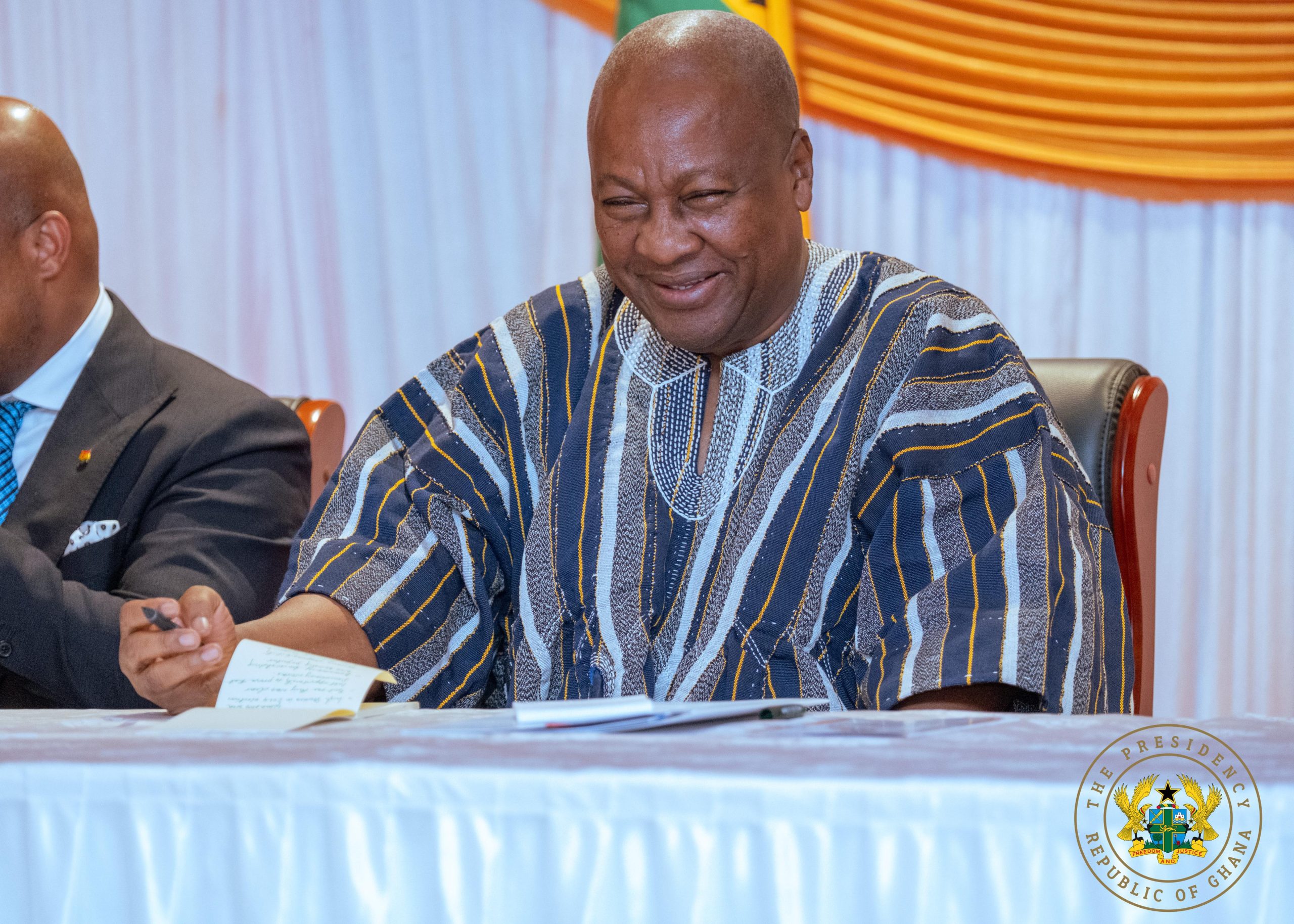
President John Dramani Mahama has called for a shift from ceremonial diplomacy to concrete economic cooperation between Ghana and Zambia, urging the private sector to anchor a new phase of bilateral relations built on trade, investment, and innovation.
Speaking at the Ghana–Zambia Business Dialogue in Lusaka, President Mahama said the ongoing state visit marked a departure from traditional engagements and signalled a deliberate focus on results.
“This state visit has not been the usual ceremonial champagne drinking, food eating, and signing of agreements,” President Mahama said. “President Hichilema and I agreed that we must go beyond the normal permanent joint commission discussions and enhance relations to the level of an enhanced economic development partnership.”
He explained that the inclusion of a business forum as a central feature of the visit underscored the importance of the private sector in sustaining bilateral relations.
“Today’s forum allows the private sector to become the anchor and underpinning of the relationship between our two countries,” he noted. “That is what truly anchors Ghana–Zambia relations.”
President Mahama reflected on the rapid transformation of the digital and communications space, recalling his early years as Minister for Communications.
“At the time, there was no convergence—video was video, voice was voice, and text was text,” he said.
“Today, a single moment can spark conversations instantly across borders.”
He cited the online reaction to his arrival in traditional attire as evidence of how digital platforms are connecting African youth in unprecedented ways.
“Ghanaians followed every single aspect of this visit from the moment I stepped out of the aircraft,” he said.
“That would not have happened years ago.”
Highlighting comparative advantages between the two countries, President Mahama praised Zambia’s progress in energy sector reforms, particularly in renewable energy and net metering.
“Zambia is a step ahead of us,” he admitted. “If you produce excess power and feed it into the grid, you get paid for it. That is a lesson we must learn from.”
He disclosed that a solar installation on his farm had generated surplus electricity worth an estimated US$70,000 over two years, though Ghana currently lacks the regulatory framework to compensate producers.
“I think the Zambian lesson would be a very good model for us,” he said, adding that Ghana’s energy ministry would be encouraged to study Zambia’s reforms.
In agriculture, President Mahama acknowledged Zambia’s strengths in seed production and commercial farming, while expressing appreciation for a personal gift from President Hakainde Hichilema.
“This is the best gift I have ever received,” he said.
“President Hichilema has given me one tonne of maize seed. I will distribute some to farmers around me and tell them it is a gift from the President of Zambia.”
The Ghanaian leader also called for a review of import substitution opportunities between the two countries.
“It will be useful to see what products on Ghana’s import list we can source from Zambia, and what Ghana can export to the Zambian market,” he said.
Turning to the power of new media, President Mahama cited the example of a foreign influencer whose visit to Ghana sparked millions of online searches about the country and its shea butter industry.
“He did more advertising for us than we could ever do ourselves,” he said, noting that digital exposure also comes with risks such as misinformation and cybercrime.
“Ghana has developed tools to track and deal with fake news that can promote ethnic hatred and instability,” he added.
“These are capabilities we can share with our brothers and sisters in Zambia.”
In his formal remarks, President Mahama expressed gratitude to President Hichilema and the people of Zambia for their hospitality, describing it as a reflection of the deep historical bonds between the two nations.
“Our friendship was forged in shared liberation struggles and strengthened by our commitment to democracy, peace, and stability,” he said.
He acknowledged that despite these ties, trade and investment between Ghana and Zambia remained below potential.
“This gap between promise and performance is both the challenge and the opportunity before us,” President Mahama said, urging African countries to leverage the African Continental Free Trade Area (AfCFTA) to build regional value chains.
“This business dialogue is not ceremonial,” he stressed. “It is a strategic platform to convert political goodwill into concrete commercial partnerships.”
Outlining Ghana’s economic recovery, President Mahama said recent reforms had stabilised the economy, reduced inflation, improved reserves, and restored investor confidence.
“We are on track to successfully conclude our IMF programme by April 2026,” he said, reaffirming Ghana’s commitment to fiscal discipline and long-term transformation.
He identified five pillars of Ghana’s development agenda, including industrialisation, export-led growth, infrastructure development, support for MSMEs, and a predictable business environment, supported by flagship initiatives such as the 24-hour economy and a US$10 billion Big Push infrastructure programme.
President Mahama pointed to opportunities for Ghana–Zambia collaboration in agriculture, mining, digital services, fintech, cybersecurity, pharmaceuticals, textiles, renewable energy, tourism, and ecotourism.
“Africa’s future will not be delivered by chance; it must be built by choice,” he said. “For too long, we have exported raw materials and imported finished goods.”
He welcomed agreements reached during the visit, including visa-free travel for citizens of both countries and bilateral air services agreements to enable direct flights.
“These will reduce transaction costs and facilitate the movement of goods, capital, and people,” he said.
President Mahama concluded with a direct appeal to the private sector.
“Government will provide the enabling environment, but it is the private sector that must build the factories, take the risks, and create the jobs,” he said.
“Let our cooperation be measured not by communiqués, but by thriving enterprises and improved livelihoods.”
He expressed optimism that the dialogue would mark the beginning of a new chapter in Ghana–Zambia relations, “defined by action, ambition, and shared prosperity.”
Story: Patrick Asford Boadu