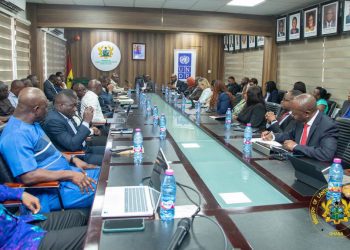
President John Dramani Mahama has welcomed the return of Mercy Ships to Ghana, describing the humanitarian mission as a powerful demonstration of “mercy and humanism” at a time when the world is becoming increasingly self-focused.
Speaking during an inspection and tour of the Global Mercy, the hospital ship operated by Mercy Ships, President Mahama said he had initially underestimated the complexity involved in bringing the vessel to Ghana.
“I did not know how complex it was to get a ship like this in,” President Mahama said.
He explained that several conditions had to be met before the ship could arrive, commending Dame Anne and other stakeholders for their persistence in overcoming the challenges.
“When I met Dame Anne last year and they said the ship was scheduled to come, there were many conditions precedent that we had to work on and there were times she hit a brick wall, but I can tell you that Dame Anne never gives up. She will push that wall down,” he said.
President Mahama also acknowledged the contributions of the Minister of Health, Kwabena Mintah Akandoh, Finance Minister Dr Cassiel Ato Forson and the broader team that worked to facilitate the mission.
He said his tour of the hospital ship had given him an opportunity to witness the impact of the free specialist surgeries being provided to Ghanaian patients.
“I have seen children and I mean just a smile on their faces after the life-changing surgeries they have had. I mean it is enough to melt the most wicked heart, and to look at the mothers and the gratitude they have on their faces,” he said.
The President said he was particularly moved by the transformation of children undergoing orthopaedic procedures.
He recalled seeing photographs of some children before surgery and said the procedures could significantly improve their confidence and quality of life.
“You can imagine that child going back. He has been the butt of jokes of his friends because he has got curved legs or clubfoot or something like that, and when he leaves this ship and goes back, he is going to be on that football field with his friends playing like any ordinary child,” President Mahama said.
“Just imagine the confidence that it gives him back to learn, study, play and recognise his full potential.”
President Mahama described Mercy Ships as an important example of humanitarian service and international solidarity.
“In this world where countries are becoming more selfish, people are becoming more selfish, it is about us,” he said.
“Countries are beginning to become unilateral, people are tired of giving to charity and all that. Mercy Ships remains a floating vessel of what it is, mercy and humanism.”
He expressed gratitude to Mercy Ships on behalf of Ghanaian patients who would benefit from the current mission.
“On behalf of all the Ghanaian patients you are going to see between now and at the end of 10 months when this mission is over, I want to express our gratitude to Mercy Ships,” he said.
President Mahama noted that the organisation had previously served Ghana on four occasions dating back to 1991, delivering more than 2,600 surgeries and 16,700 dental procedures, while supporting the development of 139 Ghanaian health professionals.
He said the current mission presented another opportunity to provide specialist treatment for patients who had waited for care, including those requiring operations for cataracts, cleft lips and palates, tumours and childhood orthopaedic conditions.
“A patient who needs surgery should not have to give up because the treatment is too far away or beyond their family’s means,” President Mahama said.
“The free care offered aboard this ship will make a difference to patients and the people who care for them.”
He also stressed the importance of ensuring that the partnership strengthens Ghana’s health system beyond the period of the ship’s stay.
According to him, Ghanaian surgeons, anaesthesia professionals, nurses and other health workers would have opportunities to learn alongside the medical team aboard the Global Mercy.
“I therefore ask the Ministry of Health to work closely with Mercy Ships on patient referrals, follow-up care and professional training. A patient’s care must continue safely even after Global Mercy has left port,” he said.
President Mahama further noted that Mercy Ships had supported work on Ghana’s national plan for surgical, obstetric and anaesthesia care, urging stakeholders to use the current mission to strengthen healthcare services that would remain after the vessel leaves Ghana.
He said government was also expanding free primary healthcare, strengthening the National Health Insurance Programme and investing in hospitals and health workers.
“Through the Ghana Medical Trust Fund, we are also working to reduce the burden of serious non-communicable diseases on families,” he added.
President Mahama directed the relevant ministries and agencies to ensure that patient movement, medical supplies and other operational arrangements for the mission were handled promptly and in accordance with Ghanaian law.
He also assured Mercy Ships that challenges identified by Dame Anne would receive attention.
“Our support for this mission must be practical and accountable and already Dame Anne has apprised me of two challenges they are facing and I can assure you that when I leave this ship those problems will be sorted out,” he said.
The President thanked Archbishop Nicholas Duncan-Williams and other friends of Mercy Ships who had helped sustain the partnership between Ghana and the organisation.
He also expressed appreciation to the captain and crew of the Global Mercy, medical personnel, volunteers and Ghanaian health professionals participating in the mission.
“To the crew I say thank you, the captain and crew and especially to the Ghanaian volunteers. I thank you for offering your time and skill to people you may never meet again,” he said.
President Mahama concluded by reaffirming Ghana’s welcome to Mercy Ships and called for the mission to have a lasting impact on both patients and the country’s health system.
“Ghana welcomes Mercy Ships. Let us make this visit count in the lives of our patients today and in the strength of our health systems for years to come.”
Story: Patrick Asford Boadu