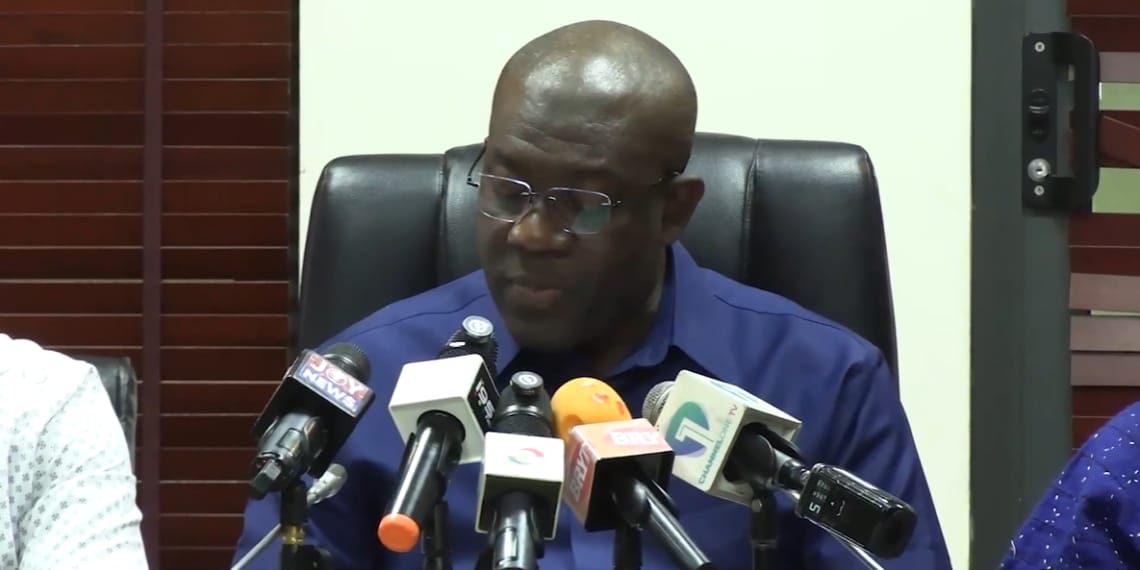
The Minority in Parliament led by ranking member on the Economy and Development Committee, Kwadwo Oppong Nkrumah, is sounding an alarm over the financial health of the Bank of Ghana, declaring that the central bank has become “policy insolvent” for the first time in the nation’s history.
Addressing the media on Sunday, May 3, 2026, he disputed the financial figures recently presented by the majority caucus, asserting that the bank’s true economic position has been obscured by “clever accounting” and a desperate sale of national gold reserves.
According to the ranking member, while the official narrative suggests an operating loss of GH¢15.6 billion, a closer examination of the 2025 audited accounts reveals a much more dire reality. He explained that by combining the declared operating loss with GH¢19.3 billion moved into “other comprehensive income,” the actual operating loss stands at GH¢34.9 billion.
Furthermore, he alleged that the bank hurriedly sold 50% of Ghana’s gold assets in late 2025 to generate an “artificial revenue” of GH¢9.5 billion to mask the deficit. “The true comprehensive loss position of the Central Bank of Ghana is GH¢44 billion,” he stated, adding that a central bank requiring one-off asset sales to cover operational costs is “operating on borrowed time.”
A central point of his critique focused on the definition of “policy solvency,” which measures a central bank’s ability to fund monetary policy from its own income without government bailouts. He argued that after stripping away the gold sale proceeds, the bank’s core operations are in a GH¢4 billion deficit.
He warned that this insolvency means the bank now requires an “urgent bailout” to perform its mandate of maintaining price stability. He further alleged that the accounts were not prepared in full accordance with International Financial Reporting Standards (IFRS), but rather the bank’s “own internal framework,” a move he claims was designed to make headline losses appear smaller than the underlying economic reality.
The ranking member also linked the central bank’s financial woes to a massive “wealth transfer” from taxpayers to commercial banks. He noted that the Bank of Ghana paid out GH¢14.6 billion in interest to commercial banks for “sterilization” operations, mopping up excess liquidity. He pointed out that while the central bank suffered record losses, commercial banks posted record profits of approximately GH¢15 billion. “This is not good monetary policy,” he remarked. “Every cedi paid to the commercial banks through open market operations is a cedi that cannot fund a classroom, an apprenticeship, or a youth skills program.”
This briefing follows a press conference held by the Member of Parliament for the Sagnarigu constituency and member of the Finance Committee, defending the central bank’s financial performance, characterizing the reported losses as a necessary “cost of stability” required to curb inflation and stabilize the cedi. He had urged Ghanaians to ignore “alarmist” interpretations of the audit report, insisting that the bank remained fundamentally sound and that the policy measures were yielding macroeconomic dividends.
However, the ranking member dismissed the majority’s defense as “propaganda” and “blatant politicization.” He criticized the decision to allow political party officials to announce audited accounts before they were formally transmitted to Parliament by the Minister of Finance, as required under Section 58 of the Bank of Ghana Act.
He warned that such interference erodes the operational independence and international credibility of the central bank. “The board of the bank is not the majority caucus,” he cautioned, “and the audited statements cannot be reduced to a political party’s press release.”
Story By: Eugenia Ewoenam Osei