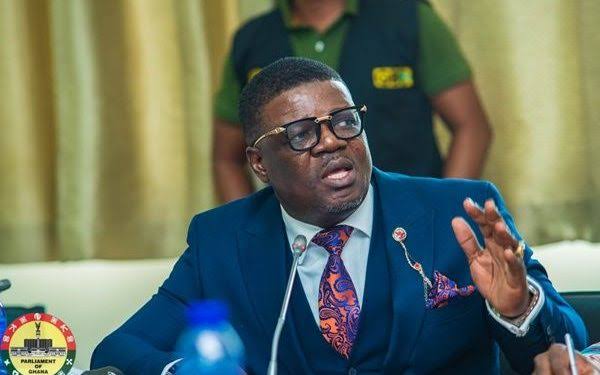
The Majority Chief Whip and Member of Parliament for South Dayi, Rockson-Nelson Dafeamekpor, has dismissed claims that the New Patriotic Party (NPP) was sidelined during the passage of the bill to re-establish tribunals in Ghana, insisting that the Minority actively participated in every stage of the legislative process.
Speaking on Gold Morning Conversation with Sena Numbo, Mr. Dafeamekpor said the bill underwent the normal parliamentary procedures, with both Majority and Minority members making contributions before it was passed into law.
“When a bill comes to Parliament, it is referred to the relevant committee made up of both NDC and NPP members. The NPP did not boycott the process. They participated, made informed contributions, and their inputs were captured in the committee’s report before the second reading and eventual passage of the law,” he stated.
The Majority Chief Whip accused the NPP of exhibiting what he described as “a phobia for anything tribunal,” arguing that the party continues to conflate constitutional tribunals with those that operated during the Provisional National Defence Council (PNDC) era.
He stressed that the tribunals established under the 1992 Constitution are fundamentally different from the PNDC tribunals that existed between 1982 and 1989, both in structure and legal procedure.
Quoting from The Role of the Supreme Court in Our Constitutional Development, page 28, Mr. Dafeamekpor said the distinction between the two systems is well established in Ghana’s legal literature and reflected in Article 143 of the 1992 Constitution and the Courts Act, 1993 (Act 459).
According to him, constitutional tribunals have long formed part of Ghana’s mainstream judicial system.
“From January 1993 to December 2002, tribunals operated uninterrupted until the Kufuor administration,” he said.
He explained that under President Jerry John Rawlings, Parliament expanded the jurisdiction of tribunals in December 1993, empowering them to hear civil matters in addition to criminal cases.
Mr. Dafeamekpor noted that it was Parliament, under the New Patriotic Party government, that passed the Courts (Amendment) Act, 2002 (Act 620), abolishing the Circuit and District Tribunals and replacing them with District Courts and Family Courts.
“The NPP should explain to Ghanaians why they removed tribunals from the judicial system instead of attempting to associate them with the PNDC,” he argued.
He maintained that the current legislation merely restores a constitutional institution that had previously existed within Ghana’s judicial framework.
The Majority Chief Whip further argued that the reintroduction of tribunals is necessary to ease the growing burden on the courts, noting that Articles 143 to 147, together with Article 126(3) of the 1992 Constitution, empower Parliament to establish Regional Tribunals as part of the country’s judicial system.
Story by: Ruth Quaye