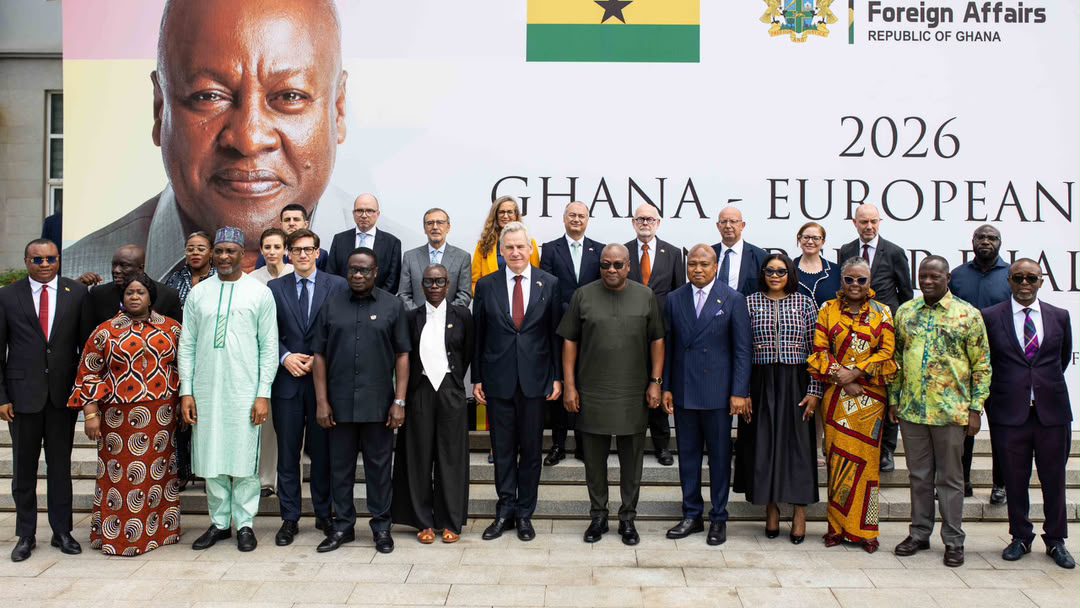
President John Dramani Mahama has called for a fundamental restructuring of the relationship between Ghana and the European Union, urging both factions to transition from a framework of traditional development aid toward an equitable, strategic alliance anchored in trade, industrialization, and technology transfer.
Speaking at the opening of the 2026 Ghana-EU Partnership Dialogue, President Mahama emphasized that amidst profound global geopolitical tensions, economic uncertainties, and climate disruptions, robust multilateral alliances are no longer merely desirable, but “indispensable.”
The address coincided with the 10th anniversary of the Ghana-EU Economic Partnership Agreement (EPA). While acknowledging that the EU remains one of Ghana’s primary trading partners and a critical source of foreign direct investment, the President stressed that the next phase of the agreement must prioritize local manufacturing and structural transformation over raw commodity exports.
”The era in which Africa exports raw strategic resources and imports finished products must come to an end,” Mahama stated.
Positioning Ghana as a production hub and a strategic gateway to the 1.4 billion-person African Continental Free Trade Area (AfCFTA), he invited European investors to actively participate in local value addition, particularly regarding critical minerals vital to the global green transition.
Reflecting on domestic progress, the President reported that Ghana is successfully emerging from one of its most challenging economic periods. Backed by a rigorous economic recovery agenda, fiscal consolidation, and structural reforms, the nation has witnessed a downward trend in inflation, improved foreign exchange reserves, and a resurgence in investor confidence.
However, President Mahama maintained that macroeconomic stability is not the ultimate end goal. To translate these indicators into tangible livelihoods, the government is prioritizing its flagship 24-Hour Economy Initiative and an accelerated export development program. The strategy aims to optimize productivity across manufacturing, agro-processing, digital services, and logistics.
”The future of Ghana’s economy lies not in exporting raw materials, but in producing higher-value goods and services,” he remarked, underscoring a deliberate pivot away from import dependence.
The President highlighted several critical legislative and structural advancements aimed at driving sustainable growth and safeguarding democratic governance:
Cocoa Sector Reforms
In a major policy announcement for the agricultural sector, Mahama revealed that a new Cocoa Bill will soon be laid before Parliament. The legislation will guarantee farmers a 70% share of the world market price, ensuring producers benefit equitably from the wealth they generate. Additionally, the Ghana Cocoa Board (COCOBOD) is transitioning toward raising local funding to purchase the upcoming season’s crop, aligning with a national target to process 50% of cocoa beans locally.
Digital Transformation and the Green Transition
Reaffirming the ambition to establish Ghana as a leading digital hub in Africa, the President anticipated deeper collaboration with the EU in artificial intelligence, cybersecurity, and digital infrastructure. On climate action, he pledged that Ghana would responsibly utilize its natural gas resources as part of a “just transition,” pairing environmental protection with aggressive investments in renewable energy.
Governance and Legislative Accountability
To reinforce public trust and institutional transparency, the administration is pushing for the swift passage of the Conduct of Public Officers Bill currently before Parliament to provide clear boundaries on conflicts of interest. Furthermore, Cabinet is set to finalize its position paper on proposed constitutional amendments this week, which will be submitted to the Constitutional Review Implementation Committee for immediate action.
Security, Migration, and the Youth Demographic
Addressing regional challenges, President Mahama noted that the recently concluded Ghana-EU security and defense partnership is vital to combating violent extremism and organized crime in the Sahel. However, he warned against relying solely on military strategies. “Lasting peace requires investment in education, jobs, governance, social cohesion, and economic opportunity,” he argued, insisting that security and development must be pursued in tandem.
With over half of Ghana’s population currently under the age of 30, the President concluded by linking the success of the bilateral alliance directly to youth empowerment through labor mobility, vocational training, and entrepreneurship.
Declaring the dialogue officially open, President John Mahama challenged delegates to move beyond routine policy reviews: “Let us commit to building a partnership that creates jobs for our young people, opportunities for our businesses, security for our citizens, and prosperity for our future generations.”
Story By: Eugenia Ewoenam Osei