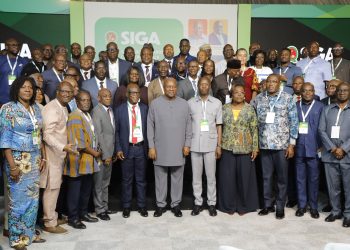
State-Owned Enterprises (SOEs), Joint Venture Companies (JVCs), and Other Specified Entities (OSEs) have been urged to align financial profitability with strict governance, timely compliance, and tangible public value.
Speaking at the Governing Boards and Chief Executive Officers (CEOs) Conference, the Director-General of the State Interests and Governance Authority (SIGA), Michael Kpessa-Whyte, commended notable financial turnarounds across key sectors while warning that partial compliance continues to expose the public purse to unnecessary risk.
Presenting highlights from the newly released 2025 State Ownership Report; the third edition since its inception and the first full-year assessment under His Excellency President John Dramani Mahama’s return to office, Kpessa-Whyte noted a direct correlation between improved governance structures and balance sheet recovery. The infrastructure subsector posted its first sector-wide operating profit in five years, swinging from a net loss of $745 million to over $1 billion within a single year. The Mapoya Refinery achieved a similar recovery, recording its first profit before interest and tax in five years.
In the manufacturing and mining space, the newly established Ghana Gold Board contributed a net profit of $896.52 million in its inaugural year, spearheading a broader subsector recovery. Ghana Publishing Company Limited also posted significant gains, increasing its net profit from $2.23 million in 2024 to $16.96 million in 2025. Meanwhile, core institutions led by the Ghana National Petroleum Corporation (GNPC) and the Ghana Ports and Harbours Authority (GPHA) demonstrated long-term consistency by remaining profitable for five consecutive years.
Despite these financial gains, SIGA expressed strong concern over low participation in basic statutory obligations. Against a target of 148 entities, only 72 signed performance contracts in 2025, and just 71 submitted quarterly reports on time. Furthermore, only 37 out of 177 target entities convened Annual General Meetings or stakeholder assemblies. On a positive note, audited account submissions rose significantly from 53 in 2024 to 108 in 2025, representing the highest coverage recorded to date.
Kpessa-Whyte warned that partial compliance deprives the state of early warnings against emerging financial risks, creating contingent liabilities that ultimately burden taxpayers. He stressed that boards and management teams must address operational risks swiftly rather than waiting for audit reports to expose deficiencies.
Emphasizing that a profit which never reaches the shareholder has not yet become public value, the Director-General commended BOST Energies for declaring and paying its dividends following a recent annual meeting. Six joint ventures, including Ghana Rubber Estates, GOIL PLC, SIC PLC, GCB Bank PLC, Gasem Limited, and Perseus Mining have also declared dividend intentions. To formalize these transfers, SIGA has submitted a comprehensive Dividend Policy to the Ministry of Finance to establish clear, predictable standards for state returns without weakening corporate capital bases.
To enforce real-time monitoring across the state portfolio, SIGA is introducing a Digital Compliance Dashboard to track board composition, statutory filings, risk exposures, and performance contract milestones. The authority will also roll out full implementation of the Annual Governance and Institutional Performance Assessment (AGIPA) under Section 4(e) of the SIGA Act, deploying field assessors to benchmark governance health across all public entities.
Michael Kpessa-Whyte concluded by reminding board chairs and chief executives that state assets are held in trust for the citizens of Ghana. He also urged all specified entities to direct corporate social responsibility budgets toward supporting the Ghana Medical Trust (MahamaCares) to combat non-communicable diseases across the country.
Story by: Eugenia Ewoenam Osei