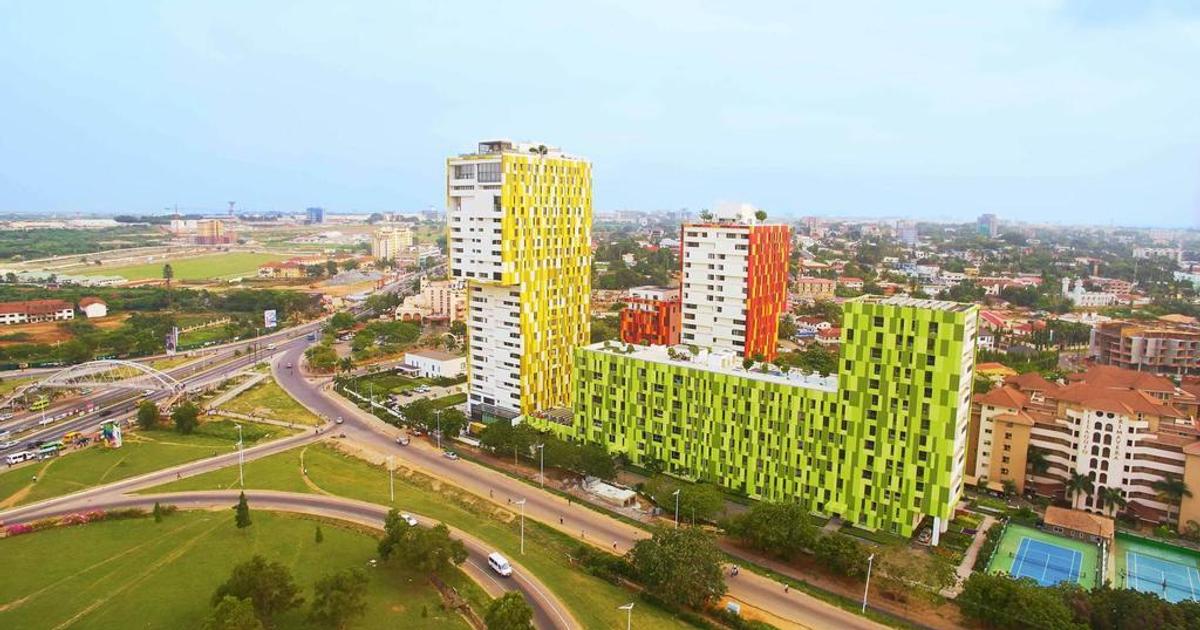
The Municipal Chief Executive (MCE) for Ayawaso West Municipal Assembly, Dr Michael Mensah, has assured the public that the Villagio building near the Tetteh Quarshie Interchange remains structurally sound following an incident in which blocks fell from the high-rise structure during a rainstorm.
The incident, which occurred on Wednesday, October 21, triggered public concern after a video circulated on social media showing building blocks falling from the upper floors of the structure near the Accra Mall.
The footage sparked fears about the safety of the building and the potential danger it could pose to pedestrians, motorists, businesses and residents in the surrounding area.
Addressing the media on Thursday, October 22, Dr Mensah said a joint team from the Ayawaso West Municipal Assembly and the Engineering Council had visited the construction site to assess the situation.
He explained that the incident involved freshly laid blockwork that was blown down by strong winds during the storm and did not indicate a failure of the building’s main structural system.
“We have been there ourselves with the Engineering Council, and we can assure the public that the structural integrity is intact. Nobody should entertain the fear that the building will come down,” he said.
Dr Mensah added that the affected area had been restricted and hoarded, stressing that the public could continue its normal activities without undue fear.
Inspection Identifies Cause of Falling Blocks
A report on the inspection indicated that a team of engineers from the Ayawaso West Municipal Assembly and the Engineering Council visited the Villagio project site at about 3 p.m. on October 21, following the circulation of the video on social media.
The team comprised the Registrar of the Engineering Council, Engineer Isaac Bedu; Engineer Gertrude Awumi, a member of the Council’s Standards and Professional Practice Committee; and Engineer Nathan Caesar, the Works Engineer of the Ayawaso West Municipal Assembly.
They met the project’s Operations Director, Philip Morrison, who represented Trasacco, the contractor undertaking the construction.
According to the report, the building under construction has 28 floors and features a structural system comprising concrete lift cores and steel frames and beams designed to be encased in concrete.
Mr Morrison explained that strong winds during the storm blew down freshly laid sandcrete blockwork on the 16th and 17th floors.
The inspection team observed that the blocks had been laid to a height of approximately 2.1 metres but had not yet been tied to the supporting columns at the time of the incident.
The report indicated that the blockwork had been secured to the beams at the base but had not been adequately connected to the columns at the top, leaving it vulnerable to strong winds.
The falling blocks subsequently broke through the fence wall surrounding the construction site.
However, according to the operations director, no casualties were recorded at the site.
Engineering Council Recommends Safety Measures
Although the MCE assured the public of the building’s structural integrity, the inspection team recommended additional safety measures to prevent a recurrence.
The recommendations include limiting freshly laid sandcrete blockwork to a height of one metre and allowing it to cure and stabilise adequately before additional courses are laid.
The team also called for the installation of safety nets around the building, particularly at elevated construction levels, to prevent falling blocks and other construction materials from reaching areas beyond the site’s perimeter.
Dr Mensah said the Assembly had communicated the recommendations to the relevant parties and emphasised the importance of implementing them to protect people and property in the surrounding area.
He explained that the absence of safety nets was a concern that needed to be addressed, particularly given the height of the building and its location in a busy part of Accra.
MCE Defends Height of High-Rise Buildings
Addressing concerns that the height of the building could pose a danger in the future, Dr Mensah maintained that the height of a structure was not, in itself, evidence of a safety problem.
He said buildings were required to go through the appropriate permitting procedures, including assessments to ensure that their structural systems could support their intended height.
According to him, vertical development has become increasingly important in areas where land values are high, making high-rise buildings a practical option for urban development.
He therefore urged the public not to assume that the building was unsafe simply because of its height, while stressing the importance of complying with the required building regulations and safety standards.
Further Investigations Expected
The incident comes amid public concerns about building safety following reports of structural failures and building collapses in parts of Accra.
Dr Mensah said the Assembly would continue working with the Engineering Council to ensure that construction activities within the municipality complied with the appropriate standards.
The inspection team also indicated that further investigations would be undertaken at the site.
The Assembly’s assurance is expected to ease public anxiety surrounding the incident, although the recommended safety measures and further technical investigations remain important to preventing similar occurrences.
Story by Osman Issah Abadoo