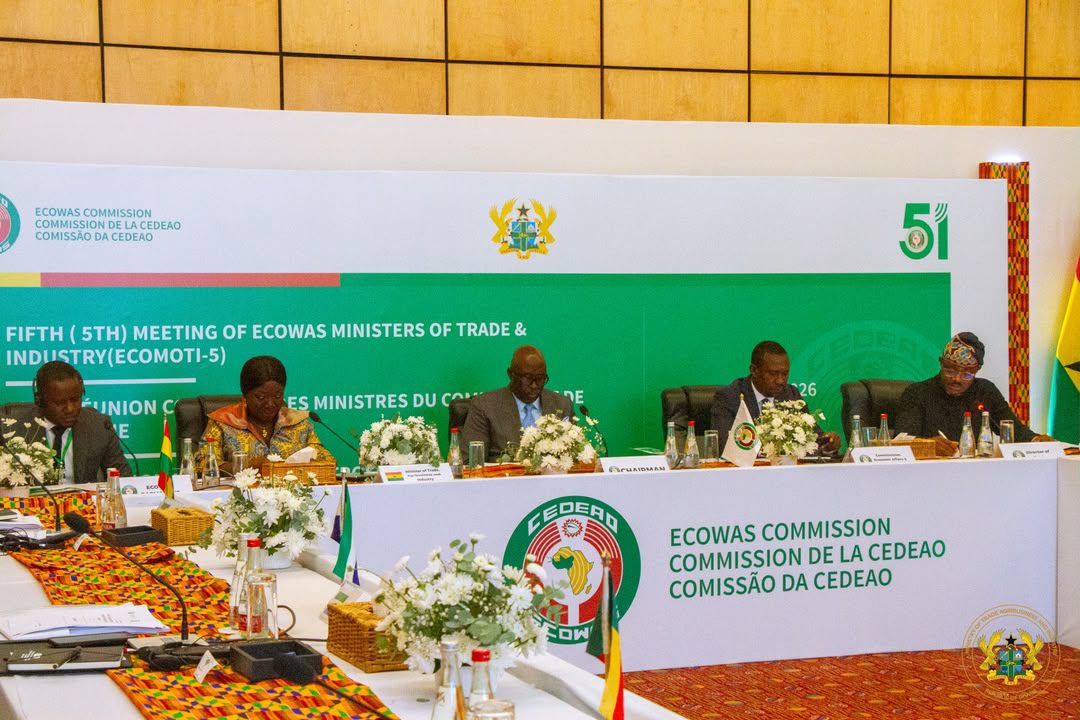
Ghana’s Minister for Trade, Agribusiness and Industry, Elizabeth Ofosu-Adjare, has called on ECOWAS member states to leverage their collective economic power to resist global trade frameworks that constrain regional development, while aggressively dismantling self-imposed trade barriers within the bloc.
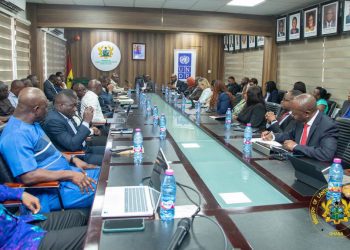
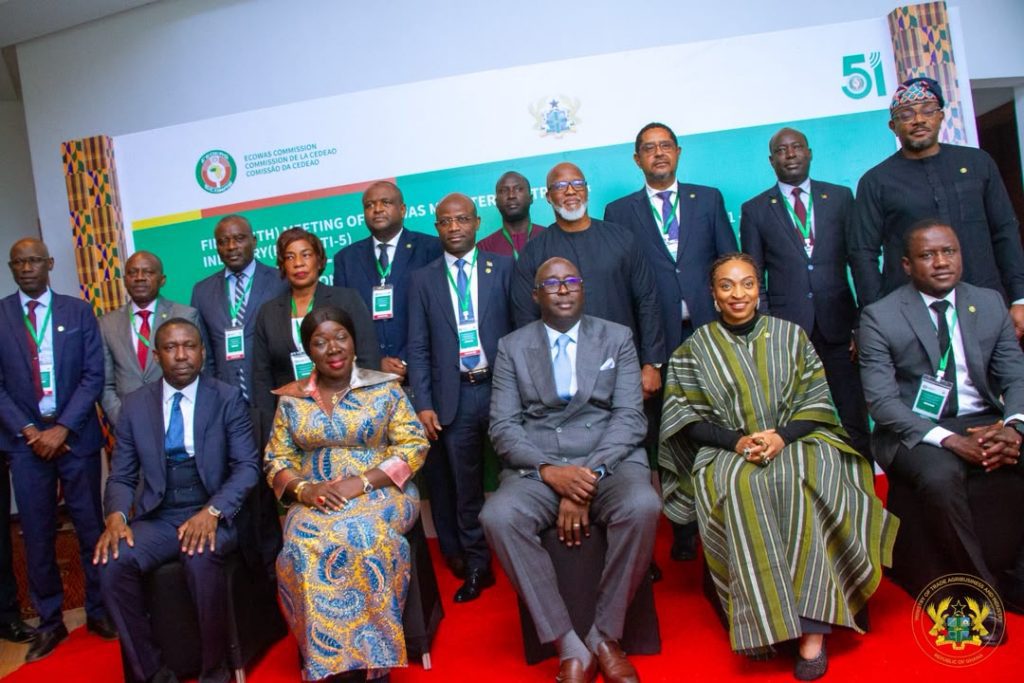
Speaking at the opening of the Fifth Joint Meeting of ECOWAS Ministers of Trade and Industry (ECOMOTI-5) in Accra, Ofosu-Adjare reminded delegates of the high expectations pinned on the host city, which serves as the home of the African Continental Free Trade Area (AfCFTA) Secretariat.
She noted that this distinction carries a profound obligation to ensure that decisions taken in Accra are worthy of continental confidence, as citizens demand markets that reward their labor and industries that employ their children.
Reflecting on the sobering outcomes of the Fourteenth WTO Ministerial Conference (MC14) held recently in Yaoundé, the Minister lamented that the conference closed without a comprehensive ministerial declaration and allowed the moratorium on customs duties for electronic transmissions to lapse. She warned that the rules governing African farmers, fishers, and digital entrepreneurs are still being written in Geneva, “too often without our full voice in the room.”
While reaffirming Ghana’s commitment to a rules-based multilateral trading system, Ofosu-Adjare stressed that every multilateral commitment must pass a single test: whether it advances or constrains the development of the African people.
”Where it constrains, we must push back together, and with one voice, as the Geneva process unfolds,” Ofosu-Adjare stated, emphasizing that true negotiating leverage lies in economic logic. She noted that while individual West African economies vary in weight, as a unified community of twelve member states, ECOWAS represents a market of over 350 million people with a combined GDP approaching USD 700 billion, a bloc no trading partner can afford to ignore.
Addressing internal bottlenecks, the Minister pointed out that formal intra-regional trade in West Africa remains critically low, hovering around one-tenth of total trade, compared to a quarter in ASEAN economies and over 60 percent in the European Union. She attributed this stagnation to export baskets dominated by raw commodities destined for outside markets, poor transport corridors, unreliable energy, costly multiple currencies, duplicated standards, and unsanctioned checkpoints.
”None of these is an act of nature,” she argued. “Each one is the product of decisions we have taken, or failed to take.”
To make the AfCFTA a reality, the Minister urged member states to collaboratively develop regional value chains, particularly in textiles, apparel, and the automotive sector. She illustrated a vision where cotton grown in one country is spun in another, finished in a third, and sold across the continent, supported by rules of origin that reward internal collaboration rather than re-labeled imports.
Ofosu-Adjare also highlighted that manufacturing contributes barely a tenth of regional GDP, representing a massive missed opportunity for a region where the majority work in agriculture and the informal economy. To correct this, she affirmed Ghana’s full support for the adoption and implementation of the West Africa Common Industrial Policy (WACIP) 2026–2030, alongside fourteen harmonized mandatory fortified-food standards, the Cross-Border Consumer Protection Regulation, and the ECOWAS Common Investment Market.
She described non-tariff barriers as the most stubborn obstacle to integration, adding an estimated 15 to 20 percent to cross-border trade costs a premium ultimately paid by consumers. “Every checkpoint that demands a payment without a receipt, every duplicated certification, arbitrary delay at a border is a tax on integration that we impose on ourselves,” she remarked.
Turning to investment, the Minister cited UNCTAD data showing that foreign direct investment flows to Africa declined to USD 53 billion in 2023, representing just four percent of global flows, with inflows to West Africa remaining flat. She asserted that a harmonized regional investment framework under the ECOWAS Common Investment Market would alter this calculus by offering predictable regulatory standards and credible dispute resolutions, allowing investors to enter one market and seamlessly access twelve.
Concluding her address, Ofosu-Adjare invoked the historic words of Osagyefo Dr. Kwame Nkrumah at the 1963 founding of the Organisation of African Unity: “We must unite now or perish.” She noted that Nkrumah was not speaking poetically but describing the only viable path forward for the continent.
Reiterating Ghana’s readiness to co-invest, co-produce, and open its markets to regionally made goods, the Minister called on all delegations to bring a spirit of partnership, urgency, and the political will necessary to sustain implementation long after leaving the meeting room.
Story By: Eugenia Ewoenam Osei