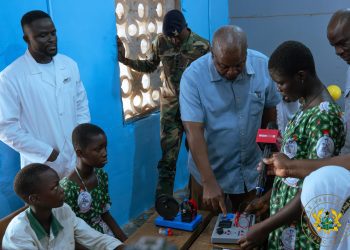
The Microfinance and Small Loans Centre (MASLOC), in collaboration with the Ghana Prisons Service and Aboboyaa Company Limited, on Friday, February 20, 2026, officially launched the Capital Behind Bars Initiative at the MASLOC Head Office in Accra.
The launch brought together key stakeholders from the three institutions, marking a strategic partnership aimed at skills development, job creation, and the socio-economic reintegration of inmates and prison support assistants.
Speaking at the event, the Chief Executive Officer of MASLOC, Abigail Elorm Mensah, highlighted the long-term objective of the initiative, which is to create sustainable employment opportunities for Prison Support Assistants.
She explained that beneficiaries have already received hands-on practical training in assembling Aboboyaa tricycles for a fee, equipping them with technical expertise to serve as trainers for fellow officers and inmates.
“This initiative is designed not only to build technical capacity but also to expose beneficiaries to enterprise opportunities that can transform their livelihoods,” she noted.
Madam Mensah further disclosed that the next phase of the Capital Behind Bars Initiative will be rolled out across all sixteen regions of Ghana.
Through the programme, inmates will gain practical technical skills, real-world work experience, and meaningful engagement in productive activities, enabling them to generate legitimate income even while incarcerated.
She emphasized that the initiative is expected to support successful reintegration into society upon release, restore dignity, and significantly reduce recidivism.
In his remarks, the Chief Executive Officer of Aboboyaa Company Limited, Nana Susu Biribi I, reiterated the broader socio-economic benefits of the programme, describing it as a practical intervention to help reduce unemployment in the country.
“Equipping inmates with practical, income-generating skills while serving their sentences is a critical step toward inclusive national development,” he stated.
The Director-General of the Ghana Prisons Service, Patience Baffoe Bonnie, outlined ongoing reforms within the Service, including enhanced skills training, artificial intelligence integration, mechanized agriculture, and the expansion of industrial production. She explained that these reforms are aimed at improving safety, welfare, and wealth creation for both inmates and staff.
Mrs. Baffoe Bonnie further called for stronger partnerships with stakeholders and appealed to the general public to support the Prisons Service through the PESPES Fund (Code: 97213100#). She also reaffirmed the Service’s commitment to deepening collaboration with MASLOC to advance its transformation agenda in support of national development.
The Capital Behind Bars Initiative is expected to serve as a model for correctional rehabilitation in Ghana, blending skills training, entrepreneurship, and social inclusion to create pathways for economic empowerment beyond prison walls.
Story: Patrick Asford Boadu