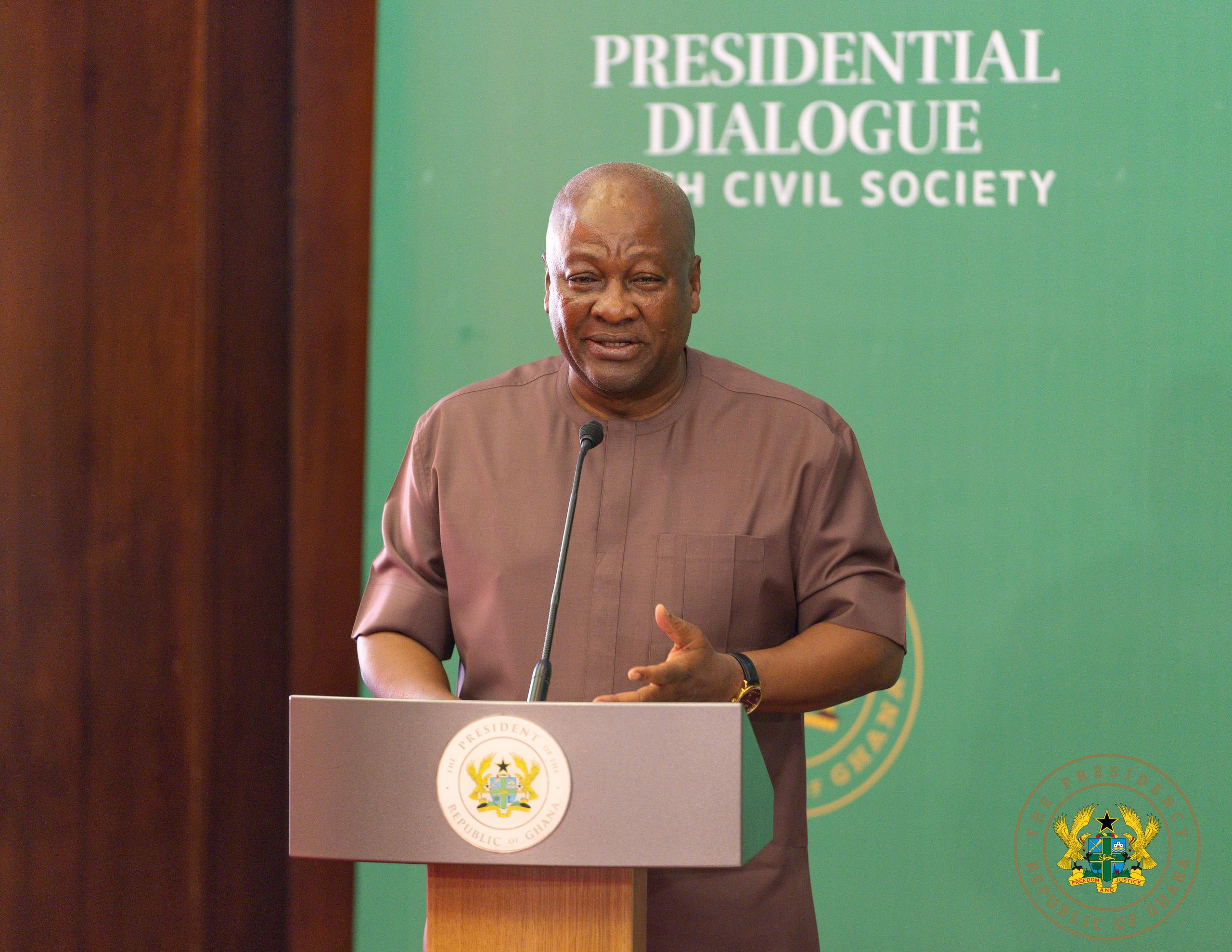
President John Dramani Mahama has reaffirmed the critical role of civil society in strengthening Ghana’s democracy, describing their contribution as indispensable to accountable governance and national development.
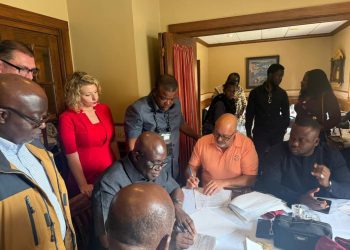
Speaking at a high-level dialogue with civil society organizations at the Presidency in Accra, the President emphasized that civil society remains a cornerstone of Ghana’s democratic journey through advocacy, research, and community engagement.
“Civil society organizations continue to play a vital role in Ghana’s democratic journey reinforcing the need for participatory, inclusive, and responsive governance,” he stated.
Dialogue for Action, Not Ceremony
President Mahama stressed that the engagement was not symbolic, but a practical platform aimed at listening, sharing ideas, and building stronger collaboration between government and civil society.
He noted that the presence of ministers and senior government officials was to ensure that discussions translate into tangible outcomes.
“This is a dialogue meant to listen, to share ideas on national priorities, and to deepen collaboration in ways that produce meaningful results,” he added.
Shared Responsibility for National Transformation
The President underscored that Ghana’s development cannot be driven by government alone, but requires collective effort from all sectors of society.
He acknowledged the longstanding contributions of civil society actors in shaping governance and policy direction in the country.
Commitment to Rule of Law and Rights
Reaffirming his administration’s commitment to democratic principles, President Mahama pledged to uphold the rule of law, protect fundamental human rights, and strengthen independent institutions.
He also acknowledged concerns about civic space, freedom of expression, and accountability, assuring that criticism and media scrutiny are essential to good governance.
“Media scrutiny and fair criticism are not obstacles they are assets to governance,” he noted.
Constitutional Review and Governance Reforms
On constitutional reforms, the President disclosed that government is reviewing recommendations from the Constitutional Review Committee and will soon establish a Constitutional Review Implementation Committee (CRIC) to guide the next phase.
He explained that the process aims to deepen democracy, strengthen checks and balances, and align the Constitution with the evolving aspirations of Ghanaians.
Strengthening Transparency and Accountability
President Mahama highlighted ongoing efforts to improve public financial management and procurement transparency, including the introduction of the Public Officers’ Code of Conduct Bill currently before Parliament.
The bill, he said, seeks to define ethical standards, address conflicts of interest, and ensure the proper use of public office.
He further revealed plans to amend the Public Procurement Act to limit single sourcing and enhance value for money, alongside the establishment of an Independent Value for Money Office.
Economic and Social Interventions
Touching on the economy, the President pointed to flagship initiatives such as the 24-hour economy and accelerated export development programme, aimed at creating jobs, supporting SMEs, and promoting export-led growth.
In the social sector, he outlined plans to strengthen healthcare delivery, including the launch of a free primary healthcare programme on April 15, 2026, to improve access and reduce financial barriers.
Human Rights and National Dialogue
On issues of rights and inclusion, including the ongoing debate around the LGBTQ+ bill before Parliament, President Mahama emphasized the need for democratic processes, dialogue, and respect for constitutional principles.
He noted that outcomes would reflect the will of the people through parliamentary deliberations, while balancing social values and legal obligations.
Environment, Governance, and Civil Society
Partnership
The President also reiterated government’s commitment to tackling illegal mining and promoting sustainable environmental practices.
He called for stronger collaboration with civil society to safeguard natural resources and ensure accountability in governance.
“Civil society must be seen as a partner in nation-building, not an adversary,” he stressed.
Regional and Global Commitments
On the international front, President Mahama reaffirmed Ghana’s advocacy for global justice, including recognition of the transatlantic slave trade as a grave crime against humanity.
He also reiterated Ghana’s commitment to regional peace and integration through ECOWAS and continental development under African Union Agenda 2063.
Sustaining Engagement Beyond Dialogue
The President assured stakeholders that the engagement would not end with the meeting, but would continue through structured follow-ups, monitoring systems, and sustained collaboration.
“Together, we can build a fairer, more inclusive, and prosperous Ghana through continuous engagement and collective effort,” he concluded.
Story: Patrick Asford Boadu