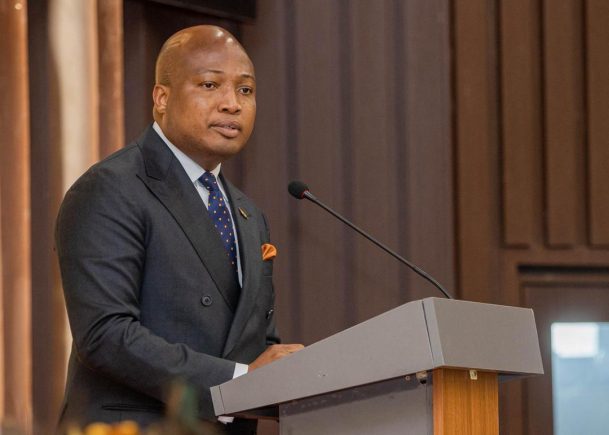
Ghana’s Minister for Foreign Affairs, Samuel Okudzeto Ablakwa, has declared that the global movement for reparatory justice has reached an unprecedented moment of momentum and international support, describing the High-Level Next-Steps Conference on Reparatory Justice in Accra as a defining milestone in the pursuit of historical accountability.
Addressing heads of state, foreign ministers, legal experts, scholars, and international delegates from Africa, the Caribbean, the Americas, Europe, and Asia, Ablakwa said the campaign for reparatory justice has evolved from a regional aspiration into a shared global responsibility.
“The march for reparatory justice has never seen this momentum,” he stated, expressing confidence that the struggle for historical truth, justice, and human dignity is approaching a decisive victory.
The Foreign Minister highlighted the symbolic timing of the conference, noting that it coincides with significant milestones in the history of the fight against slavery. He recalled that more than two centuries ago, on June 18, 1824, the British Parliament passed the Consolidated Slave Trade Act, while June 19 marks the anniversary of the final enforcement of emancipation in the United States in 1865.
Drawing lessons from history, Ablakwa stressed that humanity has previously overcome slavery, colonialism, and apartheid, and can similarly triumph in the struggle against reparatory injustice.
He commended the leadership of President John Dramani Mahama, Ghana’s President and African Union Champion for Reparatory Justice, for spearheading international efforts that culminated in the adoption of United Nations Resolution A/RES/80/250 on March 25, 2026. Supported by 123 member states, the resolution formally recognizes the transatlantic slave trade as one of history’s greatest crimes against humanity.
According to Ablakwa, the resolution has already triggered significant global actions. He cited the historic apology issued by Pope Francis for religious justifications of slavery, formal apologies from the Church of Scotland, France’s repeal of the notorious Code Noir under President Emmanuel Macron, and commitments from the European Union, Germany, and the Netherlands to support reparatory initiatives and accelerate the return of stolen cultural artifacts.
From a Crime Scene to a Sanctuary for Justice
The Foreign Minister emphasized Ghana’s unique position in the reparations movement, noting that the country bears the physical scars of the transatlantic slave trade through its numerous coastal forts and castles, which served as departure points for millions of enslaved Africans.
He described the Accra summit as a symbol of Ghana’s transformation “from a crime scene to a sanctuary for healing and reparatory justice,” urging delegates to engage in constructive dialogue aimed at producing meaningful outcomes.
In a lighter moment, Ablakwa thanked visiting dignitaries, including Nigerian President Joseph Ndumangwa, for supporting Ghana’s national football team, the Black Stars, during the previous evening’s match. He noted that the team’s name was inspired by the Black Star philosophy championed by Pan-African icon Marcus Garvey.
The Minister also welcomed Dr. Julius Garvey, son of the renowned Pan-Africanist, describing his presence as a fitting reminder of the enduring legacy of the movement for Black liberation and unity.
A Call for Courage and Action
Concluding his address, Ablakwa reminded participants that the international community is looking to Accra for a practical roadmap to advance the next phase of the reparations agenda. He urged delegates to think boldly and develop sustainable mechanisms capable of addressing the lasting effects of racial and economic injustice.
To underscore the significance of the task, he invoked the words of Ghana’s founding President, Dr. Kwame Nkrumah, who described nation-building as “a noble and glorious challenge” requiring courage, vision, determination, and action.
Ablakwa expressed confidence that the distinguished gathering of leaders and experts would transform the landmark UN resolution into tangible outcomes and lasting reforms. He concluded with the hope that future generations will remember the Accra conference as the moment the world united to confront the legacy of slavery and build a future free from racism, discrimination, and inherited inequalities.
Story By: Eugenia Ewoenam Osei