The Government of Ghana has taken a decisive policy shift on 5G deployment, announcing plans to remove exclusivity arrangements and open spectrum allocation to competitive bidding, with an ambitious target of achieving 70% 5G population coverage by March 6, 2027, Ghana’s 70th Independence Anniversary.
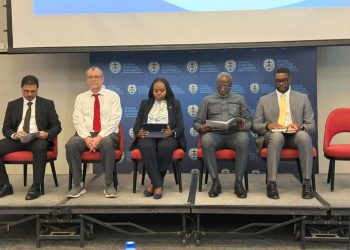
Communications, Digital Technology and Innovations Minister, Samuel Nartey George, made the announcement at the launch of the National Communications Authority’s (NCA) 30th Anniversary in Accra.

According to the Minister, Cabinet has approved a policy decision to democratize 5G rollout by ending the current exclusive wholesale arrangement and allowing broader market participation through a national competitive spectrum auction.
“This decision does not cancel the wholesale model. It simply provides multiple options for market players,” he clarified.
The NCA is expected to receive formal directives within days to begin preparations for the spectrum auction process.
The Minister stressed that this refers to population coverage, not geographical spread, meaning areas with high population density must be prioritized. “It is a steep aspiration,” he acknowledged, “but I have confidence in the resilience and capabilities of the NCA and industry players.”

The target will require rapid infrastructure expansion, major capital investments, and coordinated regulatory action.
He positioned the 5G expansion as part of a broader digital transformation agenda: “In the past 30 years, we built access. The next 30 years must be about building digital power, the power to innovate, compete globally, and shape our technological destiny.”
He highlighted emerging technologies such as artificial intelligence, big data, satellite broadband, and non-terrestrial networks as key components of Ghana’s future digital economy.
He noted that advancements in satellite-to-device connectivity could soon eliminate geographic barriers, allowing remote communities to connect directly to satellite networks.

The Ministry is currently working on approximately 15 new and revised bills aimed at modernizing Ghana’s communications, cybersecurity, digital services, and data governance laws, the most comprehensive legislative overhaul since the NCA Act 524 of 1996.
He emphasized that digital innovation must be guided by strong regulatory systems that protect citizens while enabling competition.
The Minister also praised the NCA’s revised Quality of Service (QoS) performance benchmarks, which introduce stricter standards for voice clarity and reliability, minimum data performance speeds and SMS delivery efficiency.
He revealed that telecom operators have already begun making investments to meet the new benchmarks. “Connectivity must not only exist; it must deliver value,” he stated.