President John Dramani Mahama has called on the international community to transform historical recognition into concrete action, declaring that future generations will judge today’s leaders not by the resolutions they adopt, but by the progress they achieve in addressing the enduring consequences of the transatlantic slave trade.
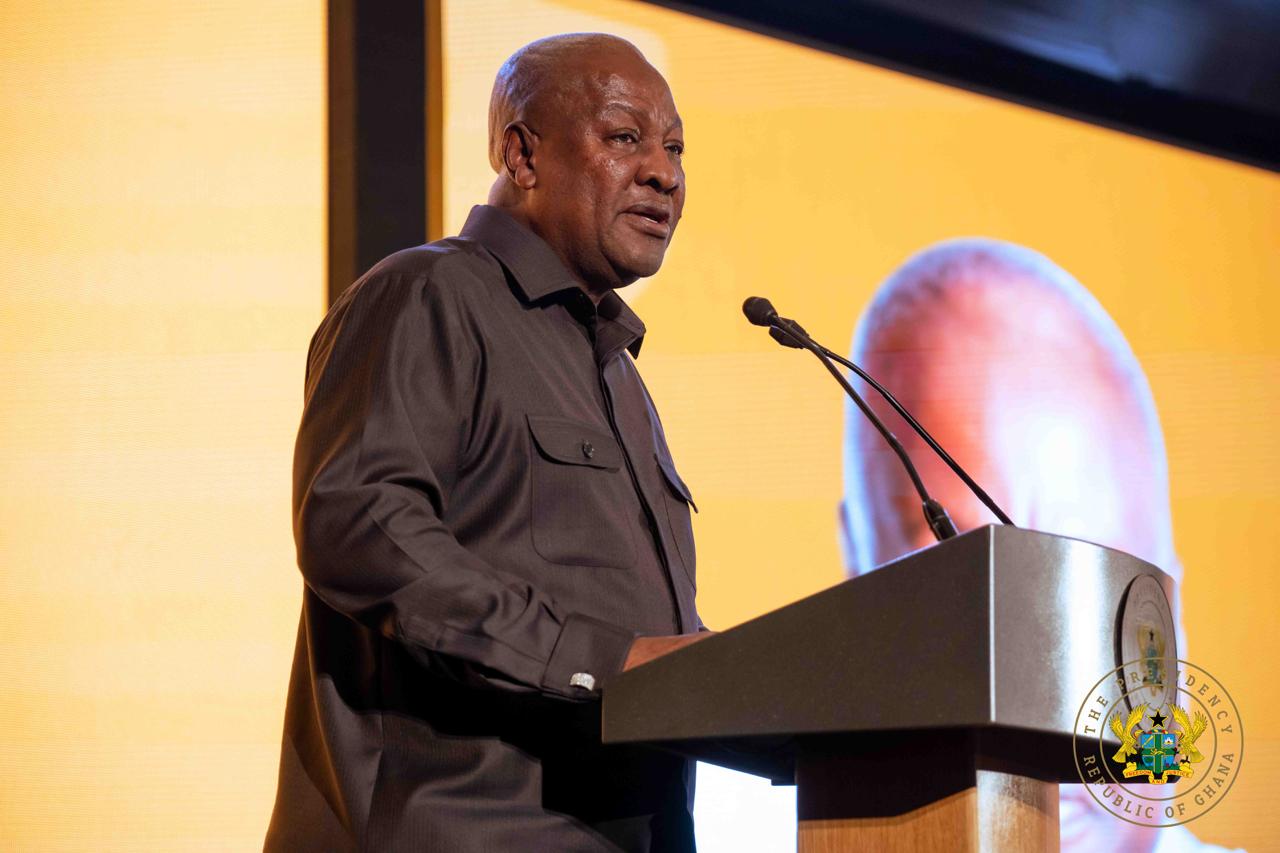
Addressing delegates at the High-Level Consultative Conference on the Next Steps Following the landmark United Nations resolution on the trafficking of enslaved Africans, President Mahama said Accra had become “the meeting place of history, conscience, and responsibility” as global leaders gathered to determine humanity’s response to one of the gravest crimes ever committed.
Welcoming participants from across the world, he described the conference as a reflection of a shared understanding that the legacy of slavery transcends national borders and demands collective responsibility.
The President recalled Ghana’s leadership role in advancing the issue on the global stage, noting that on September 25, 2025, he announced before the United Nations General Assembly Ghana’s intention to introduce a resolution declaring the trafficking of enslaved Africans as the gravest crime against humanity.
“Exactly six months later, on 25 March 2026, the United Nations General Assembly adopted Resolution A/RES 80/250 with 123 member states voting in support,” he said, expressing gratitude to member states, scholars, civil society groups, faith leaders, activists and advocates who contributed to the historic achievement.
According to President Mahama, Ghana’s pursuit of the resolution is rooted not in diplomacy alone but in a moral responsibility tied to the nation’s history and identity.
“We do not seek to reopen old wounds. We seek to heal those wounds. We do not seek division. We seek justice, understanding, and reconciliation grounded in truth,” he stated.
The President highlighted Ghana’s unique historical connection to the transatlantic slave trade, pointing to sites such as Elmina Castle, Cape Coast Castle, Assin Manso Slave River and Christiansborg Castle as enduring reminders of a system that uprooted millions of Africans.
He observed that descendants of those who were once forcibly taken from African shores have returned as presidents, prime ministers, scholars, jurists, activists and global citizens, demonstrating resilience in the face of historical injustice.
A significant portion of the President’s address focused on the experiences of women and girls during slavery, which he said have often been marginalised in historical narratives. He noted that many enslaved women endured exploitation beyond forced labour, with their reproductive capacity transformed into an instrument for perpetuating bondage across generations.
President Mahama paid tribute to prominent female resistance figures, including Nanny of the Maroons, Harriet Tubman and Sojourner Truth, emphasizing that reparatory justice must be gender-responsive and place the experiences of women and girls at the centre of truth-telling, remembrance and redress.
Addressing questions of responsibility, the President stressed that contemporary generations cannot be personally blamed for the atrocities of the slave trade.
“History does not ask us to inherit guilt, but it asks us to inherit responsibility,” he said, arguing that today’s societies remain responsible for addressing institutions, inequalities and structures shaped by that history.
He welcomed recent acts of acknowledgment from religious institutions, including remarks by Pope Leo XIV, as well as ongoing engagements by the Church of Scotland and the Church of England. He also acknowledged support and engagement from national leaders, including Emmanuel Macron.
As the African Union’s Champion on Reparations, President Mahama reaffirmed support for the African Union’s decision to establish a joint African-Caribbean mechanism on reparative justice, describing the search for justice as necessarily transcontinental because both the crime and its consequences crossed continents.
In a major announcement, the President unveiled three international panels that will guide the next phase of the reparatory justice agenda.
The first, the Global Advisory Panel on Reparatory Justice, will bring together heads of state, government leaders and prominent public figures to provide strategic direction.
The second, the Expert Panel on the Restitution of Cultural Artefacts, will focus on facilitating the return of cultural property, archives, sacred objects and historical treasures to their rightful communities.
The third, the Global Legal Panel on Reparatory Justice, will assemble jurists and legal scholars to explore pathways for justice within international law.
President Mahama indicated that the CARICOM Ten-Point Plan for Reparatory Justice would serve as an important starting point for the work of the newly established panels.
He emphasized that the adoption of the UN resolution was never intended as an endpoint but rather as the foundation for sustained engagement, research, education, memorialisation, cultural restitution and legal action.
“The African diaspora is indispensable,” he said. “The descendants of those who endured enslavement are not mere observers. They are the right holders whose experiences must shape our path.”
Looking ahead, the President announced that participants would gather at Christiansborg Castle in Osu for a traditional durbar and commemorative event marking the first joint observance of Juneteenth by Africa and the United States.
Concluding his address, President Mahama challenged the international community to move beyond remembrance and embrace meaningful action.
“The question before us is not whether history can be changed. History cannot be changed. The question is whether we have the courage to learn from it, confront it honestly, and transform remembrance into responsibility and action,” he said.
In a stirring final appeal, he declared: “Let them say that in Accra, we chose truth over denial. Let them say that in Accra, we chose partnership over indifference. Let them say that in Accra, we chose justice over delay.”
He added that when history called upon this generation to act, it must be remembered that it answered with courage.
Story: Patrick Asford Boadu