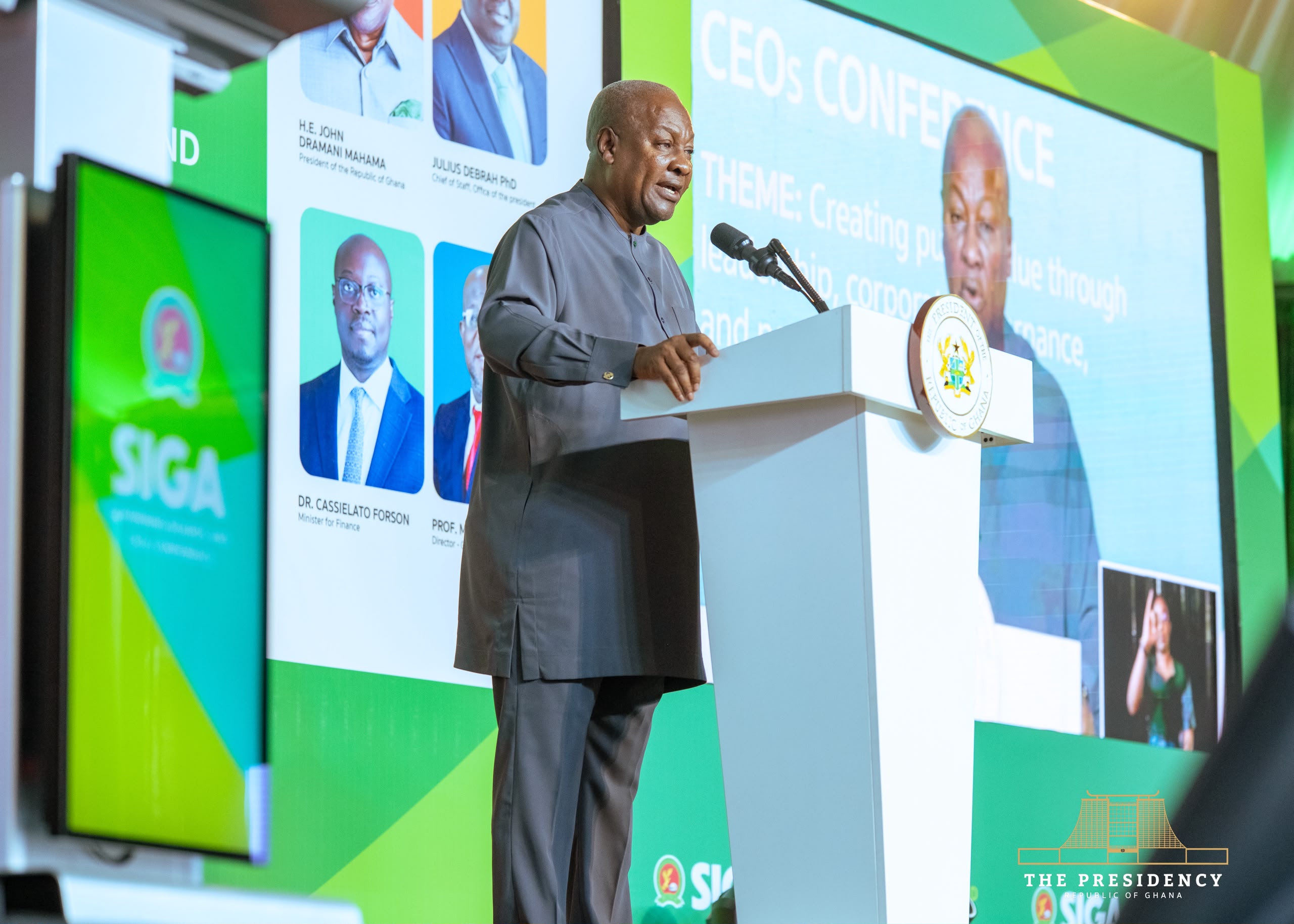
President John Dramani Mahama has called on boards and chief executives of state-owned enterprises (SOEs) to demonstrate measurable value for money, warning that persistent underperformance and misuse of public resources will no longer be tolerated.
Addressing the SIGA Governing Board and CEOs Conference, President Mahama said all public assets, including ports, power infrastructure, water systems, factories, lands, buildings and other investments, belong to the people of Ghana and must therefore be managed in the national interest.
“The ports through which our goods pass, the power that lights our homes, the water that flows through our communities, the factories, lands, buildings, equipment and public investments all belong to the people of Ghana,” he said.
“These assets do not belong to any government, board or chief executive; they belong to the citizens, and we hold them only in trust.”
President Mahama said the central objective of the conference was to ensure that public ownership translated into tangible public value.
“Every institution represented here must demonstrate with credible evidence the value it creates for the Ghanaian people,” he stated.
SOEs record strong financial turnaround
The President noted that the latest State Ownership Report showed a significant improvement in the aggregate financial performance of state-owned enterprises.
According to the report, combined revenue increased from GH¢137.71 billion in 2024 to GH¢176.43 billion in 2025, while SOEs moved from an aggregate net loss of GH¢2.26 billion in 2024 to a net profit of GH¢19.8 billion in 2025.
Return on assets improved from 1.3 per cent to 6.31 per cent, while return on equity increased from negative 1.6 per cent to 15.7 per cent.
President Mahama, however, cautioned that the improved results must be viewed against the backdrop of a stronger business environment.
He said approximately GH¢11.72 billion in foreign exchange gains and a 42.5 per cent decline in finance costs contributed significantly to the improved performance.
“Our task now is to convert this financial relief into sustained operational efficiency and stronger underlying performance,” he said.
The President commended the ten SOEs that remained profitable in every year between 2021 and 2025.
He said the Ghana National Petroleum Corporation (GNPC) recorded the highest average annual profit of approximately GH¢2.25 billion, followed by the Ghana Ports and Harbours Authority (GH¢1.41 billion) and the Minerals Income Investment Fund (GH¢773.9 million).
Bui Power, he noted, had emerged as a new dividend-paying institution, with average profits of GH¢348.1 million.
He also recognized the consistent performance of the Volta River Authority, Ghana Exim Bank, Ghana National Gas Corporation, TDC Company Limited, Ghana Supply Company Limited and the Venture Capital Trust Fund.
President praises major recoveries
President Mahama also highlighted the turnaround achieved by several state institutions during 2025.
Tema Oil Refinery, he said, moved from a loss of GH¢745 million to a profit of GH¢1.09 billion, its strongest performance in almost a decade.
Ghana Water Limited moved from a loss of GH¢3.06 billion to a profit of GH¢635 million, while the Ghana Cocoa Board recovered from a loss of GH¢5.73 billion to a profit of GH¢5.11 billion.
BOST also increased its net profit from approximately GH¢3.98 million to GH¢6.84 million, while GoldBod recorded a net profit of GH¢896.5 million, compared with GH¢178.5 million the previous year.
“These achievements demonstrate the value of transparency, accountability and strategic reform. But one successful year is not enough; sustained performance is the true measure of institutional excellence,” the President stressed.
Persistent losses
Despite the positive developments, President Mahama said persistent weaknesses remained across parts of the state-owned enterprise portfolio.
He disclosed that five state-owned enterprises recorded losses in every year between 2021 and 2025, while other state entities recorded an aggregate deficit of GH¢10.48 billion in 2025.
“Their combined liabilities continue to exceed their net assets, demanding urgent corrective action. Our objective is to move from isolated success stories to system-wide institutional improvement,” he said.
The President stressed that state-owned enterprises were not established simply to maintain offices, pay salaries or preserve institutions indefinitely.
“Commercial entities must be efficient, competitive, financially sustainable and capable of generating appropriate returns,” he said.
He added that public service entities must deliver measurable social and economic value through reliable services and effective regulation.
“The true test is not whether an institution is busy, but whether its work improves the lives of farmers, traders, workers, entrepreneurs and students,” he stated.
Stronger oversight and performance contracts
President Mahama directed the State Interests and Governance Authority (SIGA) to establish a mandatory reporting framework for government representatives serving on joint venture boards.
The framework, he said, should require written reports on financial performance, major decisions and emerging risks.
He also warned that leadership positions would increasingly be tied to measurable performance, value creation and profitability.
“Every board chairperson and chief executive must answer one fundamental question: What additional value did our institution create this year?” he asked.
He said the answer must be supported by measurable evidence in profits, jobs, infrastructure, service delivery and national capability.
“Boards and management will be assessed against clear financial, operational, governance and development targets,” he added.
“Persistent underperformance will trigger corrective action, including leadership changes where necessary.”
National budget cannot be a permanent cushion
The President further warned commercial state-owned enterprises against relying indefinitely on government financing to cover inefficiencies.
“Commercial state-owned enterprises cannot continue to treat the national budget as a permanent financial cushion,” he said.
“Every cedi transferred to inefficient enterprises reduces government’s ability to invest in schools, hospitals, roads and social protection.”
He urged boards to improve revenue, reduce costs, manage debt and eliminate structural inefficiencies before they became fiscal risks.
Profitable enterprises, he added, must honour their dividend obligations because the returns ultimately belong to the Ghanaian people.
Executive remuneration tied to performance
President Mahama also announced that government would strengthen the relationship between compensation, productivity and institutional performance.
He said the transition from the Fair Wages and Salaries Commission to the proposed Independent Public Employment Commission presented an opportunity for comprehensive reform.
“Executive remuneration must increasingly reflect financial performance, productivity, service quality and fiscal sustainability,” he stated.
He warned that while high-performing institutions should be appropriately rewarded, chronic losses could not continue to attract increasing salaries and allowances.
Boards must not interfere in management
The President also issued a direct warning to board chairpersons against interfering in the day-to-day administration of state institutions.
“Your position is not ceremonial. Boards are responsible for strategy, policy, risk oversight, financial integrity and institutional performance,” he said.
“Board chairpersons must not occupy executive offices or interfere in routine management.”
Addressing chief executives, he added: “Executive authority is not a personal privilege; it is a measurable responsibility to deliver results.”
He stressed the principle that “boards govern and management manages”, warning that interference by boards or resistance by executives to legitimate oversight weakened accountability.
Compliance gaps unacceptable
President Mahama said the 2025 State Ownership Report covered 162 of 175 entities within the state equity portfolio, representing 89 per cent coverage.
For the first time, 108 entities submitted audited financial statements, the highest level of audited reporting in SIGA’s history.
However, he said only 61 entities submitted audited accounts by the statutory deadline, while just 72 entities signed performance contracts, 71 submitted quarterly reports and 37 held their required annual general or stakeholder meetings.
“These compliance gaps are unacceptable because accountability instruments are not optional administrative exercises,” he said.
The President also disclosed that state-owned enterprises held assets valued at GH¢407.85 billion against liabilities of GH¢282 billion.
Joint venture companies held assets of GH¢96.69 billion and liabilities of GH¢82.7 billion, while other state entities held assets of GH¢341.6 billion against liabilities of GH¢382.75 billion, leaving them with a negative net position exceeding GH¢41 billion.
He said recoverable irregularities identified by the Auditor-General had declined from GH¢15.57 billion to GH¢2.24 billion, representing an 85.6 per cent reduction.
While commending the improvement, President Mahama said the remaining GH¢2.24 billion was still substantial public money that must be recovered and protected.
He expressed concern that the Minerals Commission, Lands Commission and Ghana Telecommunications Company Limited failed to submit their 2025 accounts.
“No state entity may place itself outside lawful oversight,” he stressed.
Public assets must be protected
President Mahama directed all state entities to modernize their operations, automate processes, improve data systems and eliminate bureaucratic bottlenecks.
He also urged boards and management to build enduring institutions rather than personal empires by recruiting on merit and implementing credible succession plans.
“Before approving any expenditure, boards must ask three questions: Is it necessary? Does it provide value for money? Does it advance the institution’s mandate and create public value?” he said.
He warned that conflicts of interest, abuse of office, non-transparent procurement, unauthorized disposal of public assets and recruitment based on considerations other than merit would not be tolerated.
SIGA given stronger mandate
President Mahama emphasized that SIGA’s mandate under Act 990 was statutory and compliance with it was mandatory.
“I direct all boards and chief executives to cooperate fully, promptly and transparently with every lawful request from SIGA,” he said.
He further instructed SIGA to publish clear performance assessments, recognize excellence and promptly report persistent non-compliance to the Presidency.
“Any board or chief executive that persistently frustrates lawful oversight will have that conduct considered in decisions regarding continued tenure,” he warned.
President Mahama concluded by urging all boards and chief executives to embrace a culture of discipline, accountability and measurable public value.
“Every board must govern with independence, competence and integrity. Every chief executive must deliver measurable results. Every specified entity must account transparently, accurately and on time,” he said.
“Every public asset must be protected and used to create value for the people of Ghana.”
“The resources entrusted to our state institutions must work as hard for Ghana as our nurses, teachers, farmers and entrepreneurs work every day for this nation,” President Mahama added.
Story: Patrick Asford Boadu