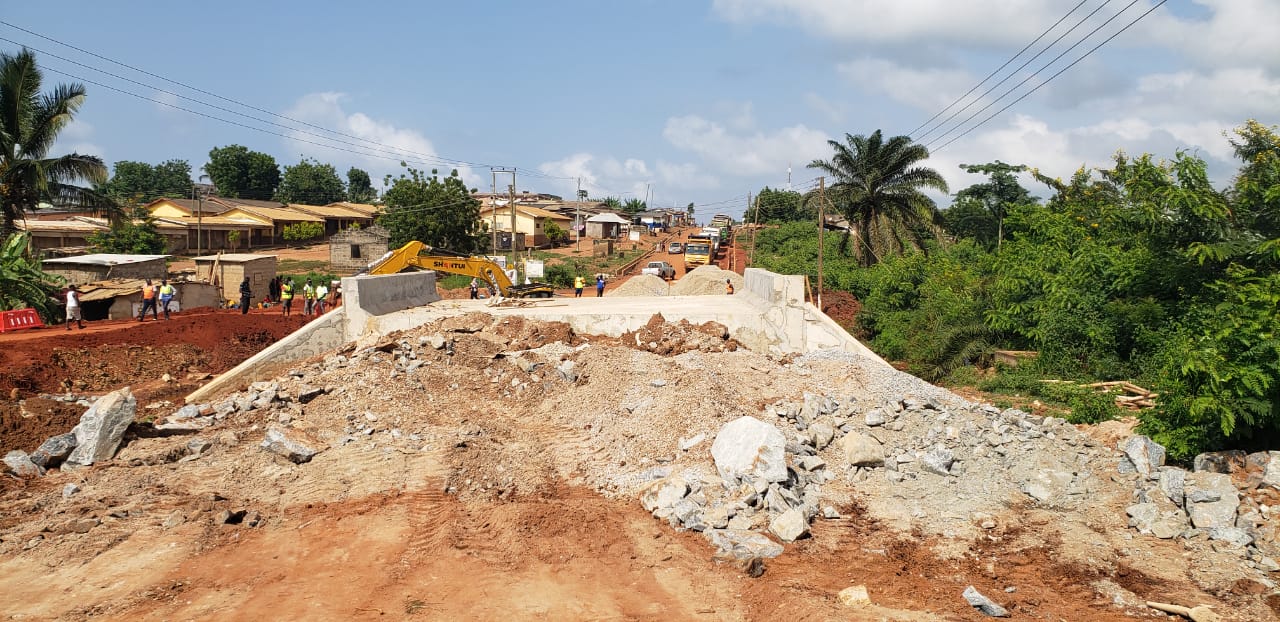
President John Dramani Mahama has inspected ongoing rehabilitation works on the Apam–Mumford–Hweda–Dago–Otuam Road, expressing satisfaction with the pace and quality of work while reaffirming his government’s commitment to expanding road infrastructure under the Big Push Programme.
The road project, being implemented by the Ghana Highway Authority under the Ministry of Roads and Highways, is being executed by M/S Timeline & Innovation Construction Limited at a contract sum of GH¢227,623,963.60.
Construction officially commenced on January 5, 2026, and is expected to be completed by January 4, 2028, over a period of 24 calendar months.
Addressing engineers and project officials during the inspection, President Mahama praised the contractor for its efficiency, saying the company has consistently demonstrated the capacity to deliver projects ahead of schedule.
“Let me congratulate the contractor for a very good job. He has established a reputation for working very quickly and very efficiently,” the President said.
“I have come across one of his projects in the Volta Region, and it’s exhibiting the same efficiency. He’s always ahead of schedule, and so with this contractor here, I’m sure that this road will be finished ahead of the 24 months that has been indicated. So I want to commend M/S Timeline,” he added.
The President disclosed that government is preparing the second phase of the Big Push Programme and indicated that contractors who demonstrate efficiency and deliver quality work on time would be rewarded with additional contracts.
“The thing about the Big Push is if you’re allocated a project and you finish quickly, we’re packaging Phase Two and so if you prove to be efficient and fast in your work, we’ll give you some more projects under Phase Two,” he stated.
President Mahama dismissed the perception that the Big Push Programme is focused solely on trunk highways, stressing that regional and rural roads are equally important to government’s development agenda.
“It’s also important to note that some people have the conception that the Big Push is affecting only the highways, but as you can see, regional roads and some rural roads are being covered under the Big Push,” he explained.
According to him, the rehabilitation of the Apam–Mumford–Otuam Road will significantly improve the transportation of agricultural produce and fish from major fishing communities to markets, reducing post-harvest losses and boosting local economic activity.
“This particular road connects Apam, which is a big fishing community, to Mumford, which is also another big fishing community, and then to Otuam, which is also on the coast and is involved in fishing. This would enable them, when they get their catch, to move it very quickly to the market so that we don’t have spoilage,” the President said.
President Mahama also noted the historical and emotional significance of the project, recalling that the late President Professor John Evans Atta Mills, a native of Otuam, had always envisioned the construction of the road.
“This road is important because it was quite sentimental for Professor John Atta Mills, who is known to come from Otuam, and we’ve always had the dream to construct this road for them. I’m happy that today we have the opportunity to do that, and I’m sure the people of Otuam will be very happy that at long last this road is being engineered,” he remarked.
The President further urged engineers supervising the project to adhere strictly to quality standards, particularly in road compaction, to ensure the durability of the infrastructure.
“I urge the engineers to do their work efficiently by making sure that the compaction of the roads is done up to the required standard because sometimes sections are not well compacted and after two or three years they begin to depress. We must ensure the work is done properly so that the road will last for many years with minimal maintenance,” he advised.
The rehabilitation of the Apam–Mumford–Hweda–Dago–Otuam Road forms part of government’s broader Big Push infrastructure programme, which seeks to improve road connectivity, facilitate trade, support agriculture and fisheries, and accelerate socio-economic development across the country.
Story: Patrick Asford Boadu