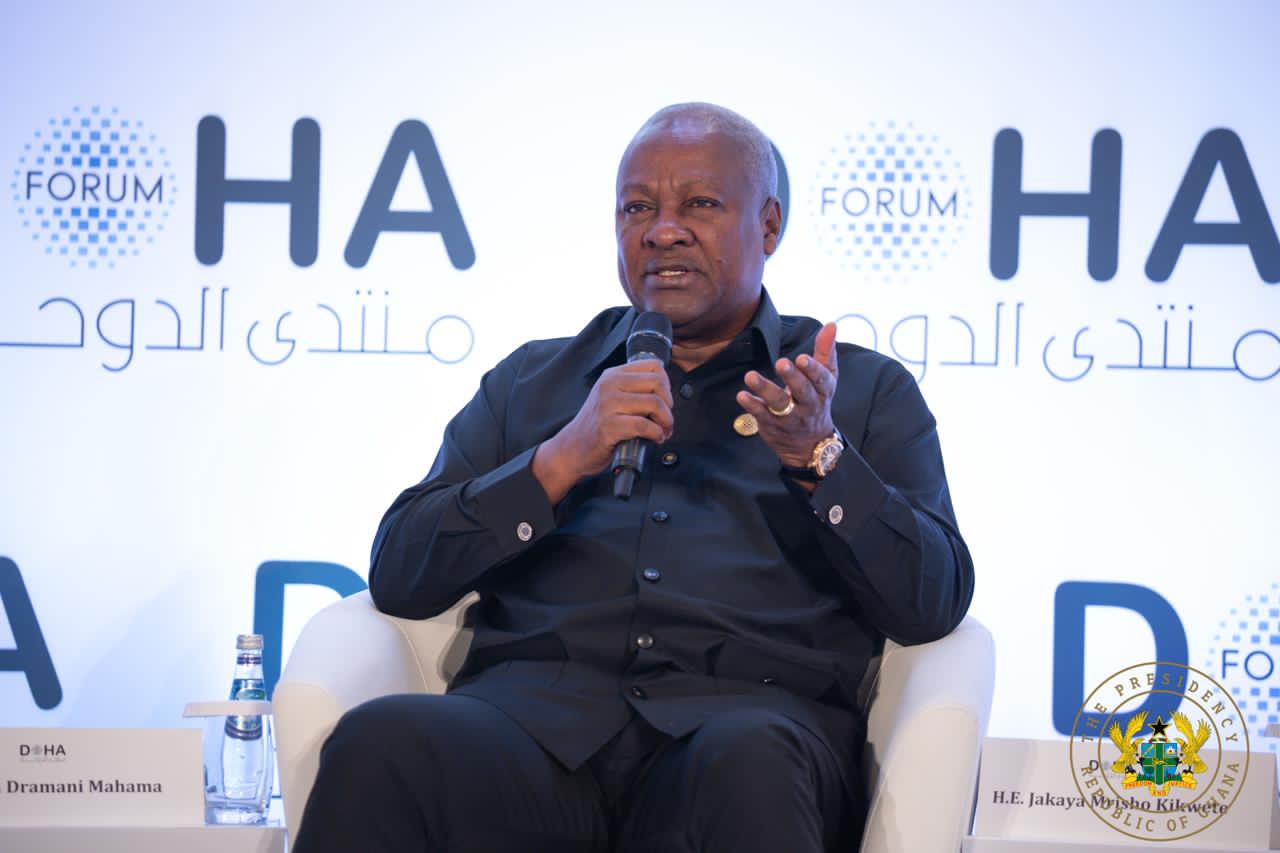
President John Dramani Mahama has opened the high-level session on “Education as Justice” at the Doha Forum 2025, delivering a powerful call for global leaders to recognize education as a life-saving intervention in times of crisis.
Addressing world leaders, policymakers, and development partners, President Mahama said the world is currently grappling with overlapping crises—conflicts, climate instability, economic shocks, pandemics, and widening inequalities—that threaten the futures of millions of children.
According to him, “These crises do not only disrupt economies; they disrupt childhoods. They do not only destroy infrastructure; they destroy the dreams of our children.”
President Mahama stressed that education must be treated as a matter of justice and a central pillar of global stability.
“Education is justice when a child uprooted by conflict does not lose her dreams or her future. Education is justice when a child living with disability receives the targeted support needed to thrive,” he said.
He noted that education systems must be resilient enough to continue functioning during pandemics, climate disasters, and economic hardships, adding that learning continuity is essential for rebuilding communities affected by crisis.
The President described the collapse of schooling in conflict zones such as Gaza, Afghanistan, and Sudan as “an unfolding humanitarian tragedy that will shape societies for decades.”
Highlighting Ghana’s progress, President Mahama pointed to reforms that have expanded access to free basic and secondary education, ensuring that family income does not determine a child’s future.
He reinforced education’s role in achieving global development targets, stating:
“Without education, we cannot end poverty, achieve gender equality, strengthen climate adaptation, or secure peace and strong institutions.”
President Mahama concluded by urging global leaders to modernize and reform education systems to reflect the needs of a rapidly changing world.
“Education must be transformational, not transactional. It must be equitable, not exclusive. It must be forward-looking and not outdated. This is the justice we owe our children,” he declared.
Story: Patrick Asford Boadu